Meta advertising is no longer “cheap traffic.”
That era ended years ago.
Businesses still advertise on Facebook, Instagram, Messenger, and Meta Audience Network because the platform remains one of the few places where advertisers can scale reach, targeting, creative testing, and conversion tracking inside a single ecosystem.
The difference is that profitable advertisers now rely on precision, structure, and signal quality instead of brute-force reach.
A campaign can generate thousands of clicks and still lose money if the targeting, creative, or objective sends weak signals into Meta’s algorithm.
Meta Ads Still Reach Buyers at Massive Scale
Meta’s ecosystem still gives advertisers access to billions of users across Facebook, Instagram, Messenger, and partner apps.
That matters because scale affects optimization quality.
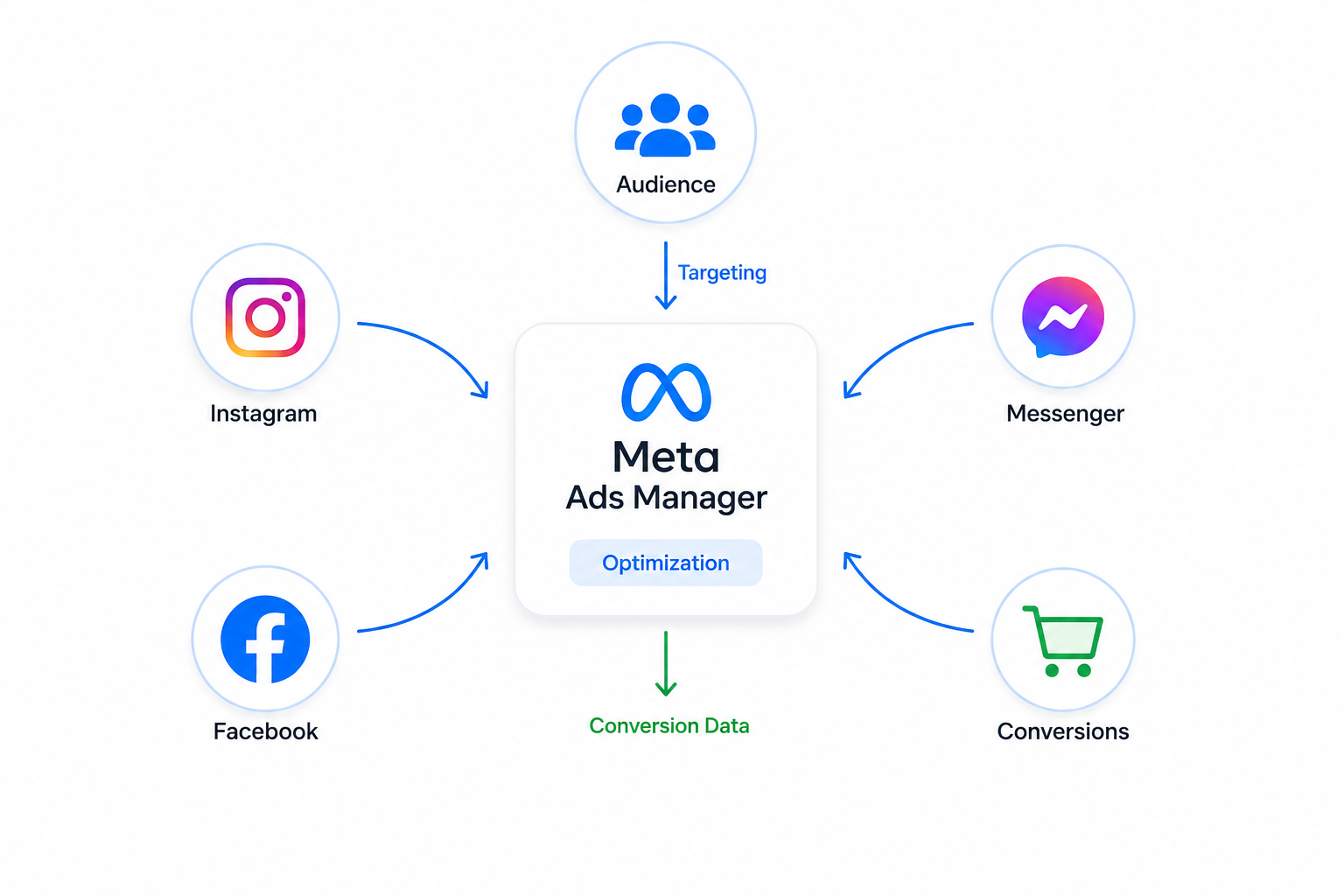
The algorithm performs better when it can identify enough behavioral patterns across impressions, clicks, video views, purchases, or leads. Smaller ad platforms often struggle with this because they lack sufficient conversion density.
Inside Ads Manager, strong Meta campaigns usually show:
- stable delivery across placements;
- faster learning-phase exits;
- lower CPM volatility;
- stronger conversion prediction accuracy;
- more scalable audience expansion.
This is why Meta remains attractive for both local businesses and enterprise advertisers.
A dentist running lead generation ads and a SaaS company spending six figures monthly both benefit from the same underlying system: large-scale behavioral data combined with aggressive auction optimization.
Organic Reach Alone Rarely Sustains Growth
Many businesses delay advertising because they want to “grow organically first.”
That approach becomes harder every year.
Organic distribution on Facebook and Instagram is limited by feed competition. As more brands publish content, fewer followers see each post consistently. Even high-engagement Pages often experience reach decay over time.
Advertisers usually notice this when:
- engagement suddenly drops despite consistent posting;
- website traffic from social becomes unstable;
- launches fail to reach existing followers;
- frequency stays low because organic visibility disappears quickly.
Paid distribution solves a distribution problem, not just a visibility problem.
Meta ads allow businesses to repeatedly reach users most likely to engage, purchase, or convert instead of hoping the algorithm surfaces content organically.
The Biggest Advantage of Meta Ads Is Targeting Depth
Meta’s targeting system remains one of its strongest advantages.
Advertisers can target users using demographics, interests, behaviors, locations, engagement history, lookalike audiences, and custom audience data. More importantly, Meta continuously updates delivery based on behavioral feedback signals.
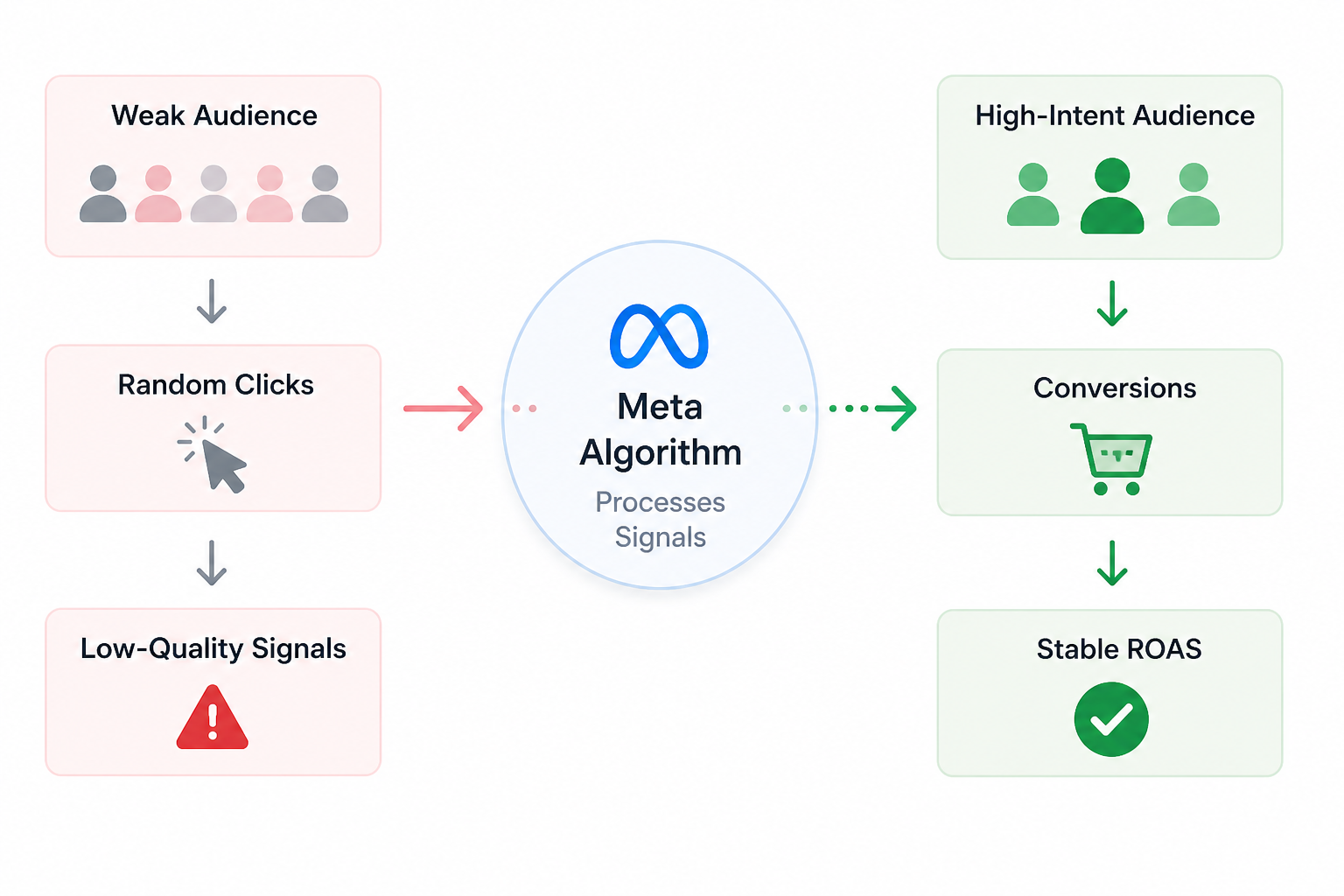
That creates enormous performance differences between weak and strong audience inputs.
Broad targeting often produces lower CPC initially because Meta prioritizes cheap inventory. The problem appears later when lead quality collapses or conversion rates weaken.
That is exactly why advertisers should understand why broad interest targeting wastes ad budgets.
The cheapest audience is rarely the most profitable audience.
High-performing advertisers increasingly focus on intent-based audience building instead of relying only on broad interests. That is where LeadEnforce becomes valuable. Instead of targeting vague interests alone, advertisers can build audiences from Facebook groups, Instagram followers, engaged communities, and social-profile signals tied to real behavioral intent.
For advertisers looking beyond Meta’s default targeting tools, smarter audience building beyond Meta’s built-in targeting tools becomes increasingly important as competition rises.
Meta Ads Work Because They Support Different Business Goals
One reason Meta advertising remains dominant is flexibility.
The same platform can support awareness campaigns, local lead generation, e-commerce sales, webinar registrations, app installs, remarketing, and full-funnel nurture campaigns.
Different objectives train Meta’s algorithm differently.
For example:
- Awareness campaigns optimize for attention and reach.
- Lead campaigns optimize for form submissions or inquiries.
- Sales campaigns optimize toward purchases or high-value actions.
- Engagement campaigns optimize toward reactions, comments, or shares.
Choosing the wrong objective creates optimization mismatches.
A campaign optimized for engagement may generate cheap interactions while producing weak buyers. A sales campaign without enough conversion volume may struggle to exit learning.
This is why experienced advertisers treat objective selection as a performance decision, not just a setup step.
Boosted Posts and Ads Manager Are Not the Same Thing
Meta encourages businesses to boost posts because the setup is simple.
That simplicity comes with limitations.
Boosted posts work reasonably well for visibility or lightweight engagement. They are rarely ideal for serious performance marketing because targeting, testing, reporting, and optimization controls remain limited.
Inside Ads Manager, advertisers gain access to:
- conversion-focused objectives;
- advanced audience exclusions;
- structured campaign testing;
- placement controls;
- event-based optimization;
- deeper attribution reporting.
This difference becomes obvious once campaigns scale.
A boosted post may generate reactions cheaply. A properly structured Ads Manager campaign can optimize toward booked calls, purchases, or qualified leads instead.
Businesses focused on measurable ROAS should usually transition into Ads Manager early.
Budget Flexibility Makes Meta Attractive for Small Businesses
Meta ads remain accessible because advertisers can start with small budgets.
That does not guarantee profitable results, but it lowers the barrier to testing.
A local business can launch campaigns with modest daily budgets, validate messaging, and scale gradually once conversion data becomes reliable.
At the same time, flexible budgeting creates a common mistake: scaling before signal quality stabilizes.
Inside Ads Manager, unstable campaigns often show:
- strong CTR but weak purchases;
- rising CPM during scaling;
- inconsistent daily CPA;
- high learning-phase spend;
- volatile ROAS swings.
These are usually signs that the audience or optimization structure is still weak.
Advertisers who scale profitably focus on consistency before volume.
Meta’s Measurement System Gives Advertisers Faster Feedback
One reason advertisers continue investing heavily in Meta is feedback speed.
Meta’s reporting infrastructure allows advertisers to evaluate CTR, CPM, CPA, ROAS, frequency, conversion events, demographic breakdowns, and placement performance in real time.
That feedback loop matters because optimization speed directly affects profitability.
A campaign that wastes budget for two weeks becomes expensive quickly. Strong reporting helps advertisers detect weak creatives, audience saturation, overlap, or delivery instability earlier.
The best advertisers combine Meta reporting with CRM and backend sales data instead of relying only on platform metrics.
Final Takeaway
Meta ads still work because the platform combines massive reach, deep targeting, flexible campaign objectives, and fast optimization feedback inside one system.
The advertisers seeing the best results today are usually not the ones spending the most. They are the ones feeding Meta stronger audience signals, cleaner campaign structures, and better intent data.
That is why why Facebook ads are still worth it usually comes down to targeting quality, not platform size.