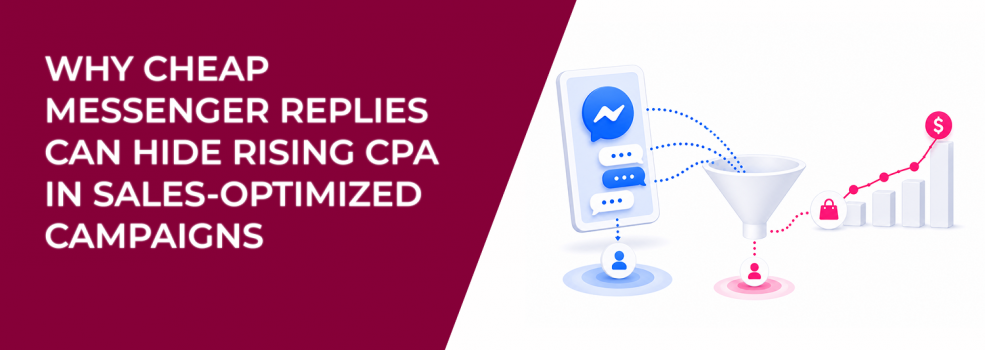
Cheap Messenger replies can feel like progress. The campaign is active, people are responding, and the inbox is filling up.
But cheap replies can hide a serious problem. If those replies do not turn into sales, cost per acquisition can rise while the campaign still looks efficient at the top of the chat funnel.
This article is not about signal setup or message flow. It is about reading the wrong success metric.
The core problem: reply cost is not the same as acquisition cost
A low cost per reply only tells you that people are willing to start a conversation. It does not tell you whether those people are qualified, ready to buy, or likely to close.
This matters because Messenger campaigns often create a false sense of efficiency. A campaign can generate 200 replies at a low cost and still produce only a few customers. If sales teams spend time answering repetitive, low-value questions, the real CAC becomes higher than Ads Manager suggests.
This is where CPA vs CPL becomes more than a reporting debate. In Messenger campaigns, the “lead” may simply be a reply. The business still pays for staff time, follow-up, discounts, and lost attention.
Why reply volume can distort campaign decisions
Messenger campaigns create many visible actions before a purchase happens. That makes it easy to overvalue the earliest metric.
A media buyer may pause an ad set with fewer replies, even if those replies close better. They may scale the ad set with the cheapest conversations, even if the sales team says those users are not serious.
This is how a sales-optimized campaign slowly becomes reply-optimized in practice.
The warning signs are usually clear:
- Cost per reply falls while CPA rises. The campaign gets cheaper conversations, but each customer costs more.
- Sales teams report repetitive objections. Users ask about price, shipping, location, or eligibility after the ad should have filtered them.
- Close rate drops as volume increases. More replies enter the inbox, but fewer move to payment or booking.
- ROAS stays flat despite better chat metrics. The campaign looks efficient in Messenger but not in revenue.
These are classic examples of ad metrics that hide bad performance. The metric is not fake. It is just too early in the funnel.
The solution: judge Messenger ads by sales movement, not chat activity
A purchase-optimized Messenger campaign needs a reporting view that connects spend to revenue. Replies can stay in the report, but they should not decide scaling alone.
A better review starts with the bottom of the funnel. Look at purchases, booked calls, deposits, checkout starts, qualified opportunities, or closed deals. Then work backward to see which campaigns created those outcomes.
For example, one ad may produce replies at $2 each and customers at $180 CPA. Another may produce replies at $7 each and customers at $65 CPA. The second ad is the better sales asset, even though it looks worse in Messenger metrics.
This is why the team needs shared definitions before launch. A qualified Messenger conversation should mean more than “the user replied.” It should reflect buying potential.
How to build a better reporting view
Do not remove reply metrics. Put them in the right place.
Use them as diagnostic signals, not final success metrics:
- Cost per reply shows entry friction. If it jumps sharply, the ad may be losing relevance or clarity.
- Qualified chat rate shows intent quality. This is the percentage of replies that meet buying criteria.
- Chat-to-sale rate shows sales efficiency. This reveals whether the inbox volume creates real outcomes.
- CPA or CAC shows business performance. This should guide budget increases, cuts, and campaign rebuilds.
This type of reporting protects advertisers from scaling the easiest action. It also helps sales and media buying teams discuss the same campaign without using separate definitions of success.
For a broader measurement view, compare Messenger metrics with Facebook ad metrics that predict profitability. Profitability rarely comes from one dashboard number.
Final takeaway
Cheap Messenger replies are useful only when they lead to valuable outcomes. If reply cost falls while CPA rises, the campaign is not getting more efficient. It is getting better at finding people who talk.
Sales-optimized Messenger campaigns need sales-based reporting. Keep reply metrics as supporting signals, but let CPA, close rate, CAC, and ROAS decide what deserves more budget.