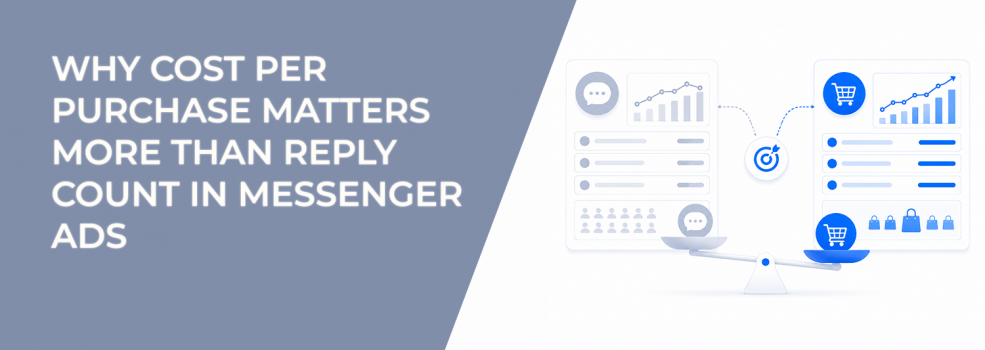
Cheap Messenger replies can make a campaign look efficient before it has actually proven anything. The inbox gets busier, cost per reply drops, and the campaign appears easier to scale.
The problem is that reply count sits too far from the business outcome. A reply tells you someone was willing to start a conversation. It does not tell you whether that person had budget, urgency, trust, or purchase intent.
For sales-focused Messenger campaigns, cost per purchase should carry more weight than reply count.
The problem: Low cost per reply can hide a rising cost per purchase
A low cost per reply can create false confidence because it makes the top of the funnel look efficient. Advertisers see cheaper conversations and assume the campaign is improving.
That assumption breaks when purchase data is added.
A campaign can move from $6 per reply to $3 per reply while cost per purchase rises from $45 to $80. The platform metric improves, but the business metric gets worse. That usually means the campaign is finding easier conversations, not better buyers.
This is where the difference between CPL and CPA becomes important. Messenger replies behave more like leads than purchases, so they need to be judged by what they eventually produce.
Why reply count should not control scaling decisions
Scaling based on reply count can push more budget into low-intent traffic. The campaign may generate more conversations, but those conversations can create extra work without adding revenue.
This happens often in product categories where people ask many pre-purchase questions. Reply volume looks strong because users are comfortable asking about price, shipping, sizes, availability, or comparisons. But many of those users never reach checkout.
A campaign should not be scaled because more people are willing to ask questions. It should be scaled because the cost of acquiring customers remains acceptable as spend increases.
That is why CPA should guide decisions when sales matter. Reply count helps explain the funnel, but CPA tells you whether the funnel is worth funding.
A real-world use case: Pet food subscriptions
A pet food brand runs Messenger ads for a subscription offer. The campaign generates a large number of replies because people ask whether the food is grain-free, suitable for puppies, or available for sensitive stomachs.
At first, the campaign looks strong. Cost per reply is low, and the support team is handling steady message volume.
After tracking purchases, the brand sees a different pattern. Users asking about delivery frequency and subscription changes convert well. Users asking broad ingredient questions often continue researching and do not subscribe.
If the brand scales based on reply count, it buys more conversations from undecided shoppers. If it scales based on cost per purchase, it can focus on ads, prompts, and audiences that attract users closer to subscribing.
The solution: Scale Messenger ads only when purchase CPA stays stable
A Messenger campaign should earn more budget by proving that purchase efficiency holds beyond the reply stage. If reply volume grows but purchase CPA worsens, the campaign is not ready to scale.
The practical check is simple. Before increasing spend, compare conversation volume against qualified conversations, purchases, and revenue. If all three move together, the campaign is probably attracting useful demand. If only conversations increase, the campaign is drifting toward softer engagement.
A stable purchase CPA does not mean every day will look identical. Messenger campaigns still fluctuate because conversation timing, sales follow-up, and buying cycles vary. The goal is to confirm that higher spend does not consistently pull the campaign into lower-quality conversations.
How to use reply count without letting it distort decisions
Reply count still has diagnostic value. It can show whether the ad creates enough initial interest and whether the message prompt is easy to start.
The mistake is using it as the main success metric. A more useful approach is to read reply count alongside:
- Cost per purchase, because this shows whether conversations become customers.
- Conversation-to-purchase rate, because this reveals the quality of the message flow.
- Revenue per conversation, because some conversations produce higher-value buyers.
- Sales close rate, because weak follow-up can make strong traffic look weak.
This combination gives reply count context. A campaign with fewer replies can be more profitable if those replies convert at a higher rate.
Why purchase data still needs context
Cost per purchase is stronger than reply count, but it should not be read in isolation. A campaign can show a good CPA for a few days because one high-value buyer converted, while most conversations remain weak.
That creates a different kind of false confidence.
For example, a custom furniture retailer may get one large order from a Messenger conversation, making ROAS look excellent for the week. But if the rest of the conversations are low-quality price checks, scaling that campaign may not repeat the same result.
This is why profitability needs more context than surface metrics. Advertisers need to know whether purchases are repeatable, not just whether one reporting period looked good.
Final takeaway
Reply count tells you whether people are willing to start a conversation. Cost per purchase tells you whether those conversations are commercially useful.
For Messenger campaigns tied to sales, scaling decisions should be based on purchase CPA, qualified conversation rate, and revenue quality. Cheap replies are only valuable when they lead to profitable customers.