When a campaign starts scaling successfully, advertisers often notice something counter-intuitive: cost per result temporarily improves.
CPA drops, conversion volume increases, and performance appears to strengthen as spend rises.
Then the pattern reverses. After a period of efficiency, costs begin increasing — even though the campaign settings remain unchanged.
This pattern is not random. It reflects how ad delivery algorithms expand into new auctions and audience layers during scaling. Understanding that process prevents advertisers from misreading a normal scaling phase as a campaign failure.
Early Scaling: The Algorithm Focuses on the Highest-Intent Users
When a campaign begins delivering conversions, the platform prioritizes users most likely to convert based on existing signals.
These users typically belong to behavioral clusters similar to past converters.
Typical examples include:
-
Recent category researchers, who recently visited competitor websites or pricing pages.
-
Behavioral overlap clusters, where users interact with multiple ads in the same product category within a short timeframe.
-
High-proximity lookalike users, whose behavioral signals closely resemble previous buyers.
Because these users already demonstrate strong purchase intent, the algorithm can bid confidently in auctions where the probability of conversion is high.
Inside Ads Manager, this phase usually produces visible signals:
-
Conversion rate increases.
-
CPA declines.
-
Budget concentrates within a small subset of the audience.
At this stage, the algorithm is not exploring broadly. It is harvesting the most predictable conversions first.
Why This Efficiency Doesn’t Last
Once the most responsive audience pockets are exhausted, the delivery system must begin entering additional auctions to spend the increased budget.
Two structural shifts occur.
| Structural Shift | What Happens in Delivery | Observable Result |
|---|---|---|
| Audience intent becomes more variable | The algorithm expands delivery beyond high-intent clusters into broader behavioral segments. | Conversion rate becomes less stable. |
| Auction competition increases | The campaign enters additional auctions where more advertisers are bidding for the same impressions. | CPM fluctuates and acquisition costs rise. |
Audience intent becomes more variable
The next layers of users share weaker behavioral similarity with previous converters.
Examples include:
-
users reading informational content rather than researching pricing,
-
users interacting with ads passively instead of clicking,
-
lookalike audiences matching fewer behavioral signals.
These audiences still contain potential buyers, but the conversion probability is lower and less consistent.
Auction competition changes
Scaling also exposes the campaign to different competitive environments.
The system may begin entering auctions where:
-
larger advertisers dominate bids,
-
CPM fluctuates based on time-of-day demand,
-
several advertisers target the same broad audiences.
If you want to understand how these competitive dynamics affect delivery, read Crack the Code: What You Need to Know About the Facebook Ad Auction.
Why CPA Often Gets Worse Quickly
Many advertisers expect performance deterioration to happen gradually.
Instead, CPA often rises within a short window.
That happens because delivery expansion occurs in layers, not evenly across the same audience.
The progression typically looks like this:
-
Initial cluster saturation
The algorithm first delivers impressions to the highest-conversion users. -
Budget pressure increases
More spend forces the system to enter additional auctions. -
Audience layers expand rapidly
New behavioral clusters with weaker signals enter delivery. -
Conversion signal density declines
The ratio of conversions to impressions falls. -
CPA rises
The algorithm recalibrates bidding based on new signals.
Signal Density Declines During Expansion
Another factor behind rising CPA during scaling is signal dilution.
Signal density refers to how much reliable conversion feedback the algorithm receives relative to the number of impressions.
Example:
Early phase:
-
1,000 impressions
-
40 conversions
Scaling phase:
-
3,000 impressions
-
60 conversions
Conversions increase, but conversion rate declines significantly.
The algorithm now evaluates more users with fewer confirmed buying signals.
When Campaign Performance Stabilizes Again
In many campaigns, the cost increase is temporary.
Once the algorithm gathers enough new data, it identifies new profitable audience clusters inside the broader environment.
Delivery then shifts toward those pockets.
Recovery is more likely when:
-
the campaign generates consistent daily conversions,
-
targeting remains broad enough to find new clusters,
-
budget increases occur gradually.
For a deeper explanation of scaling dynamics, see The Science of Scaling Facebook Ads Without Killing Performance.
How to Diagnose Whether Rising Costs Are Normal
Not every CPA increase indicates a structural problem.
Several delivery signals inside Ads Manager can reveal whether the campaign is simply expanding.
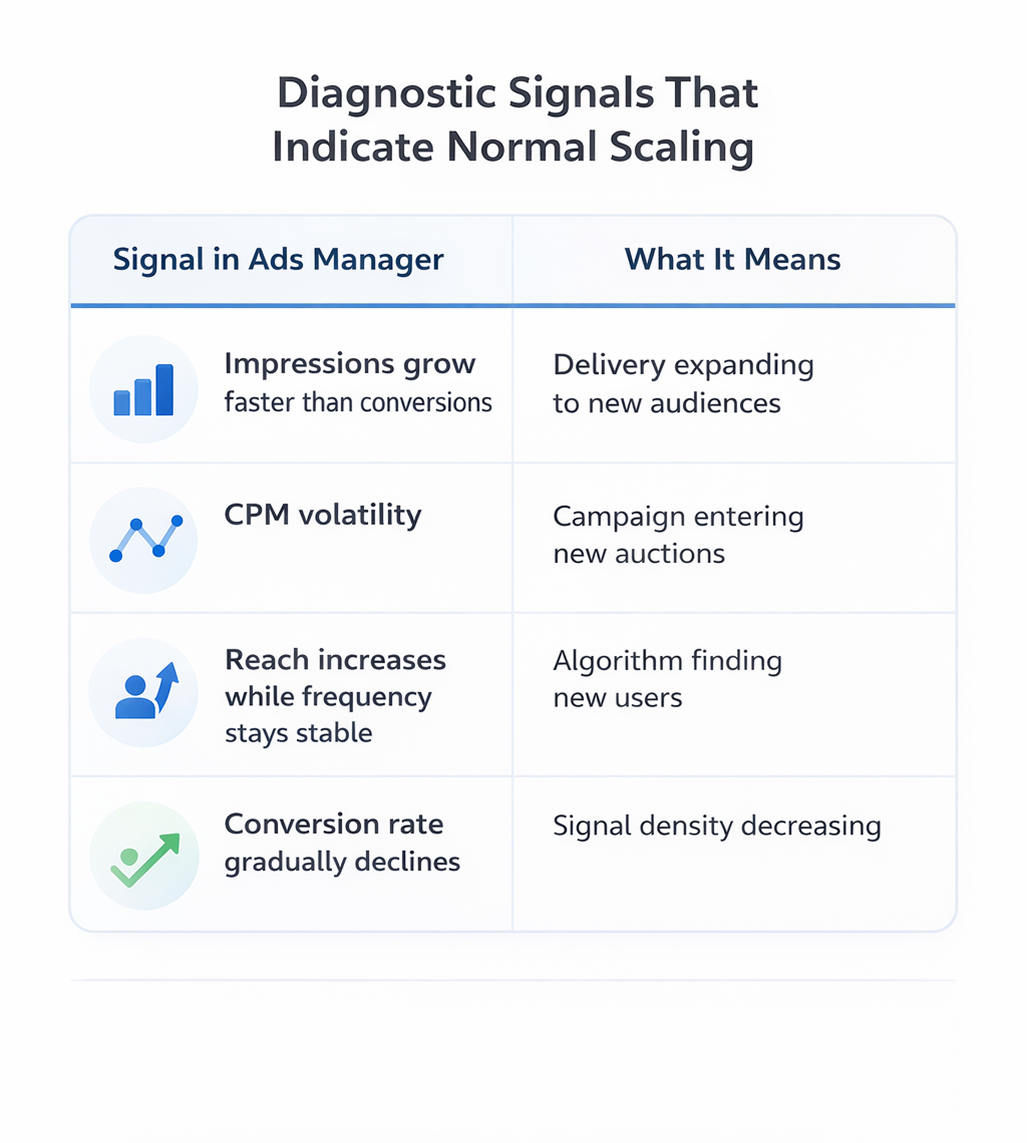
Important indicators include:
-
Impression growth relative to conversions
Rapid impression growth usually means the algorithm is exploring broader audiences. -
CPM volatility
Entering new auctions often produces fluctuating CPM. -
Reach expansion with stable frequency
If reach increases while frequency stays stable, the algorithm is finding new users.
Understanding these patterns requires looking beyond basic metrics. See How to Analyze Facebook Ad Performance Beyond CTR and CPC.
How to Scale Without Triggering Extreme CPA Volatility
Although some cost fluctuation is inevitable, several practices reduce instability.
Increase budgets gradually
Large budget jumps force the algorithm to expand delivery too quickly.
For guidance on safe budget adjustments, read Why Daily Budget Increases Can Hurt Your Performance (and What to Do Instead).
Maintain strong conversion signal flow
If event tracking is inconsistent or missing, the algorithm receives poor feedback.
Accurate tracking helps the system identify profitable segments faster.
Avoid excessive targeting restrictions
Narrow targeting limits the algorithm’s ability to discover new profitable clusters.
Broader targeting environments often stabilize scaling performance.
The Structural Takeaway
The temporary improvement in cost per result during early scaling does not mean the campaign became inherently more efficient.
It simply means the algorithm started with the most predictable conversion pockets.
As scaling continues, delivery expands into less certain auction environments. Conversion probability becomes more variable, signal density declines, and CPA often rises before stabilizing again.
Recognizing this pattern changes how scaling decisions are made.
Instead of reacting immediately to cost increases, experienced advertisers watch delivery signals that reveal whether the algorithm is still discovering profitable audience segments.