Budget cannibalization silently drains performance across paid campaigns. When multiple campaigns compete for the same audiences, keywords, or placements, marketing teams often see rising costs without a proportional increase in conversions.
What Is Budget Cannibalization?
Budget cannibalization occurs when multiple marketing campaigns compete against each other for the same traffic, impressions, or conversions. Instead of expanding reach, campaigns start bidding against themselves, driving up costs while limiting overall efficiency.
This problem appears frequently in platforms that use automated auctions such as Google Ads, Microsoft Ads, and social media advertising systems.
Common examples include:
-
Multiple campaigns targeting the same keywords
-
Overlapping audience segments
-
Identical geographic targeting
-
Duplicate product campaigns
According to industry research, advertisers can waste up to 15–30% of paid media budgets due to inefficient campaign overlaps and internal competition.
Why Budget Cannibalization Happens
Budget cannibalization usually emerges as advertising accounts grow. New campaigns are added to test strategies, expand markets, or launch new products. Without strict segmentation, these campaigns often begin competing for the same traffic.
Typical causes include:
1. Overlapping Keyword Sets
Running multiple search campaigns that target the same or very similar keywords causes auction competition within the same account.
2. Duplicate Audience Targeting
When several campaigns target identical audience lists, ad platforms may distribute impressions inefficiently.
3. Geographic Overlap
Campaigns meant for different regions sometimes end up targeting the same locations.
4. Product or Offer Duplication
E‑commerce advertisers frequently launch separate campaigns for collections, promotions, or remarketing that ultimately promote the same products.
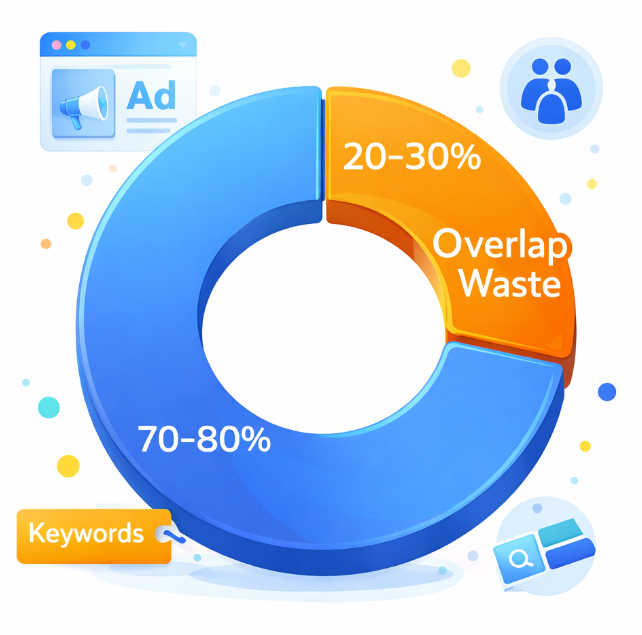
Up to 20–30% of paid advertising budgets can be wasted when campaigns compete for the same audiences or targeting segments
Research from marketing analytics platforms shows that more than 40% of large advertising accounts contain overlapping campaign segments, which significantly increases cost-per-click and reduces return on ad spend.
Warning Signs of Budget Cannibalization
The earlier you identify cannibalization, the easier it is to correct. Several performance patterns commonly indicate that campaigns are competing internally.
Rising CPC Without Increased Competition
If cost‑per‑click rises while market competition remains stable, internal bidding overlap may be the cause.
Stable Traffic but Declining Efficiency
Another signal is when traffic volume stays the same but conversion rates or return on ad spend decline.
Uneven Budget Distribution
Campaigns may begin spending unpredictably, with certain campaigns suddenly dominating impressions for shared audiences.
Duplicate Search Term Performance
Identical search queries appearing across multiple campaigns is a clear indicator that those campaigns are competing for the same auctions.
How to Detect Budget Cannibalization
Analyze Auction Overlap
Search advertising platforms often provide reports that show how frequently campaigns appear in the same auctions.
If multiple campaigns from the same account appear in overlapping auctions, this usually indicates keyword duplication.
Audit Keyword and Audience Segments
Export campaign structures and compare keyword lists, audience groups, and geographic targets.
Large accounts often reveal hidden duplication across hundreds or thousands of targeting parameters.
Monitor Conversion Attribution
Budget cannibalization frequently causes attribution instability. Conversions may fluctuate between campaigns even when the underlying traffic sources remain the same.
Track Performance by Query or Placement
Breaking performance down to the search query or placement level helps reveal where campaigns overlap.
Strategies to Prevent Budget Cannibalization
Build Clear Campaign Hierarchies
Campaigns should follow strict segmentation rules based on product categories, audiences, or funnel stages.
For example:
-
Brand vs. non‑brand search campaigns
-
Prospecting vs. remarketing audiences
-
Region‑specific campaigns
Use Negative Keywords and Exclusions
Negative keywords are one of the most effective tools for preventing campaigns from competing with each other.
Exclusion lists should be applied consistently across campaign groups.
Consolidate Redundant Campaigns
If multiple campaigns promote identical offers to the same audiences, consolidation often improves performance and simplifies optimization.
Review Campaign Expansion Carefully
Whenever a new campaign is added, marketers should verify that it does not overlap with existing targeting segments.
The Business Impact of Fixing Cannibalization
Reducing campaign overlap can significantly improve advertising efficiency.
Studies from marketing performance benchmarks show that advertisers who restructure overlapping campaigns typically achieve:
-
10–25% lower cost‑per‑click
-
15–35% improvement in return on ad spend
-
More stable conversion attribution
Even small structural improvements can unlock meaningful budget savings at scale.
Conclusion
Budget cannibalization is a common but often overlooked problem in growing advertising accounts. As campaigns expand across channels, keywords, and audiences, internal competition can quietly inflate costs and limit performance.
By regularly auditing campaign structures, identifying overlaps, and enforcing clear segmentation rules, marketing teams can eliminate unnecessary competition and unlock better efficiency from existing budgets.
Further Reading