Many Facebook campaigns fail before the first impression even happens.
The creative may look strong. The offer may already convert through outbound or email. The landing page may perform well in other channels.
But the audience itself sends Meta weak optimization signals. This usually starts when advertisers build targeting around interests that sound related to the niche instead of traits connected to actual buyers.
A B2B SaaS advertiser might target:
- entrepreneurship,
- startups,
- business owner,
- digital marketing.
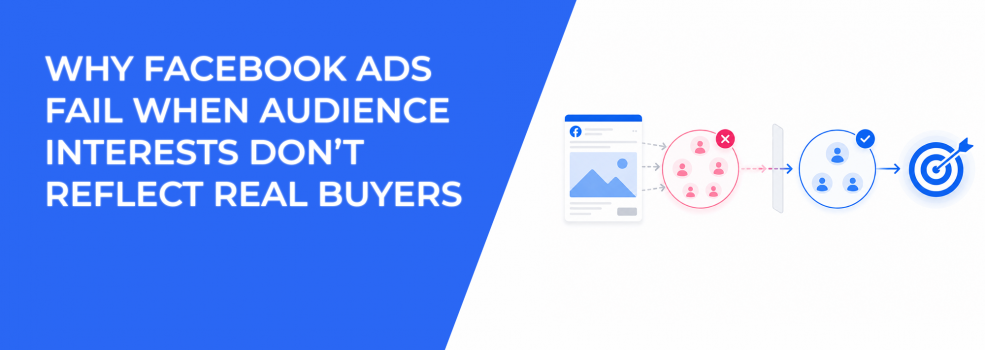
The audience feels relevant on paper. Inside Meta’s delivery system, it becomes behaviorally inconsistent.
Some users are founders. Some consume motivational content. Others follow creators casually without purchasing software.
Meta sees engagement activity but struggles to identify reliable conversion patterns.
Why interest relevance and buyer intent are not the same thing
Meta’s algorithm optimizes around predicted outcomes, not semantic meaning.
An audience interested in “marketing” may contain:
- agency owners,
- freelancers,
- junior employees,
- students,
- content consumers,
- software buyers,
- or people looking for entertainment.
The targeting label alone tells Meta very little about purchase intent. That is why broad interest audiences often generate:
- high CTR,
- low CPC,
- weak conversion rates,
- unstable lead quality.
Cheap engagement signals usually outperform buying signals early in delivery because they are easier for the system to generate at scale.
This creates the illusion of strong performance while downstream metrics decline.
Weak audience cohesion reduces optimization accuracy
Meta performs better when conversion events come from users sharing similar behaviors.
Random interest stacking weakens that similarity.
For example, a CRM software advertiser may combine:
- sales,
- startups,
- business growth,
- entrepreneurship.
The audience becomes massive but behaviorally disconnected.
One cluster interacts with motivational business content. Another watches productivity videos. A third group actively researches CRM solutions.
Meta receives mixed behavioral signals after every conversion event. That slows optimization and weakens audience learning depth.
You can usually spot this problem through:
- CPA rising while CTR remains healthy. The campaign attracts engagement but not qualified buying intent.
- Strong first-week performance followed by instability. Meta exhausts the obvious converters quickly and expands into weaker behavioral clusters.
- Lead quality dropping during scaling. The algorithm begins prioritizing cheaper interactions instead of high-intent users.
What stronger audience construction looks like
Better audiences start with observed customer behavior instead of assumptions.
Strong advertisers study:
- who already converts,
- what communities buyers engage with,
- which creators they follow,
- how they behave before purchasing.
That creates more consistent signal clusters.
For example:
- cybersecurity buyers often overlap inside technical infrastructure communities,
- ecommerce operators repeatedly engage with operational scaling content,
- agency founders commonly interact with workflow and client acquisition discussions.
These patterns create behavioral similarity that Meta can optimize around more effectively.
This is why many advertisers move toward approaches like finding ideal Facebook ad audiences without interest targeting.
Why audience quality affects ROAS more than audience size
Large audiences do not automatically improve scalability.
Weak audience quality usually increases wasted delivery.
When Meta cannot confidently predict conversion likelihood, the system enters cheaper auctions to maintain spend distribution.
That often leads to:
- lower-quality placements,
- accidental broadening,
- weaker lead intent,
- inconsistent conversion behavior.
Many advertisers interpret this as creative fatigue when the real issue comes from audience instability.
This is also why audience quality matters more than audience size in performance campaigns.
A smaller audience with consistent buying patterns often produces stronger ROAS than a massive audience built from disconnected interests.
Using behavioral audiences instead of random interest stacking
Audience construction improves when targeting reflects real engagement behavior.
Examples include:
- Facebook group members connected to industry workflows,
- Instagram followers engaging with niche operational content,
- users interacting with competitor ecosystems,
- customer lists segmented by purchase stage.
These audiences contain stronger intent density.
LeadEnforce helps advertisers build these behavioral audiences using:
- Facebook groups,
- Instagram followers,
- social engagement data,
- profile-level audience signals.
That creates more reliable optimization inputs before campaigns scale.
This becomes especially important as Facebook interest targeting expansion continues widening delivery beyond manually selected interests.
Final takeaway
Most Facebook targeting problems are not caused by audience size. They come from weak audience similarity.
When audience interests do not reflect real buyer behavior, Meta struggles to identify who should receive future impressions. The campaign generates activity without consistent conversion intent.
Performance usually improves when targeting starts with customer behavior patterns instead of broad industry assumptions.