High click-through rates feel productive. Cheap traffic looks efficient in Ads Manager. Yet the wrong hook quietly damages lead quality and sales efficiency.
Many Meta advertisers optimize for attention first. They forget that attention and intent operate on different psychological levels. A hook that maximizes clicks can simultaneously minimize commercial fit.
What a Hook Actually Does in Meta Ads
A hook is the first filtering mechanism in your campaign. It signals who should stop scrolling and who should ignore the message.
On Meta, that signal does more than attract users. It feeds the algorithm behavioral data about who engages, clicks, and converts. If the wrong people respond, the delivery system adapts toward similar profiles.
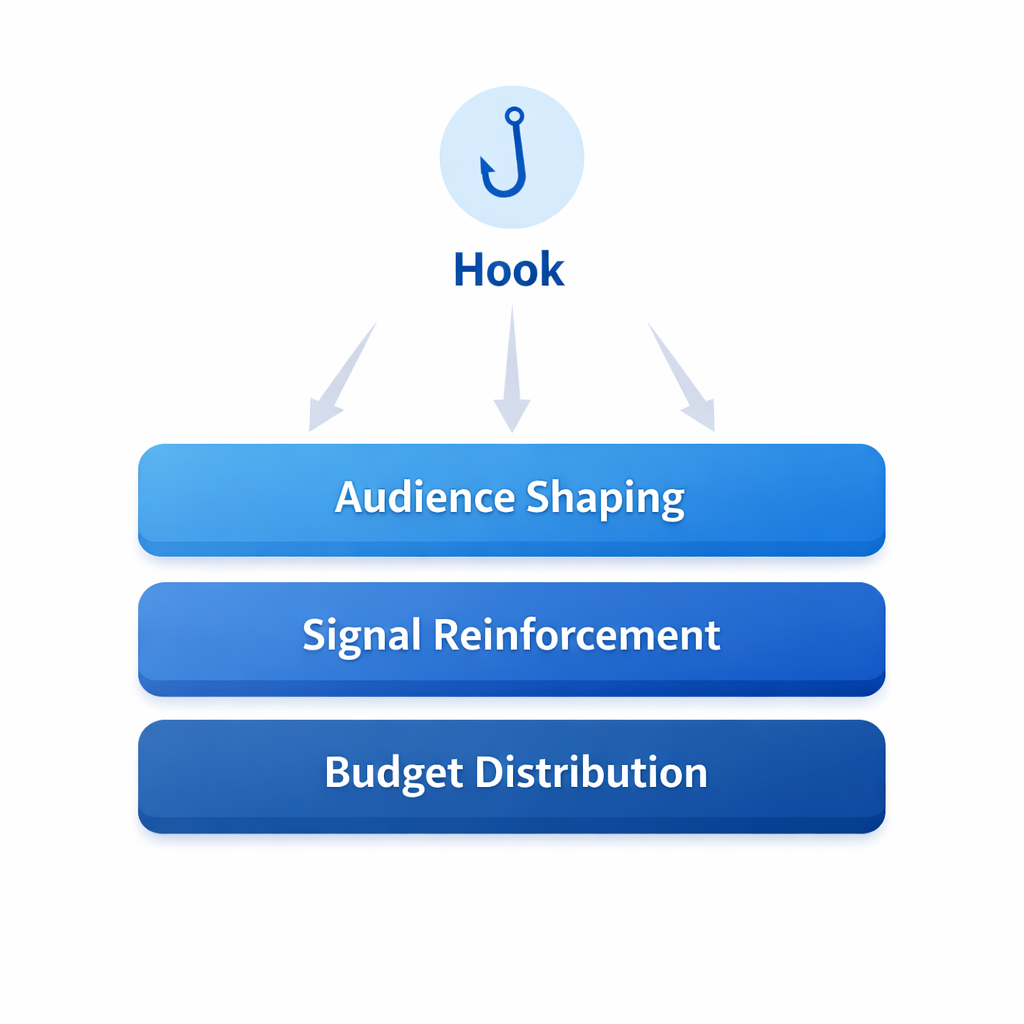
In practice, your hook influences three structural layers inside the ad account:
-
Audience shaping; The algorithm expands toward users who behave like early engagers.
-
Signal reinforcement; Conversion data trains delivery toward similar responders.
-
Budget distribution; Spend shifts to segments that react fastest, not necessarily those that buy.
Over time, your ad set becomes optimized for responsiveness rather than buying power. Engagement metrics look healthy, but downstream revenue weakens. This is why many advertisers later ask why their ads are shown to the wrong people, even when targeting seems correct, a problem explored in Why Are Your Facebook Ads Being Shown to the Wrong Audience?
Why High-Engagement Hooks Produce Low-Quality Leads
The issue rarely sits in targeting settings alone. Most of the distortion begins in positioning.
Hooks designed for maximum curiosity remove qualification. They invite users who enjoy content consumption rather than purchase decisions. The algorithm interprets those interactions as positive signals and expands accordingly.
This mismatch usually shows up in the following patterns:
-
Rising CTR paired with flat revenue; Attention increases but buying intent does not.
-
Lower CPL with weaker sales calls; Lead forms fill faster, yet deal quality declines.
-
Higher reach after scaling; Expansion pulls in cheaper but less relevant users.
Broad Emotional Hooks
Emotion drives action, but broad emotion drives broad audiences. When your hook addresses a universal frustration, it captures people at very different levels of readiness.
Common examples include:
-
“Struggling with marketing?”; This targets almost every founder, from early-stage freelancers to funded startups.
-
“Need more clients fast?”; This appeals strongly to businesses under pressure and often underfunded.
-
“This strategy changed everything”; This activates curiosity without clarifying operational context.
These hooks often produce high CTR and strong top-of-funnel metrics. They rarely produce stable pipelines with consistent deal quality because they lack built-in qualification signals.
Aggressive Outcome Promises
Big claims accelerate engagement. They also distort audience composition.
Consider hooks such as:
-
“Generate 100 leads in 7 days”; This attracts tactic seekers who focus on short-term wins.
-
“Scale to six figures quickly”; This appeals to aspirational operators rather than structured teams.
-
“No experience required”; This signals that complexity and investment are minimal.
When these users enter your funnel, qualification rates drop. Sales conversations shift toward education, budget objections, and unrealistic expectations.
If you notice clicks without meaningful pipeline impact, review performance through a deeper lens, similar to the framework in How to Analyze Facebook Ad Performance Beyond CTR and CPC.
Free-Value Hooks Without Qualification
Free offers drive conversion volume, especially for lead forms. However, without contextual framing, they attract a wide spectrum of users.
Typical patterns include:
-
High opt-in rate with low show-up rate; Users want resources, not conversations.
-
High download volume with low activation; Content is saved but not implemented.
-
Strong cost efficiency with weak revenue; Cheap leads fail to convert into deals.
Examples include:
-
“Free marketing template”; Students, consultants, and competitors download it without buying intent.
-
“Free audit”; Agencies and researchers request it for benchmarking rather than partnership.
-
“Free checklist”; Resource collectors opt in without implementation plans.
Meta records successful conversions. Your CRM records weak opportunities and low close rates. This pattern aligns closely with the broader issue covered in Why Your Ads Get Clicks But No Sales: Fixing the Audience Misalignment.
How Hooks Influence Meta’s Optimization Logic
Meta optimizes for the event you select. It does not evaluate margin, lifetime value, or sales velocity unless you feed that data back.
If your hook attracts low-intent users who complete forms, the system reinforces similar profiles. Cost per lead may decline while cost per qualified opportunity rises.
Three mechanics amplify this effect:
-
Lookalike modeling; The system searches for users who resemble low-intent converters.
-
Budget concentration; Spend flows toward segments with faster form submissions.
-
Expansion logic; Broader audiences are explored to maintain volume.
As budgets increase, these dynamics compound. Advertisers who rely only on surface metrics often misinterpret this shift, which is why understanding the difference between engagement and real business outcomes matters, as discussed in CTR vs Conversions: Why High CTR Doesn’t Always Mean More Sales.
Warning Signs That Your Hook Is Misaligned
Many advertisers focus on CTR as a health indicator. That metric alone hides structural misalignment.
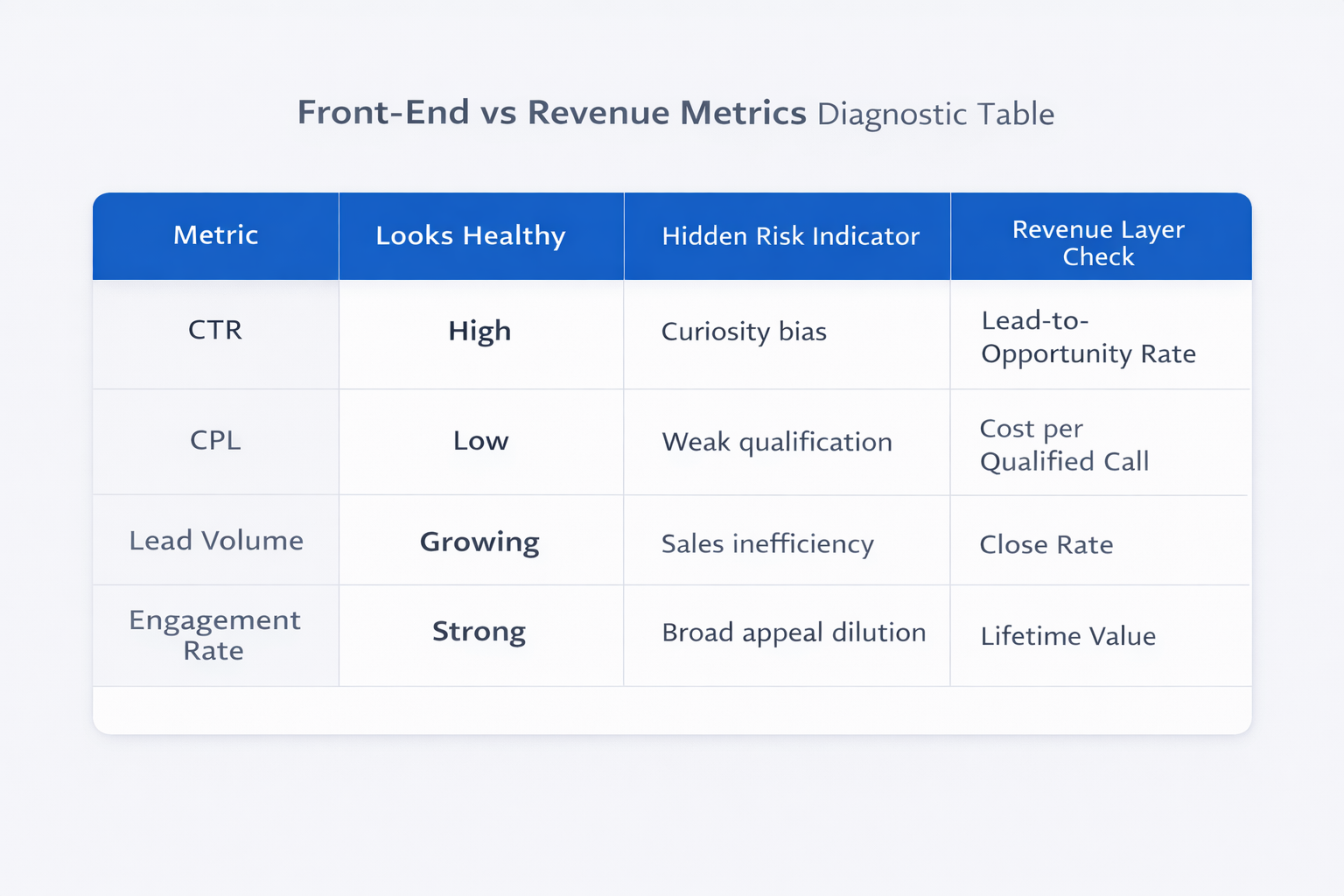
Instead, monitor patterns across the funnel:
-
High CTR combined with weak landing page conversion; The hook promise does not match the offer depth.
-
Stable CPL with declining close rate; Top-of-funnel volume masks deteriorating buyer intent.
-
High lead volume with low booked-call rate; The hook attracts information seekers rather than decision-makers.
-
Performance drop after scaling budget; Expansion reaches cheaper but less qualified responders.
If these signals appear consistently, the issue is strategic. The first line of your ad is shaping the wrong demand profile.
How to Build Hooks That Pre-Qualify the Right Audience
A strong hook attracts and filters at the same time. It clarifies who the message is for and indirectly excludes everyone else.
Introduce Strategic Friction
Friction increases intent density. It narrows the audience without touching targeting settings.
Examples of productive friction include:
-
“For B2B companies spending $5k+ monthly on ads”; This filters out early-stage businesses with limited budgets.
-
“For agencies managing 10 or more active clients”; This excludes freelancers testing new services.
-
“For founders with an internal sales team”; This removes operators without follow-up capacity.
You may observe lower CTR. However, lead-to-opportunity rates and revenue per lead often improve.
Embed Operational Context
Specific language attracts experienced operators. It signals depth and repels beginners who lack the same framework.
Hooks such as:
-
“Reduce CPL without resetting the learning phase”;
-
“Improve lead quality using CRM feedback loops”;
-
“Lower cost per qualified sales call in B2B funnels”;
These formulations assume platform knowledge and pipeline structure. They filter by mindset, not demographics.
Align the Hook With the Revenue Event
Most campaigns optimize for form fills because they are easy to track. Revenue depends on qualified deals and closed contracts.
Shift your hook toward metrics that matter financially:
-
Cost per qualified opportunity;
-
Lead-to-close conversion rate;
-
Revenue per ad dollar;
-
Sales cycle efficiency.
This mindset mirrors the broader principle of audience quality over quantity discussed in Audience Quality vs Quantity: What Drives Better Long-Term Results?
Case Example: Same Offer, Different Hook
Imagine a B2B lead generation agency targeting SaaS companies. The service, pricing, and funnel remain identical.
Hook A reads, “Get more leads for your business.” It generates strong CTR and low CPL. The leads include startups without budgets and founders without sales teams.
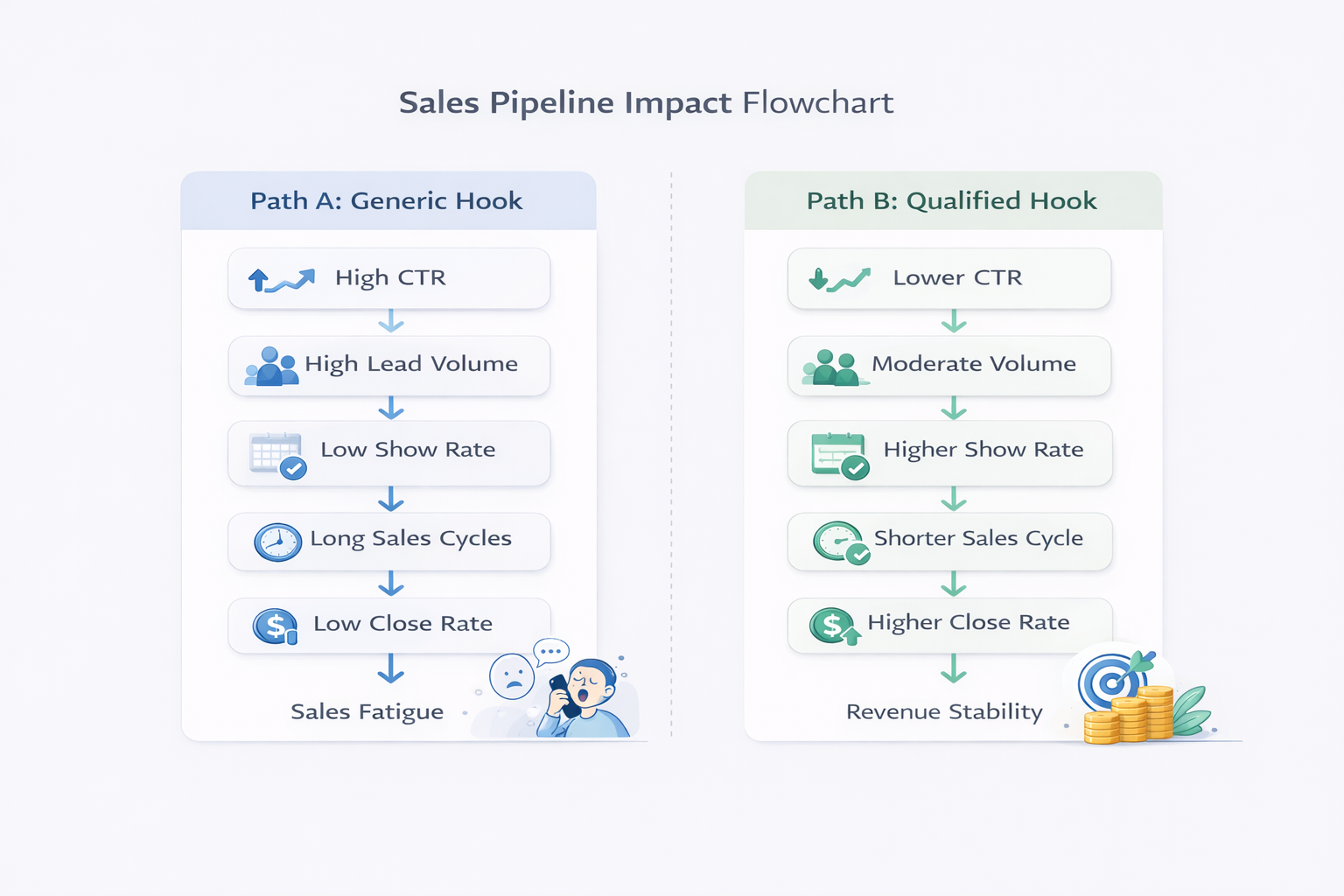
Hook B reads, “Lower cost per qualified demo for B2B SaaS teams spending $10k+ monthly.” CTR declines. Close rates and average deal size increase.
The service does not change. The hook redefines who feels invited to respond, and Meta optimizes around that behavior.
Final Thoughts
Hooks are not cosmetic elements of copy. They are strategic filters that shape algorithmic learning and revenue outcomes.
If your campaigns attract the wrong audience, review the first line of your ad before touching targeting settings. That single sentence often determines who your entire funnel will be built around.