Meta campaigns usually break for one of two reasons. You are talking to the wrong people, or you are saying the wrong thing. Most advertisers change both at the same time. That is how accounts get messy fast.
If you want stable performance, you need to know which lever is actually failing. Audience and creative problems leave different fingerprints in your metrics. Once you learn to read those patterns, diagnosis becomes straightforward.
Why This Diagnosis Actually Changes Results
When you misread the issue, you reset learning for no reason. You duplicate ad sets, swap creatives, expand targeting, and hope something sticks. Performance becomes unstable because you are fixing symptoms, not causes.
Audience problems require structural changes. Creative problems require messaging changes. Mixing the two leads to random outcomes and inconsistent scaling.
Start With Metric Relationships, Not Single Numbers
Most advertisers stare at CPA. That number alone tells you nothing.
Break it down instead:
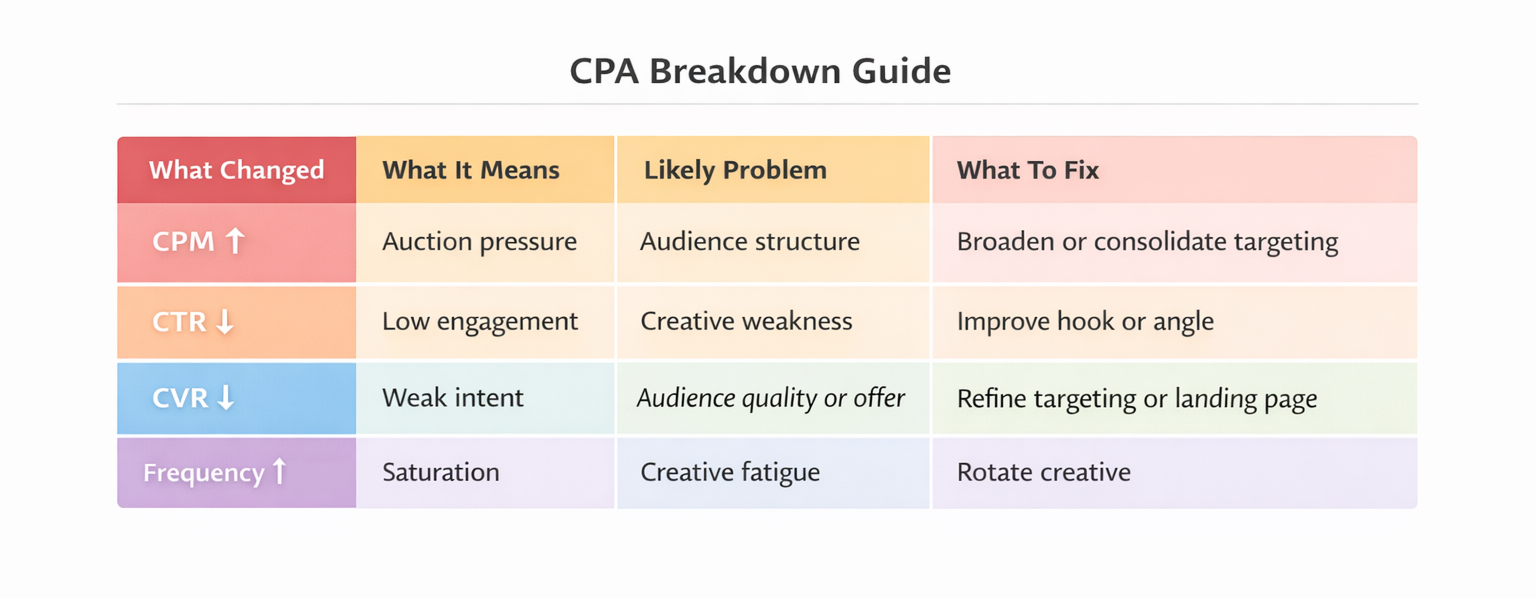
CPA = CPM × (1 / CTR) × (1 / Conversion Rate).
Now you can see what is driving cost. If CPM rises, the audience is expensive. If CTR drops, the message is weak. If conversion rate falls, traffic quality or the landing page is off.
If you want to go deeper into which metrics actually connect to revenue, review these Facebook ad metrics that predict profitability.
How To Tell If Creative Is the Problem
Creative problems show up early. Engagement weakens before costs explode.
Clear Signs Creative Is Underperforming
Look for these patterns:
-
CPM stays stable, but CTR is low across multiple audiences. That means the auction is fine, but the message is not resonating.
-
CTR declines over time while frequency rises. That is fatigue, not targeting failure.
-
Different audiences produce similar weak CTR. If every segment ignores the ad, the issue is not the segment.
-
Conversion rate is decent once people click. That means traffic quality is not terrible.
If the same ad underperforms in broad, lookalike, and retargeting pools, swapping audiences will not fix it. The hook needs work.
If you suspect fatigue, study early signals in this guide on creative fatigue and how to prevent it.
High CTR But Low Conversions
This pattern confuses many advertisers.
When CTR is strong but conversion rate is weak, the ad overpromises. The click comes from curiosity, not intent. The audience is responding, but not the way you want.
In this case:
-
Align the promise in the ad with the landing page.
-
Remove exaggerated hooks.
-
Pre-qualify inside the copy.
If you are running structured tests, make sure your setup isolates variables correctly. A proper A/B testing framework for Facebook ads prevents false conclusions.
How To Tell If Audience Is the Problem
Audience problems behave differently. Engagement can look healthy, but economics break.
Signals That Targeting Is Off
Watch for these patterns:
-
CPM is significantly higher than account averages. This often points to narrow, competitive targeting.
-
CTR is normal, but conversion rate is weak. Clicks are coming from low-intent users.
-
Performance swings heavily between segments. Some audiences convert well, others burn budget.
-
Delivery concentrates in tiny pockets of your total audience. Scale becomes impossible.
If warm retargeting performs well but cold prospecting struggles, the product may convert, but your cold targeting lacks intent.
For a broader refresher on audience structure, revisit this complete guide to Facebook audience targeting.
The CPM Reality Check
CPM is an underrated diagnostic tool.
When CPM spikes after narrowing interests or stacking layers, you are competing harder in the auction. When CPM rises with small custom audiences, you are hitting saturation.
If performance drops while you run multiple similar ad sets, internal competition may be the issue. This breakdown of how audience overlap affects Facebook ad performance explains why cannibalization quietly kills efficiency.
A Simple Diagnostic Sequence
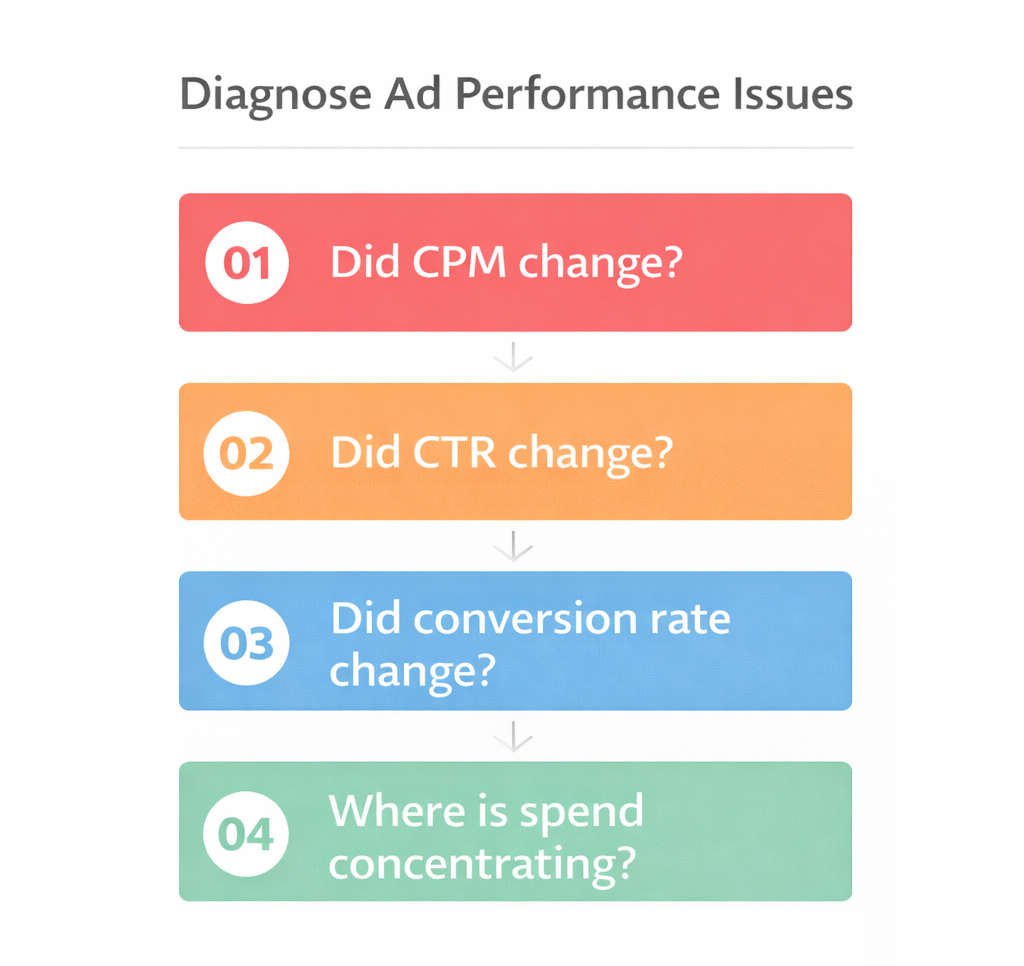
Before touching anything, follow this order.
Step 1: Check CPM Movement
If CPM changed dramatically, start with audience structure. Creative rarely causes sharp CPM swings on its own.
Step 2: Compare CTR Across Audiences
If CTR is weak everywhere, the message is failing. If CTR varies significantly by audience, targeting likely needs refinement.
Step 3: Analyze Conversion Rate Separately
Strong CTR with weak conversion suggests misaligned targeting. Weak CTR with stable conversion suggests weak creative.
Step 4: Review Spend Allocation
Meta pushes budget toward predicted performance. If only one ad set receives spend, others may lack signal strength or scale.
Do not edit everything at once. Isolate the failing variable.
Patterns Experienced Buyers Recognize Quickly
Over time, you start spotting recurring combinations.
High CTR + High CPM + Stable Conversion
The creative works. The audience is expensive. To scale, broaden targeting rather than rewriting the ad.
Stable CPM + Falling CTR + Rising Frequency
Classic fatigue. The audience is fine, but the message is worn out.
Strong Performance in Niche, Weak in Broad
Narrow audiences can hide mediocre messaging. Broad targeting exposes weak positioning fast.
Volatile Conversion Rate With Stable CTR
Often a small audience problem. Limited retargeting pools create unstable daily results.
How To Structure Tests Without Confusion
Testing audience and creative together clouds diagnosis.
Use this approach:
-
Lock one broad audience and rotate creative variations inside it.
-
Identify the strongest creative angle based on CTR and conversion rate.
-
Freeze that creative and test new audience expansions separately.
-
Avoid duplicating similar ad sets that fragment learning.
Clean tests create clean conclusions.
When Both Creative and Audience Are Failing
Sometimes nothing works. You see:
-
High CPM.
-
Low CTR.
-
Weak conversion rate.
That usually means the offer or positioning is off. Ads cannot fix a fundamental demand problem.
In those cases, revisit:
-
Who the product is truly for.
-
What pain it solves clearly.
-
Whether the hook reflects real intent.
No amount of targeting adjustments will compensate for weak market alignment.
Recap
Diagnosing audience versus creative issues is less about formulas and more about reading movement in the data. When CPM, CTR, and conversion rate shift together, they tell a story.
Once you understand that story, you stop reacting emotionally to daily fluctuations and start fixing the actual constraint in the system.