A campaign that suddenly performs better after a budget cut is a familiar situation for many advertisers. CPA drops, CPM stabilizes, and conversions become more consistent — even though the campaign now spends less.
This usually happens when a campaign was operating outside its efficient delivery range. The budget forces the algorithm to enter auctions where the campaign cannot compete effectively.
Reducing the budget removes that pressure. The system stops chasing impressions in expensive auctions and concentrates on the impressions where the ad actually performs.
To understand why this happens, it helps to look at how budget influences Meta’s auction participation and how the platform distributes impressions across different audience segments.
A Sudden CPM Drop After a Budget Cut Is a Strong Signal
One of the clearest indicators appears in the CPM column.
A campaign might run for several days with CPM around $16–$20. After lowering the budget, CPM falls to $10–$12 within 24 hours while conversions remain stable.
This change reveals something about the auctions the campaign was entering.
Meta does not allocate impressions evenly across the platform. Each impression opportunity is part of an auction with a different price level and different predicted conversion probability. When a campaign has a large budget, the system must participate in more auctions to spend that budget.
The algorithm therefore starts entering auctions that are:
-
more competitive,
-
priced higher,
-
and associated with weaker conversion signals.
Lowering the budget removes the requirement to enter those auctions. The system can spend the budget entirely inside the cheaper and more efficient segment of the auction pool.
Budget Size Changes How Aggressively the Algorithm Competes
Meta’s delivery system is designed to pace spending throughout the day. When the budget is large, the algorithm must maintain a high auction participation rate to avoid underspending.
That requirement pushes the system toward more aggressive bidding behavior.
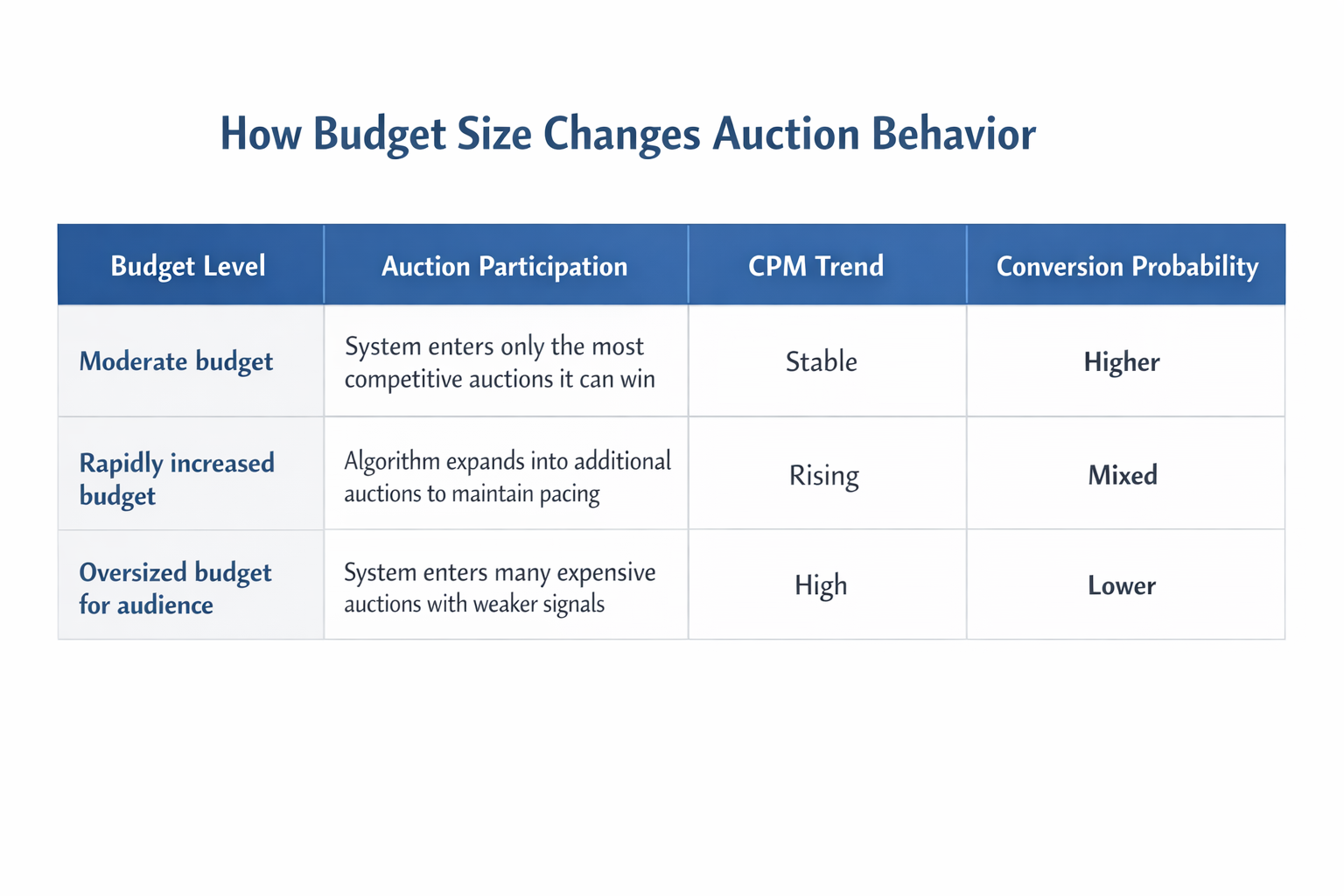
In practice, the campaign begins competing in auctions where:
-
advertisers are bidding aggressively for the same audience,
-
CPMs rise because multiple advertisers are targeting the same users,
-
the predicted action rate is weaker.
If you want a deeper explanation of how audiences influence delivery behavior, see the ultimate guide to Facebook audience targeting.
You can often observe this behavior during aggressive scaling.
Hourly delivery becomes uneven. Spend increases quickly early in the day, then slows down as the system searches for additional impressions. CPA fluctuates widely because the campaign is competing in auctions with inconsistent conversion probability.
Lower budgets reduce the need for this aggressive auction entry.
The System Eventually Exhausts the Most Efficient Impressions
Every audience contains a distribution of conversion probabilities.
Some users have strong behavioral signals related to the conversion event. Others have weaker signals. Meta’s algorithm typically finds the highest-probability users first.
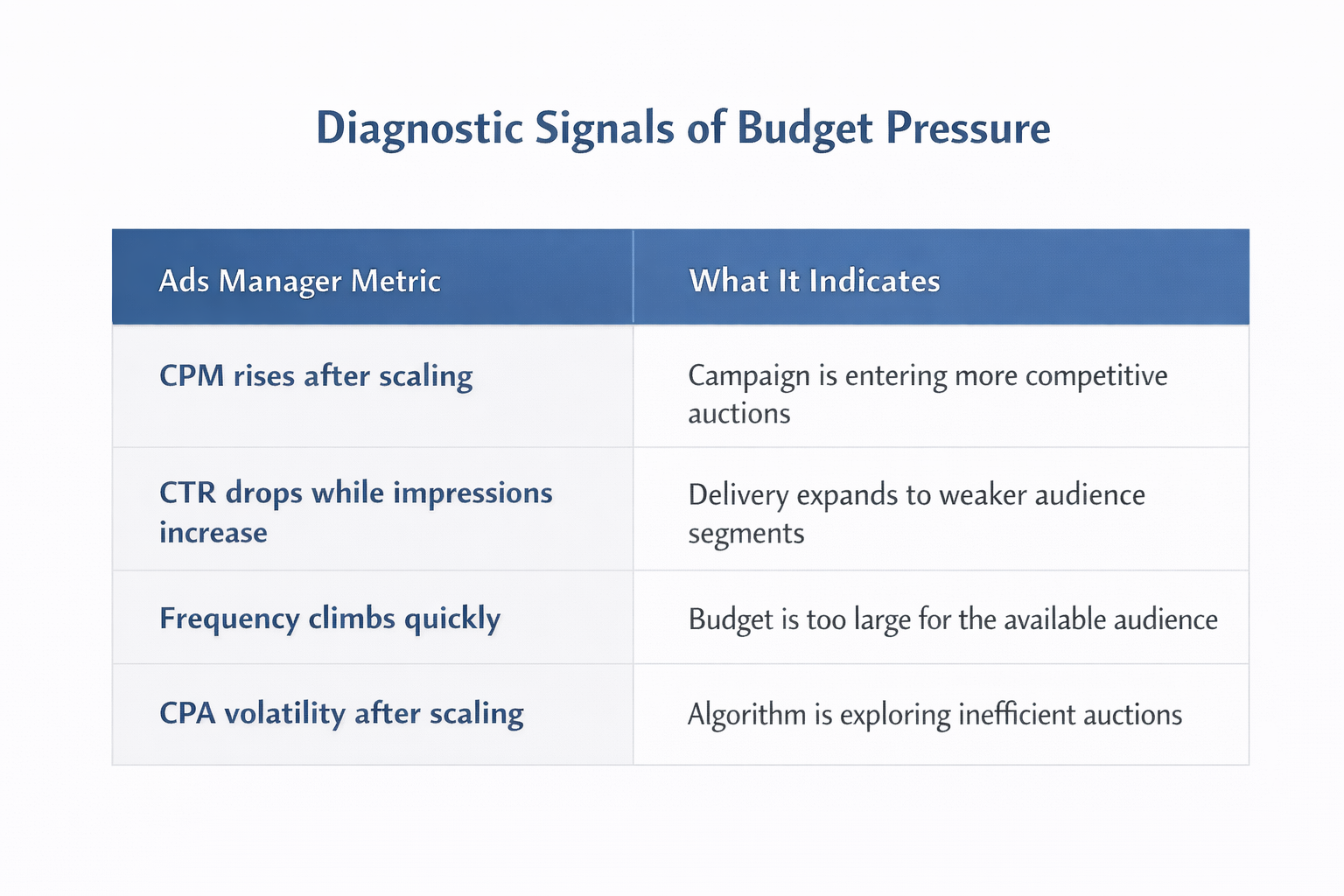
When budgets increase rapidly, the system quickly serves impressions to those users. After that pool is exhausted, delivery expands into weaker segments of the audience.
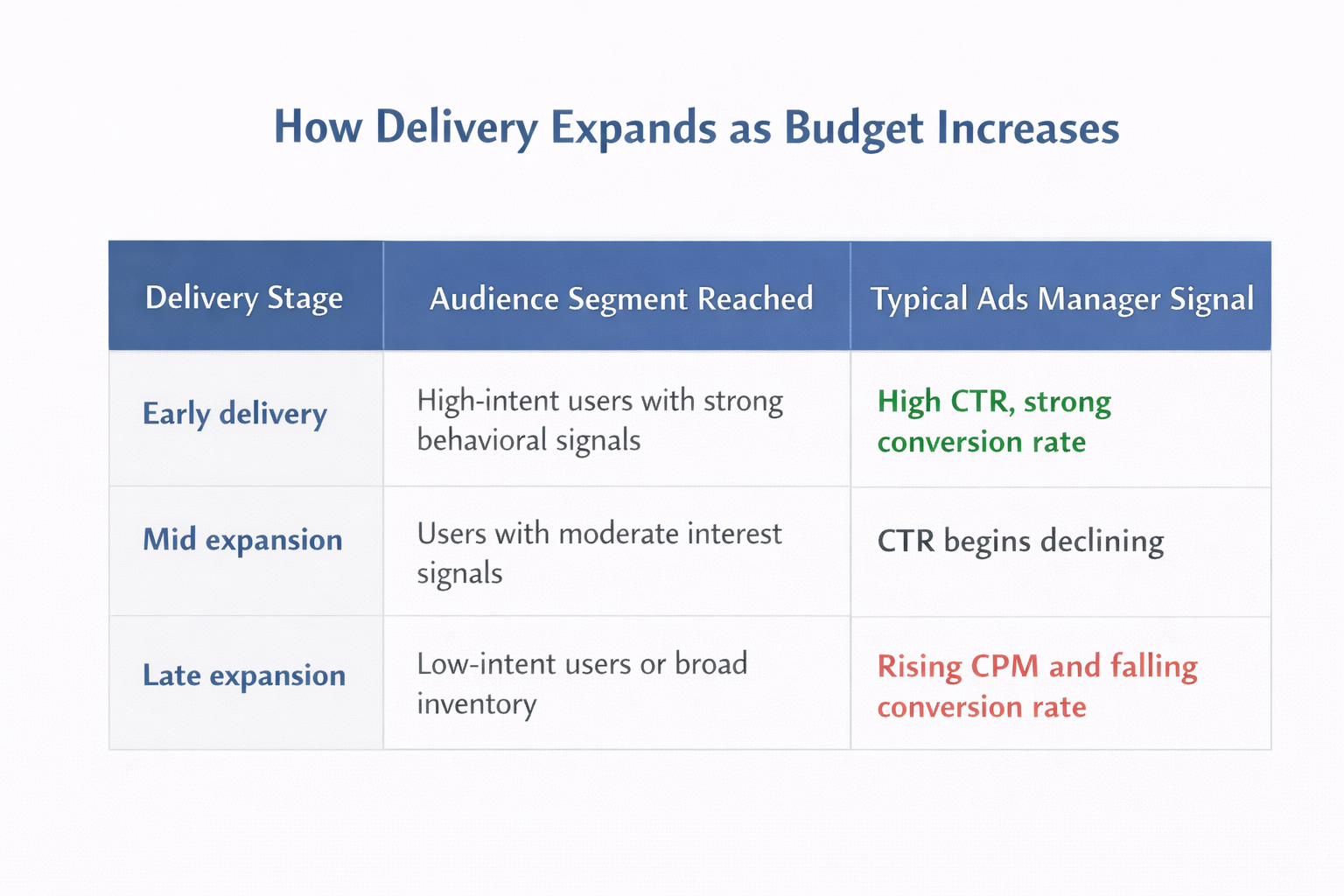
The shift usually shows up in Ads Manager through several metrics:
-
CTR begins to decline.
Ads are shown to users with lower engagement probability. -
CPM increases.
The system competes in auctions with higher advertiser density. -
Conversion rate decreases.
The additional impressions come from users less likely to convert.
Reducing the budget slows the expansion into these weaker segments. Delivery concentrates again on the highest-probability users.
A strong audience structure makes this process easier to control. For example, campaigns built on high-converting Facebook custom audiences often maintain stable performance longer because the algorithm starts with stronger behavioral signals.
Large Budgets Can Create Artificial Frequency Pressure
A small audience combined with a high budget often produces another pattern: frequency climbs faster than expected.
This happens because the system cannot find enough new users to spend the budget efficiently.
The result is repeated exposure to the same people.
Inside Ads Manager, the pattern usually looks like this:
-
frequency rises above 3 within a few days,
-
CTR declines even though CPM remains stable,
-
conversions drop despite stable reach.
Repeated exposure reduces ad responsiveness. Users who have already ignored the ad are unlikely to convert after seeing it multiple times.
Reducing the budget slows the rate at which impressions are delivered to the same users. The audience refresh cycle becomes longer, and engagement often recovers.
Budget Pressure Distorts the Learning Phase
A campaign that receives a large budget relative to its conversion volume often shows unstable learning behavior.
The algorithm needs conversion signals to refine delivery. When the budget is too high, the system is forced to explore aggressively before enough signals accumulate.
This produces recognizable delivery patterns:
-
large swings in hourly CPA,
-
inconsistent CPM across different hours,
-
conversions clustering unpredictably during certain periods of the day.
Lowering the budget reduces this exploratory pressure. The system can rely more heavily on known conversion patterns rather than continuously testing new audience segments.
In many scaling strategies, advertisers introduce lookalike audiences seeded with high-intent data to expand reach without forcing the system into inefficient auctions.
Over time, delivery stabilizes.
Every Campaign Has an Efficiency Range
Campaign performance rarely scales in a straight line with budget.
Instead, most campaigns operate inside a range where auction participation remains efficient. Inside that range:
-
CPM remains relatively stable,
-
CTR stays consistent,
-
conversion rate does not deteriorate.
When the budget exceeds what the audience and conversion volume can support, the algorithm expands beyond this range.
The expansion introduces diminishing returns.
Understanding how Meta builds and uses audience pools helps explain why this happens. The Facebook custom audiences guide breaks down how these segments influence delivery and auction participation.
How to Confirm That Budget Was the Problem
Before attributing performance changes to creative or targeting, it helps to check whether the campaign behavior matches budget pressure.
Three signals usually appear together:
-
CPM falls immediately after the budget reduction.
The system stopped entering expensive auctions. -
CTR increases while impressions decline.
Delivery shifts toward users with stronger engagement signals. -
CPA improves despite lower reach.
The campaign is competing in more efficient auctions.
These signals are visible within a few days after adjusting the budget.
Scaling Without Triggering Efficiency Loss
Scaling campaigns successfully requires expanding the delivery environment rather than forcing the system to spend faster.
Experienced media buyers usually combine several adjustments when increasing budgets:
-
Increase budgets gradually.
Smaller increments allow the algorithm to adjust bidding behavior without immediately entering expensive auctions. -
Expand audience reach.
Broader targeting creates additional pools of high-probability users. -
Introduce new creatives before scaling.
Strong engagement signals allow the campaign to compete more effectively in new auctions. -
Monitor CPM during scaling.
A rapid CPM increase often indicates the campaign is entering more expensive auction segments.
This approach increases scale while maintaining efficiency.
The Real Reason Budget Cuts Sometimes Improve Performance
Performance improvements after a budget reduction are rarely random.
They usually reveal that the campaign had moved beyond the range where it could compete efficiently in Meta’s auction system.
When the budget is reduced, the algorithm no longer needs to participate in expensive auctions with weak conversion signals. Delivery shifts back toward the impressions where the campaign performs best.
The campaign reaches fewer people, but those impressions carry higher conversion probability.
And in auction-driven systems like Meta Ads, selectivity often matters more than raw spend.