You launch a Facebook campaign. It starts strong — great cost per lead. Then it spikes for a day. Then it drops again.
What happened?
It feels random. But it’s not. The truth is, Meta’s ad system works in ways that make results look unpredictable — even when everything is working as expected.
This article breaks down what’s really going on behind the scenes — and how to build more stable campaigns that don’t fall apart at the first sign of volatility.
Why performance feels random — when it’s not
Facebook ads don’t run in a fixed environment. Every single impression happens in a real-time auction — and that auction is always changing.
Key factors that affect every campaign:
-
Other advertisers enter or exit the auction. This changes costs for your audience — even if you change nothing.
-
Your own campaigns can compete with each other. If you’re targeting similar people across ad sets, Meta makes you outbid yourself.
-
Inventory is limited. There are only so many impressions available each day — and demand changes constantly.
What looks like a sudden drop in ROAS may just be a shift in your auction environment. You’re not testing in a vacuum. You’re testing in a moving market.
This is one reason you shouldn’t evaluate campaigns based on single-day results. Even a perfectly healthy campaign can spike in cost due to temporary auction changes.
Meta optimizes for what it sees — not what you value
Facebook uses machine learning to optimize delivery. But it can only work with the data it sees inside the platform. That creates a gap between what Meta thinks is working and what actually helps your business.
| Platform Signals (Meta sees) | Business Signals (You care about) |
|---|---|
| Click-through rate (CTR) | Lead quality (SQL vs junk) |
| Pixel conversions (leads/sales) | Cost per acquisition (CAC) |
| Time on site | Lifetime value (LTV) |
| View-through conversions | Profit margins, payback period |
What Meta uses to optimize:
-
Click-through rates and engagement. These are early signals of ad interest, but they can reward clickbait.
-
Pixel-based events like leads or purchases. These are powerful, but easy to misread if your tracking is off.
-
On-site behavior. Things like bounce rate, scroll depth, and time on site can influence delivery — indirectly.
But none of this tells Meta whether a lead is high-quality — or if a customer will come back and buy again. That’s your job to track.
This disconnect leads many advertisers to scale campaigns that look great on ROAS, but fail to bring real value. Always track your cost per acquisition (CAC), customer lifetime value (LTV), and payback period outside the platform — and compare them to platform results regularly.
Here’s why ROAS isn’t always the full story.
The learning phase always causes turbulence
When you start a new campaign, Meta doesn’t know who will respond best — so it runs tests. That’s called the learning phase.
What causes learning-phase instability:
-
Not enough conversions. If you don’t get 50+ events per week, the system stays unstable.
-
Delayed purchases. If users buy days later, Meta has a hard time learning quickly.
-
Too many edits. Changing budget, creative, or targeting resets the learning — and performance drops again.
During learning, Meta is guessing. You’ll see results jump around. That doesn’t mean the ad is bad — it just means the system needs more data.
You should let campaigns run long enough to stabilize. Don’t judge anything too early. If your CPA target is $30, wait until the campaign spends at least $60–$90 before making decisions.
Speed up the learning phase with these practical tips.
Timing can distort performance
Some hours and days perform better than others. If you look at results without context, you’ll think the campaign is broken — when it’s just bad timing.
| Day | 12–6am | 6–9am | 9–12pm | 12–3pm | 3–6pm |
|---|---|---|---|---|---|
| Monday | Low CTR 🟡 | High Conv. 🟢 | High Conv. 🟢 | Low CTR 🟡 | High CPM 🔴 |
| Tuesday | Low CTR 🟡 | High Conv. 🟢 | High Conv. 🟢 | Low CTR 🟡 | High CPM 🔴 |
| Wednesday | Low CTR 🟡 | High Conv. 🟢 | High Conv. 🟢 | Low CTR 🟡 | High CPM 🔴 |
| Thursday | Low CTR 🟡 | High Conv. 🟢 | High Conv. 🟢 | Low CTR 🟡 | High CPM 🔴 |
| Friday | Low CTR 🟡 | High Conv. 🟢 | High Conv. 🟢 | Low CTR 🟡 | High CPM 🔴 |
| Saturday | High CPM 🔴 | Low CTR 🟡 | Low CTR 🟡 | High CPM 🔴 | High CPM 🔴 |
| Sunday | High CPM 🔴 | Low CTR 🟡 | High Conv. 🟢 | High Conv. 🟢 | Low CTR 🟡 |
Key timing effects:
-
Late nights often cost less — but convert worse.
-
Weekends shift user behavior. Some products do better Sunday night, others tank Saturday morning.
-
Holidays and seasons matter. Ad inventory tightens during Black Friday or Q4. Summer might see a drop in urgency.
Short-term timing changes can throw off your numbers — especially if your budget is small. A bad six-hour window might ruin your daily average.
Instead of overreacting, use hourly and daily breakdowns to spot patterns. Schedule your ads to avoid low-performance windows. And always evaluate over a full week — not a single day.
Creative decay is real — and fast
Even great ads don’t last forever. Meta loves new creative — and punishes old ones once performance starts dropping.
What causes creative fatigue:
-
High frequency. If users see the same ad too many times, they tune out.
-
Click-through rate drops. Meta interprets this as poor performance and reduces delivery.
-
Cost per result rises. Suddenly, an ad that crushed for three days stops getting impressions.
Creative fatigue often feels like randomness — but it’s just overexposure. The more successful an ad is early, the faster it burns out.
The fix is to create ads with swappable parts — different hooks, visuals, formats, and CTAs. This way, you can launch variations without building everything from scratch. And you can track which parts start to fail first.
Learn how to detect and fix ad fatigue early.
Budget changes break the balance
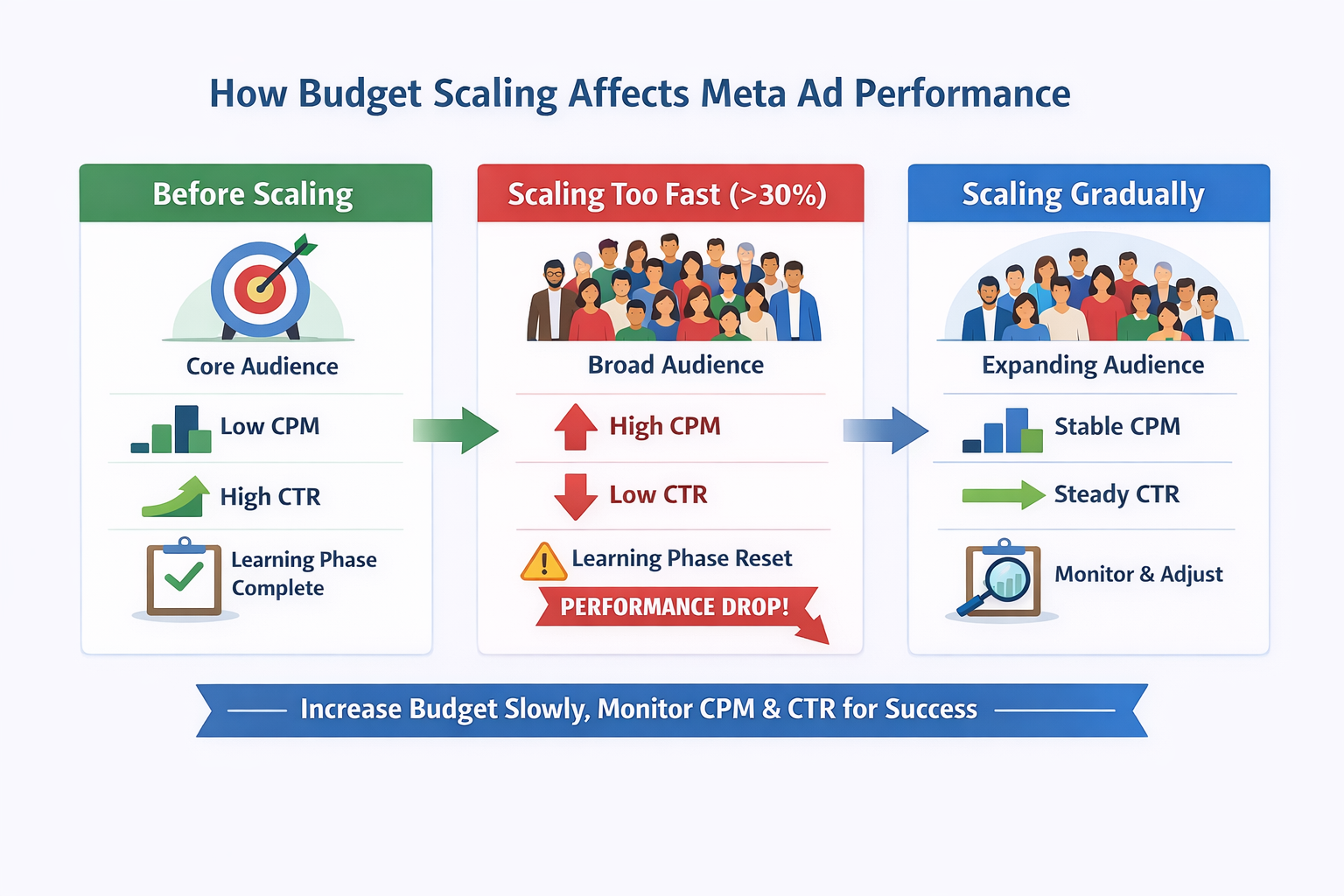
Scaling your budget can crash your performance — if you do it too fast.
Why scaling disrupts results:
-
Meta expands your audience. You reach people outside your best-performing segment.
-
You enter higher-cost auctions. Bigger spend pushes you into more competitive territory.
-
The learning phase resets. A big jump (over 20–30%) tells Meta to start over — and performance dips.
This doesn’t mean scaling is bad. It just means you need to expect short-term volatility — and plan for it.
The best way to scale is gradually. Increase budget by 10–20% every few days. Watch leading signals like CPM and CTR. And don’t scale unless your creative performs well with broad audiences — not just early adopters.
Explore advanced scaling techniques without killing ROAS.
Attribution makes results hard to read
Meta’s attribution models are useful — but limited. They don’t always match how you track revenue or measure success.
Where attribution skews results:
-
View-through conversions. Facebook gives credit even if a user only saw the ad, which inflates results.
-
Short windows miss real purchases. If someone clicks but buys three days later, you might not see that conversion.
-
Cross-platform confusion. Meta might claim credit for a sale that also shows up in GA4 or your CRM.
None of this means attribution is useless — but you should treat it like an estimate, not the full story.
Track business results with your own tools. Use Facebook’s reporting to spot patterns — but make decisions using your CAC, retention, and LTV from first-party data.
Final takeaway: it’s not random — it’s just how the system works
Facebook Ads don’t produce random results. They respond to a fast-changing system — and if you don’t know what’s driving the changes, the data looks chaotic.
But once you understand the moving parts — auctions, timing, learning, scaling, creative fatigue, and attribution — things make more sense.
To build better campaigns:
-
Look at performance over time — not just daily spikes.
-
Track business outcomes, not just ROAS.
-
Scale slowly and test creative often.
-
Accept volatility as part of paid social — and plan around it.
When you design for system behavior instead of chasing short-term stability, results stop feeling random and start becoming predictable.