Many campaigns look strong at first glance. Lead volume is steady, CPL is low, and Ads Manager suggests everything is working as expected.
But when you look beyond the surface, the results don’t hold up. Sales struggles to turn leads into conversations, meetings remain limited, and pipeline growth stays flat.
This isn’t random. It’s a structural issue, and it often comes from relying on metrics that don’t reflect real business outcomes — something also explained in Ad Metrics That Lie: When Good Numbers Hide Bad Performance.
Meta Optimizes for the Easiest Action
Meta’s system is designed to get more of whatever action you optimize for. If that action is a form submission, the algorithm will focus on users who are most likely to submit forms, not those who are most likely to buy.
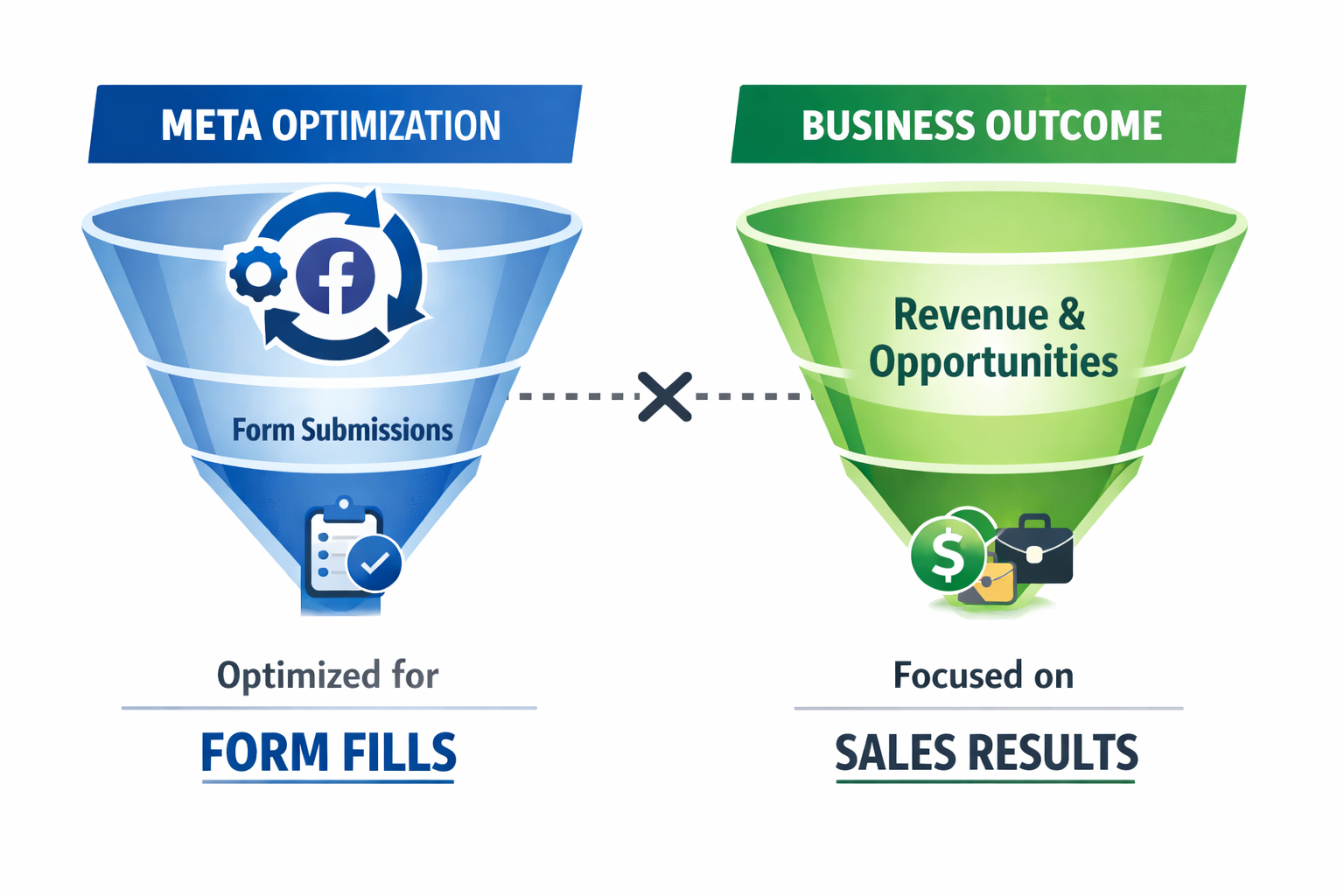
As campaigns stabilize, delivery gradually shifts toward patterns that produce quick and frequent conversions. In practice, this means the system starts prioritizing:
-
Users who complete forms quickly, often with minimal consideration.
-
People who have interacted with similar lead ads before.
-
Lower-cost placements where conversions are easier to generate.
This is why performance metrics can look better over time, with CPL decreasing and conversion rates increasing. However, these improvements rarely translate into better lead quality or stronger pipeline results.
If this feels familiar, it’s the same disconnect many teams face when dealing with Facebook Ads Not Converting: How To Fix It.
Easier Forms Bring Worse Leads
Lowering friction in your form will almost always increase conversion rates, but it also changes the type of user who converts.
When forms become too easy, they stop filtering intent. Instead of attracting people who are actively evaluating a solution, they start attracting users who are simply willing to submit a form with little commitment.
This typically shows up in patterns like:
-
High lead volume combined with low response rates.
-
Booked meetings that rarely happen or don’t progress.
-
Consistent feedback from sales that leads don’t match the target profile.
The system is doing exactly what it’s supposed to do — finding users who convert easily. The problem is that “easy conversion” is not the same as “high intent.”
Introducing a small amount of friction helps restore that balance. It forces users to slow down and signals stronger intent before they enter your pipeline.
When the Message Doesn’t Match, Intent Drops
Another common issue appears when the ad and the landing experience don’t align properly.
A user clicks because the ad promises a specific outcome, but the page they land on feels generic or unclear. At that point, they have to rethink why they clicked, which weakens their initial intent.
This hesitation shows up in behavior:
-
Users take longer to interact with the page.
-
Engagement drops earlier than expected.
-
Fewer visitors move forward to start the form.
Some users still convert, but often without a clear understanding of what they’re signing up for. Others drop off entirely.
This kind of breakdown is often tied to the post-click experience, whichis covered in more detail in Optimizing for Post-Click Experience: What Happens After.
CPL Can Be Misleading
CPL is one of the most commonly used metrics, but it doesn’t reflect the full picture.
A lower CPL usually means the system has found an audience that is easier to convert, not necessarily one that is more valuable. As a result, cheaper leads often require more effort to qualify and convert.
In most cases:
-
Lower-cost leads come with lower intent.
-
Slightly higher CPL introduces more friction and improves lead quality.
-
The real cost appears later, when leads fail to move forward.
This is why evaluating campaigns only through CPL often leads to the wrong conclusions. A more accurate view comes from looking at cost per qualified lead or opportunity.
Your Form Decides Who Enters the Funnel
Lead forms are not just a step in the process. They actively define who enters your pipeline.
When qualification happens only at the end of the form, low-intent users move through most of the process before dropping off. This creates inconsistent data and increases the workload for sales teams.
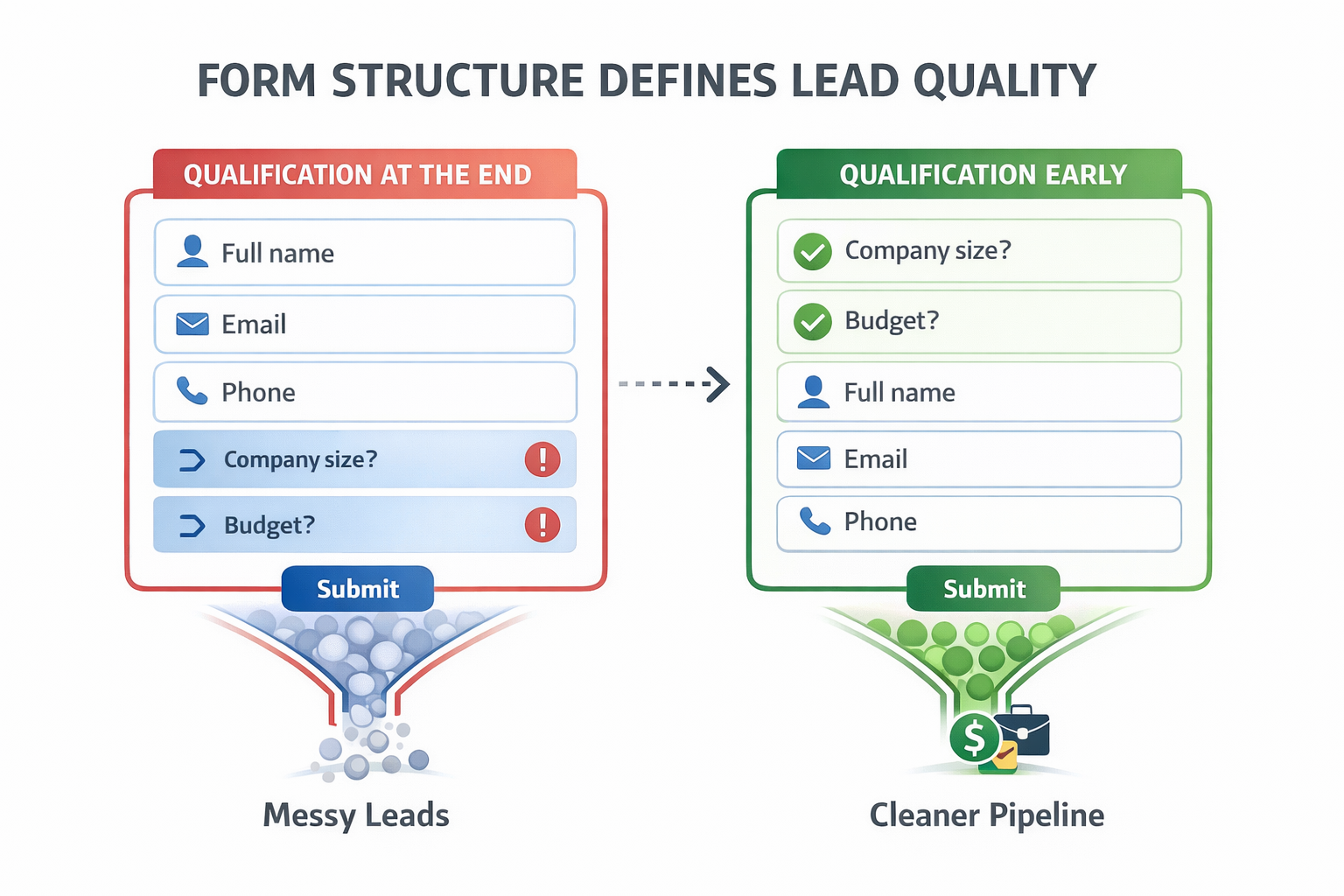
A better structure introduces filtering earlier:
-
Key qualifying questions appear at the beginning of the form.
-
Conditional logic removes obvious mismatches before submission.
-
The order of fields prioritizes intent signals over basic information.
This approach reduces volume but improves consistency and data quality. It also helps the algorithm learn from more meaningful conversion signals.
Meta Doesn’t See Your Sales Feedback
One of the biggest gaps appears after the lead is generated.
Sales teams often identify clear patterns in low-quality leads, but that information rarely reaches Meta. The platform continues optimizing based only on the signals it receives, which are usually limited to form submissions.
Without a feedback loop, the system keeps reinforcing the same behavior:
-
It finds more users who submit forms easily.
-
It ignores what happens after the submission.
-
It continues scaling low-quality patterns.
To correct this, you need to send better signals back into the system:
-
Track qualified leads, not just submissions.
-
Send events like booked meetings or accepted leads.
-
Use these events for optimization once there is enough data.
This is what allows campaigns to improve over time instead of repeating the same outcomes.
What Actually Improves Lead Quality
Improving lead quality doesn’t require a complete rebuild. It comes from aligning a few key elements across the funnel.
Start by tightening your offer so it speaks to a specific audience. Broad messaging attracts broad traffic, which usually lowers intent.
Then adjust your form to introduce controlled friction, especially early in the process. This helps filter users before they fully enter the funnel.
It’s also important to keep your messaging consistent from the ad through to the form. Any disconnect forces users to reinterpret the offer, which weakens intent.
Finally, shift how you evaluate performance. Instead of focusing on CPL, track metrics tied to real outcomes such as qualified leads or pipeline contribution. A more detailed approach to this is outlined in How to Use Facebook Ads to Fill a Sales Pipeline — Not Just a Form.
The Bottom Line
If your Facebook leads look strong in Ads Manager but don’t convert into real opportunities, the issue is not random.
Meta is optimizing for the easiest measurable action available. When that action is a form submission, the system will generate more submissions, regardless of whether those leads are useful.
Once you change the signal and align your funnel around intent, lead quality becomes much more predictable — and much easier to control.