Most teams assume rising costs mean something is wrong with their campaign. In many cases, that’s not true.
Sometimes, the real reason is simple: the market got more competitive.
If CPM goes up but your CTR and conversion rate stay stable, your strategy is probably fine. You’re just paying more to reach the same people.
If you want a deeper breakdown of cost drivers, check Factors That Influence the Cost of Facebook Ads.
When It’s Not a Strategy Problem
You can usually spot this pattern quickly in Ads Manager.
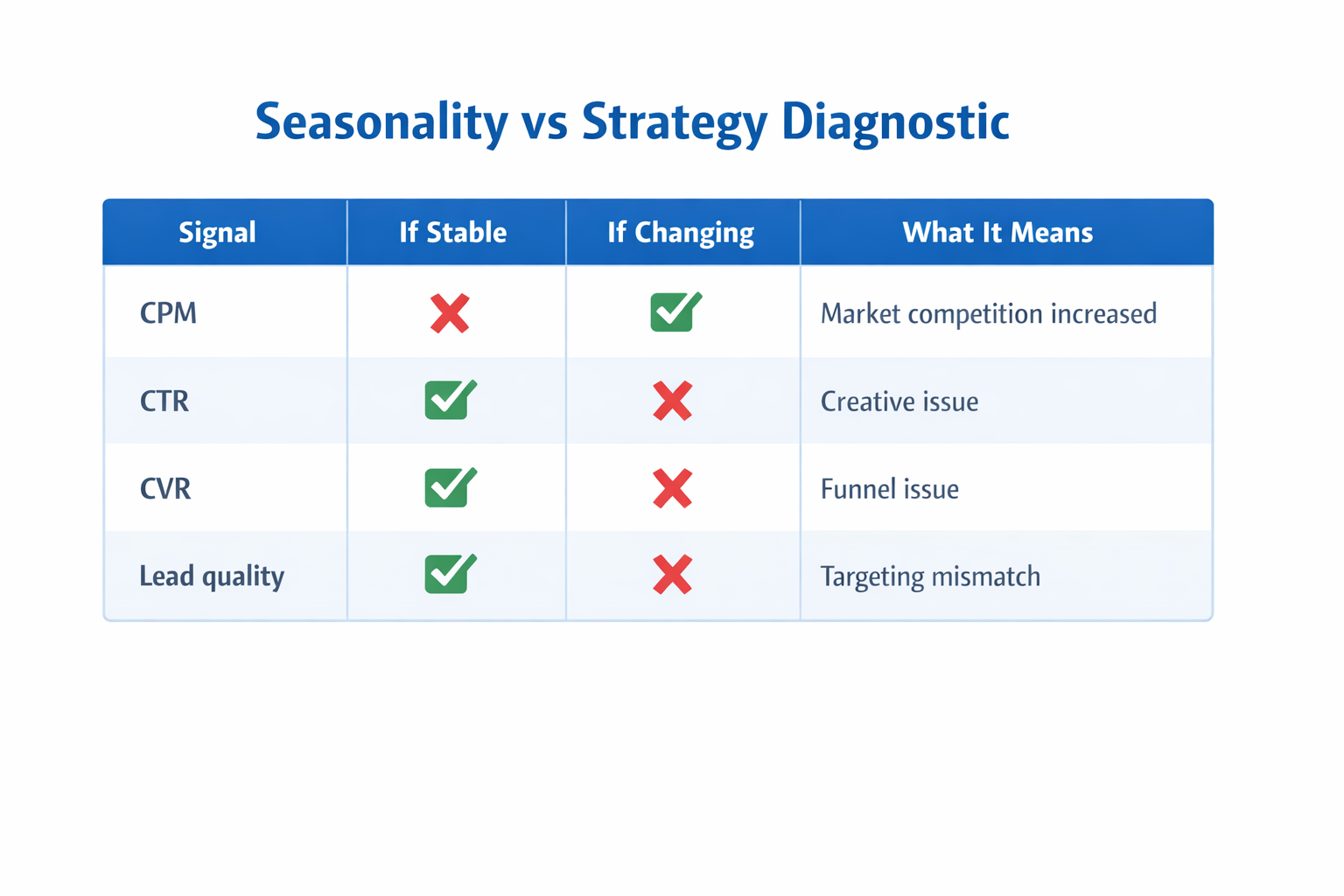
Here’s what it looks like:
-
CPM rises quickly.
You might see a 20–50% increase over a few days, even though you didn’t change anything. This usually means more advertisers are competing for the same audience. -
CTR stays stable.
People are still clicking at the same rate, which tells you your creatives are still relevant and doing their job. -
Conversion rate stays stable.
Users who click still convert at the same rate, so your landing page and offer are not the issue. -
Delivery becomes less consistent.
Spend may fluctuate during the day because your ads are entering fewer auctions or losing more of them.
When you see all of this together, the issue is not performance quality. It’s auction pressure.
This often happens during:
-
High-demand periods.
For example, Q4, product launches, or industry-wide campaigns where many advertisers go live at once. -
Planning cycles.
Months like January or September, when companies restart budgets and campaigns. -
Seasonal buying windows.
Some audiences simply become more competitive at specific times of the year.
What Actually Changes
Seasonality affects how the ad auction works, not how your campaign behaves.
Here’s what changes behind the scenes:
-
More competition in the same auctions.
More advertisers are targeting similar users, so the system raises prices. You either pay more or lose impressions. -
Fewer cheap opportunities.
The algorithm prioritizes higher-value impressions, which means your campaign sees fewer low-cost placements. -
Slower learning.
If your ads enter fewer auctions, you get fewer conversions per day. That slows optimization and can make performance look unstable. -
Faster audience saturation.
You may see frequency increase because the system keeps showing ads to the same users when cheaper reach is limited.
If you want to understand this better, read Facebook Ad Auction: Do Ad Sets Compete Against Each Other?
Why Teams Make It Worse
When costs go up, most teams try to “fix” the campaign.
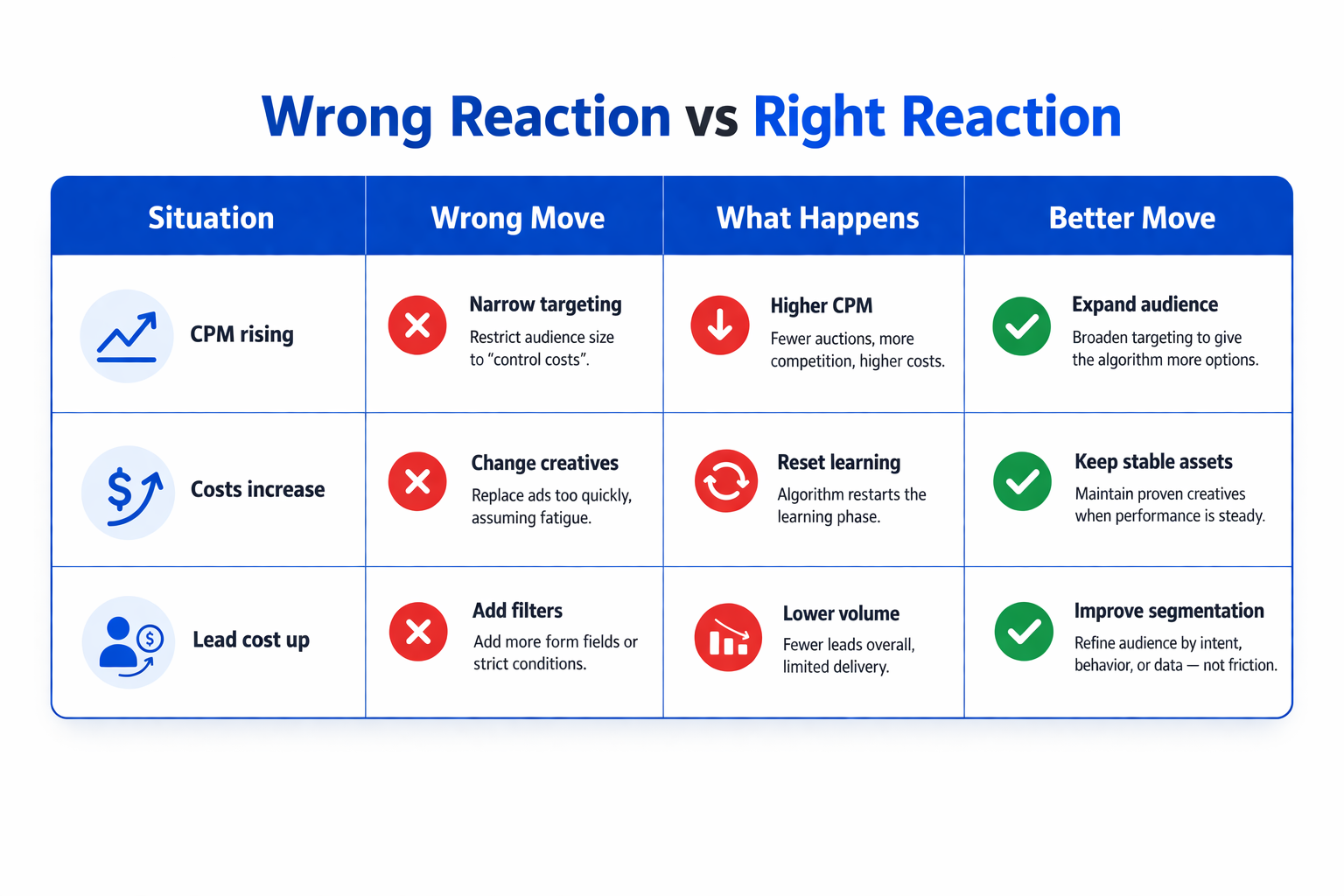
That usually leads to mistakes:
-
Narrowing targeting too much.
This reduces your audience size and pushes you into even more competitive auctions, which increases CPM further. -
Changing creatives too early.
If CTR is stable, your creatives are not the problem. Replacing them resets learning without solving anything. -
Adding more filters to forms.
This reduces lead volume but doesn’t change auction costs, so overall efficiency can drop.
If you’ve seen confusing performance changes before, this is similar to what’s explained in What to Check When Your Cost Per Lead Suddenly Spikes.
How to Diagnose It Properly
Instead of guessing, look at three layers of data.
1. Auction signals
-
CPM trend.
If CPM is the main thing increasing, that’s your first clue. -
Delivery stability.
If impressions and spend fluctuate, the system is struggling to win auctions consistently.
2. Engagement signals
-
CTR.
Stable CTR means your message still works. -
Creative performance.
If multiple ads perform similarly, it’s unlikely that creative fatigue is the issue.
3. Conversion signals
-
Landing page CVR.
If it holds steady, your funnel is fine. -
Lead quality.
If qualification rates don’t drop, user intent hasn’t changed.
If only CPM is moving while everything else stays stable, you’re dealing with seasonality.
What to Do Instead
You don’t need to “fix” the campaign. You need to adapt to the market.
Expand, don’t restrict
-
Use broader audiences.
This gives the algorithm access to more auctions, including cheaper ones. -
Test larger lookalikes.
Moving from 1% to 3–5% often reduces CPM without hurting performance too much. -
Avoid over-segmentation.
Too many filters force your ads into expensive micro-audiences.
If you want to go deeper on this, see Facebook Interest Targeting Expansion.
Stop judging performance daily
-
Use 7–14 day averages.
This smooths out short-term spikes. -
Ignore single-day changes.
These are common when competition shifts quickly. -
Compare similar periods.
Look at past cycles if you have data.
Adjust expectations
-
Accept temporary cost increases.
If conversion rate and lead quality stay stable, the campaign can still work. -
Shift budget if needed.
Move spend toward less competitive segments or campaigns.
Trying to force old CPL targets during high competition usually reduces scale.
Focus on high-intent traffic
-
Prioritize retargeting.
These users convert better, even when CPM is high. -
Use CRM-based audiences.
They help the algorithm find better users faster. -
Cut weak segments.
Low-intent traffic becomes expensive very quickly.
A Simple Example
Let’s say:
-
CPM increases from $18 to $26.
-
CTR stays at 1.8%.
-
CVR stays at 12%.
-
Lead quality is unchanged.
Nothing is broken.
- If you narrow targeting, CPM may go even higher.
- If you expand targeting, CPM may stabilize and delivery improves.
The difference comes from how you react, not from the campaign itself.
Final Takeaway
Seasonality changes price, not performance.
If people still click and convert the same way, your system works. The market just got more expensive.
The right approach is simple:
-
Give the algorithm more room to find cheaper auctions.
-
Look at trends instead of daily numbers.
-
Adjust expectations instead of constantly changing the campaign.
Once competition drops, performance usually stabilizes on its own.