Lookalike Audiences often deliver strong lead quality in the early weeks. Cost per lead drops, conversion rates rise, and sales teams feel the difference. Then performance shifts, sometimes quietly, sometimes fast.
The problem is rarely the algorithm itself. The issue sits inside the data, the market, and your own optimization behavior. If you need a structural refresher, review this practical breakdown of how Facebook Lookalike Audiences work.
What Actually Changes Over Time
Lookalikes are dynamic models. They adapt to signals you continuously feed into the system. If those signals degrade, the audience quality follows.
Below are the core mechanisms behind declining lead quality.
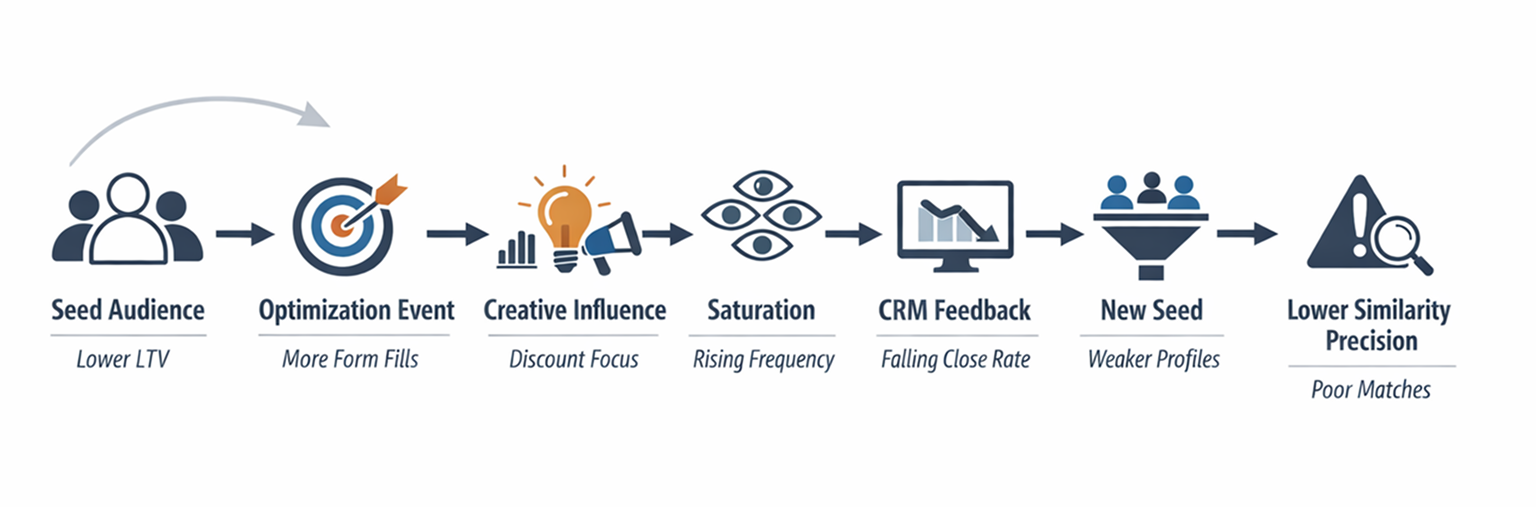
The Seed Audience Becomes Less Representative
Your Lookalike is only as strong as the source audience. If the seed shifts, the output shifts with it.
This often happens without anyone noticing. Many advertisers underestimate the importance of proper Lookalike audience seeding best practices .
Common seed deterioration patterns:
-
Sales teams lower qualification standards during slow months; weaker deals enter the CRM; those contacts later become part of the seed audience.
-
Lead forms collect broader audiences over time; early high-intent users mix with low-intent opt-ins.
-
Offline conversions are uploaded late; the model optimizes toward incomplete revenue signals.
When the seed no longer reflects your ideal customer, similarity loses meaning.
The Algorithm Finds Easier Conversions
Meta optimizes for the event you select. If that event is a low-friction action, the system finds users who complete it cheaply.
Over time, it exploits efficiency pockets inside the Lookalike pool.
How this plays out:
-
If you optimize for leads instead of qualified leads, the model prioritizes form fillers, not buyers.
-
If you optimize for purchases without value signals, it treats every sale equally, regardless of margin.
-
If your sales cycle is long, early-stage signals dominate optimization before revenue data arrives.
This is also why many teams struggle with why Lookalike Audiences underperform over time .
The algorithm does what you ask. It just does not protect your margins.
Audience Saturation Changes Behavior
Lookalike Audiences are finite. Even at 1 percent, the size is limited within each country.
Repeated exposure shifts response patterns.
As frequency climbs, high-intent users convert first. Remaining users require more persuasion and often convert with lower intent.
If you ignore this stage, you will likely face the same patterns explained in what to do when Lookalikes stop performing .
You may see stable cost per lead. Revenue quality drops instead.
Hidden Feedback Loops That Reduce Lead Quality
Performance decay is rarely caused by a single factor. It often results from feedback loops that compound over time.
Here are the most common ones.
Volume Pressure From the Sales Team
When revenue dips, teams push for more leads. Marketing increases budget and relaxes targeting constraints.
That decision changes the input signals.
More low-quality leads enter the CRM. The CRM becomes the future seed audience. The Lookalike recalibrates around weaker patterns.
Creative Drift
Ad creatives influence who clicks and converts. Subtle shifts in messaging attract different intent profiles.
Consider these scenarios:
-
Early creatives focus on pain points; later ones emphasize discounts; bargain seekers dominate new leads.
-
Educational ads attract informed buyers; generic hooks attract curiosity clicks.
-
Broad claims increase click-through rate; qualification language filters serious prospects.
Creative choices quietly reshape your Lookalike output.
Geographic and Market Expansion
Expanding to new countries often uses the same seed audience. Behavioral similarity does not equal economic similarity.
Income levels, purchasing power, and competition vary widely.
A 1 percent Lookalike in one region may contain buyers. In another, it contains browsers.
Platform-Level Factors You Cannot Ignore
Some shifts come from outside your account. They still affect lead quality.
Privacy changes limit signal depth. Attribution windows compress visible revenue data. Event prioritization narrows optimization inputs.
As signal quality declines, the model leans more on proxy behaviors. Proxy behaviors do not always correlate with sales.
How to Protect Lead Quality Over Time
Lookalikes are not set and forget assets. They require active management and diagnostic discipline.
Below are structured controls that reduce degradation.
1. Audit the Seed Audience Quarterly
Do not rely on default CRM exports.
Instead:
-
Filter by closed-won deals within the last 90 days; remove stalled or discounted contracts.
-
Exclude refunded customers and unprofitable segments; margin matters more than volume.
-
Segment high lifetime value buyers into separate seeds; build distinct Lookalikes.
For a deeper framework, review this guide on how to build profitable Facebook Lookalike Audiences .
Seed hygiene directly affects similarity modeling.
2. Optimize for Revenue-Linked Events
Lead events are easy for the system to scale. Revenue events protect quality.
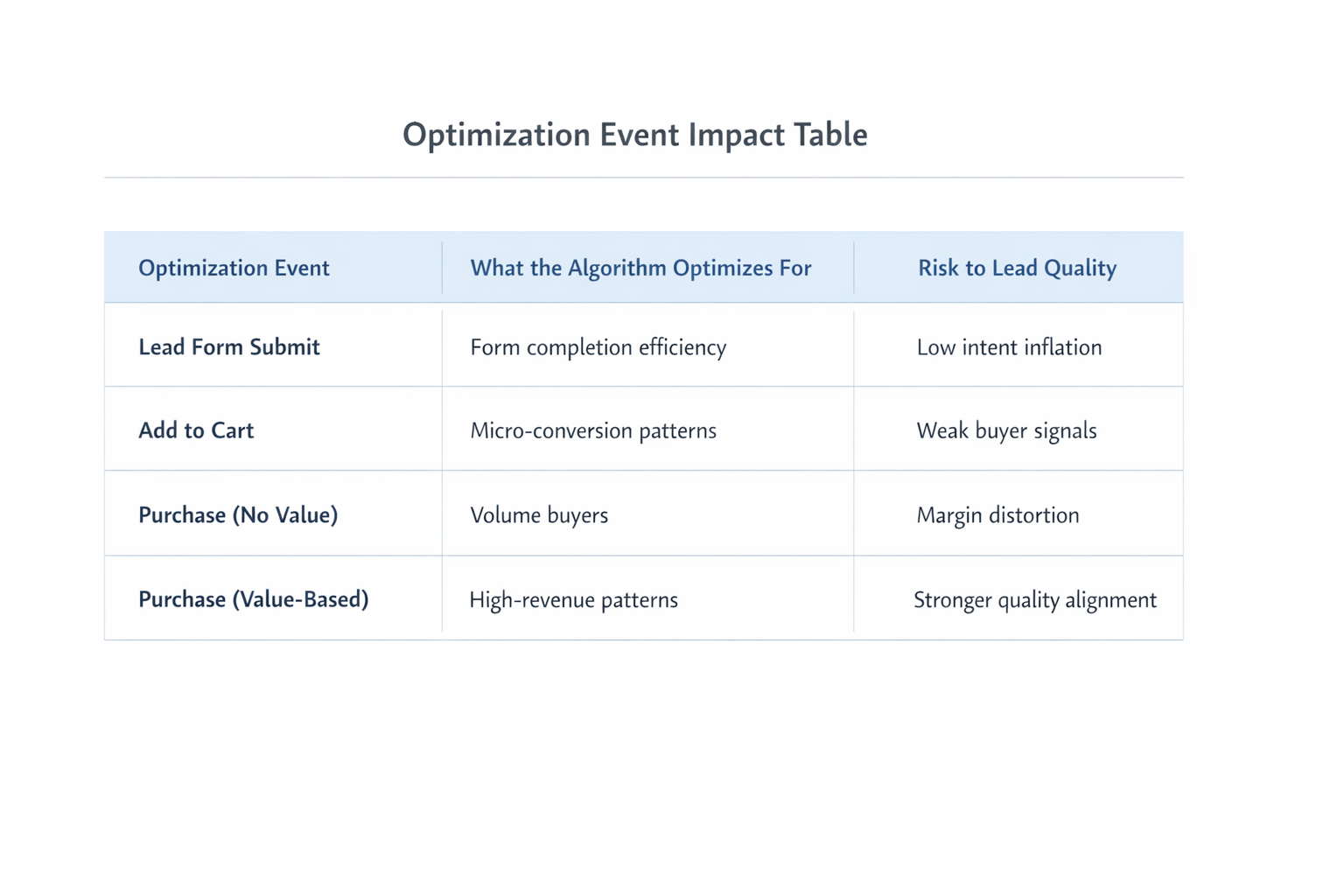
If full purchase data is delayed, upload offline conversions weekly. Assign real values instead of flat numbers.
When possible, use value-based Lookalikes. They bias the model toward higher revenue profiles.
3. Monitor Quality Ratios, Not Just CPL
Cost per lead can stay flat while qualification drops.
Track metrics such as:
-
Lead-to-opportunity rate; reveals early qualification strength.
-
Opportunity-to-close rate; reflects alignment between marketing promise and sales reality.
-
Average deal size by campaign; exposes subtle shifts in buyer intent.
These ratios surface decay before revenue collapses.
4. Control Frequency and Rotation
High frequency inside a Lookalike pool signals saturation. It often precedes quality decline.
Rotate creatives before fatigue distorts engagement patterns. Expand to adjacent percentage tiers cautiously, not reactively.
A move from 1 percent to 3 percent should follow revenue validation, not cost pressure.
When to Replace a Lookalike Entirely
Sometimes optimization is not enough. The audience structure itself becomes outdated.
Replace or rebuild when:
-
The original seed reflects a past product positioning.
-
Pricing strategy changed significantly.
-
Your target segment shifted from SMB to enterprise, or vice versa.
In these cases, similarity modeling optimizes around the wrong identity.
The Core Principle
Lookalike Audiences do not lose quality randomly. They reflect the signals, incentives, and constraints inside your system.
When lead quality drops, treat it as diagnostic data. The model is revealing a mismatch between optimization logic and business reality.
Fix the inputs. The outputs will follow.