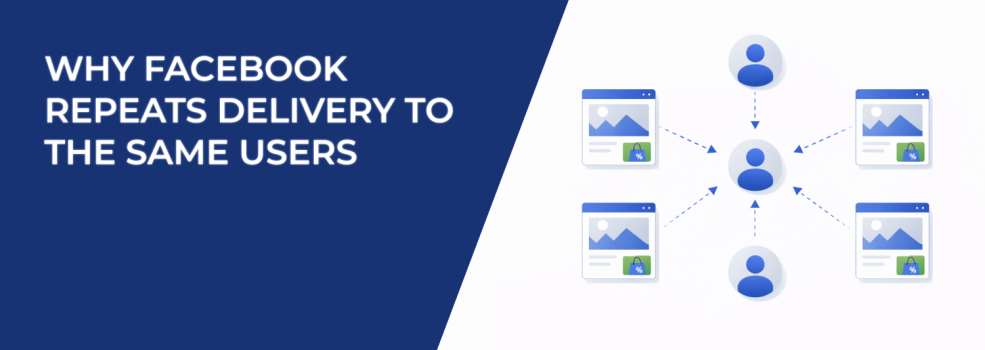
If your Facebook campaign keeps reaching the same users over and over, it usually shows up in the numbers before anything else. Frequency climbs quickly, performance plateaus, and the campaign stops producing new leads or conversions.
Many advertisers interpret this as a targeting problem. They assume Facebook has “run out” of people or that the audience size is too small.
In reality, repeated delivery is rarely caused by a single setting. It is usually the result of several structural signals that push the delivery algorithm to concentrate impressions within a narrow group.
Understanding why this happens helps you diagnose the issue properly and fix the structure behind the campaign rather than reacting with random audience expansion.
Why Facebook Repeats Delivery to the Same Users
Facebook’s delivery system is designed to optimize toward outcomes, not to distribute impressions evenly across an audience.
When the algorithm detects a group of users who are more likely to convert, it tends to prioritize them heavily. Over time, this concentration can become extreme if the campaign structure does not provide enough alternative signals.
Several mechanisms usually drive this behavior.
1. The Algorithm Finds a High-Probability Pocket
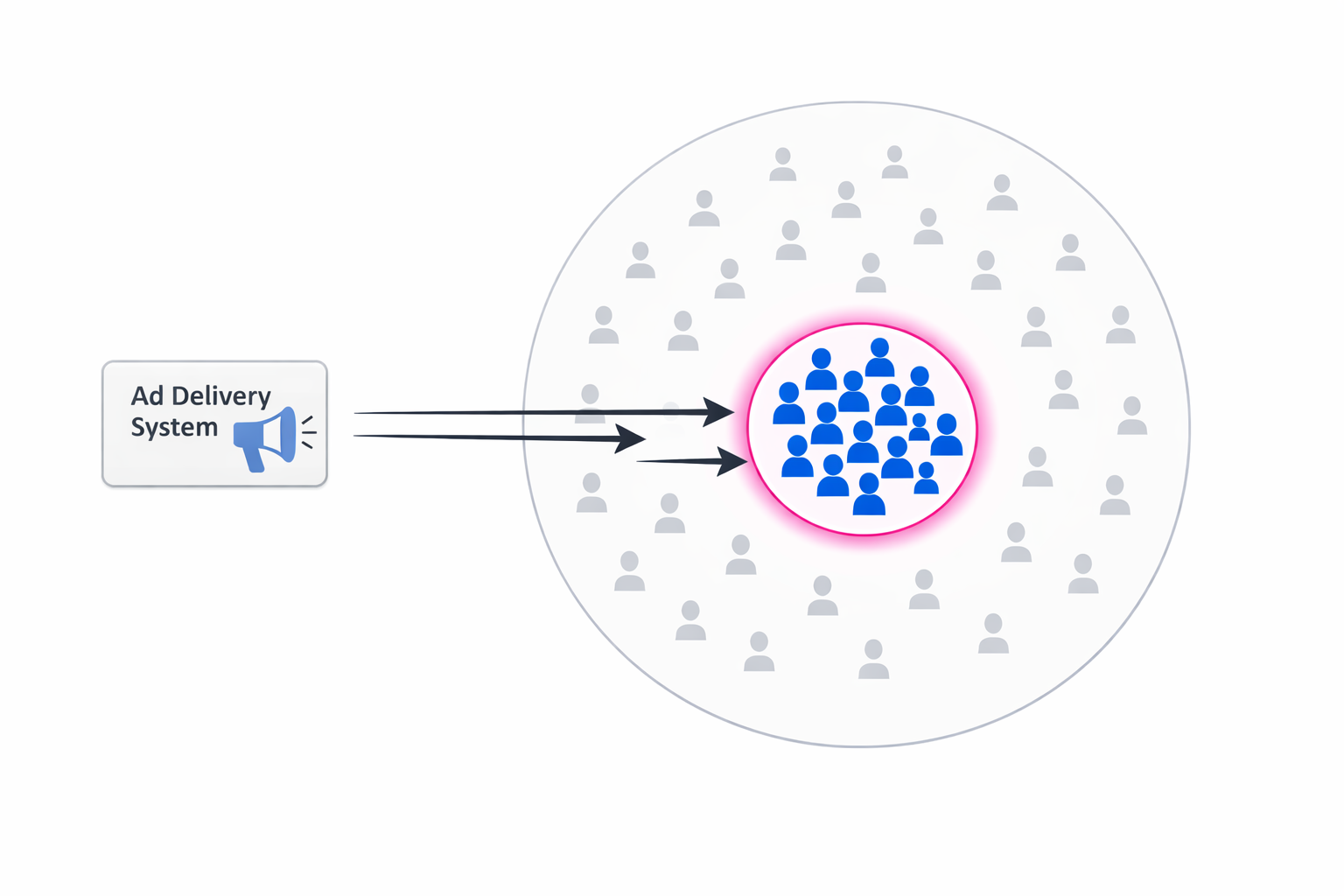
In the early phase of delivery, Facebook tests different segments of your potential audience. Once it finds users who respond positively, it begins allocating a larger share of impressions to them.
This concentration happens because the system is trying to minimize the cost of the optimization event.
For example:
-
A small subset of users clicks and converts quickly.
When Facebook detects a strong signal from a group of users, it increases delivery toward them because they provide predictable outcomes. -
Other segments show weaker engagement.
If other parts of the audience produce fewer conversions, the system deprioritizes them and keeps returning to the higher-performing pocket. -
The campaign continues reinforcing the same signal.
As more conversions come from the same group, the algorithm becomes increasingly confident that this is the safest delivery path.
From the advertiser’s perspective, this looks like the campaign “showing ads to the same people.” From the algorithm’s perspective, it is simply following the strongest probability signal available.
2. The Effective Audience Is Smaller Than It Appears
Many advertisers assume their campaign has access to millions of people because the potential reach number is large.
However, the effective audience that Facebook actually considers viable for the objective can be much smaller.
Several structural factors shrink the real delivery pool:
-
Highly specific interests or stacked targeting layers.
Combining multiple narrow interests or behaviors can dramatically reduce the segment that Facebook considers relevant. -
Strong demographic filters.
Adding age restrictions, income categories, or location filters can remove large portions of the reachable population. -
Optimization toward rare events.
When optimizing for a low-frequency event like a purchase or qualified lead, Facebook tends to focus on users who have historically triggered that event type.
This is one of the reasons many advertisers struggle when working with very narrow targeting. If you have ever wondered what happens when an audience becomes too constrained, it is worth reviewing the mechanics behind Facebook Ads audience too narrow: how to troubleshoot a limited audience.
For example, a theoretical audience of 3 million people may effectively behave like a 200,000-person pool once optimization filters are applied.
When the campaign budget is large relative to this effective audience, repeated exposure becomes inevitable.
3. Budget Pressure Forces Impression Concentration
Budget size also plays a major role in repeated delivery.
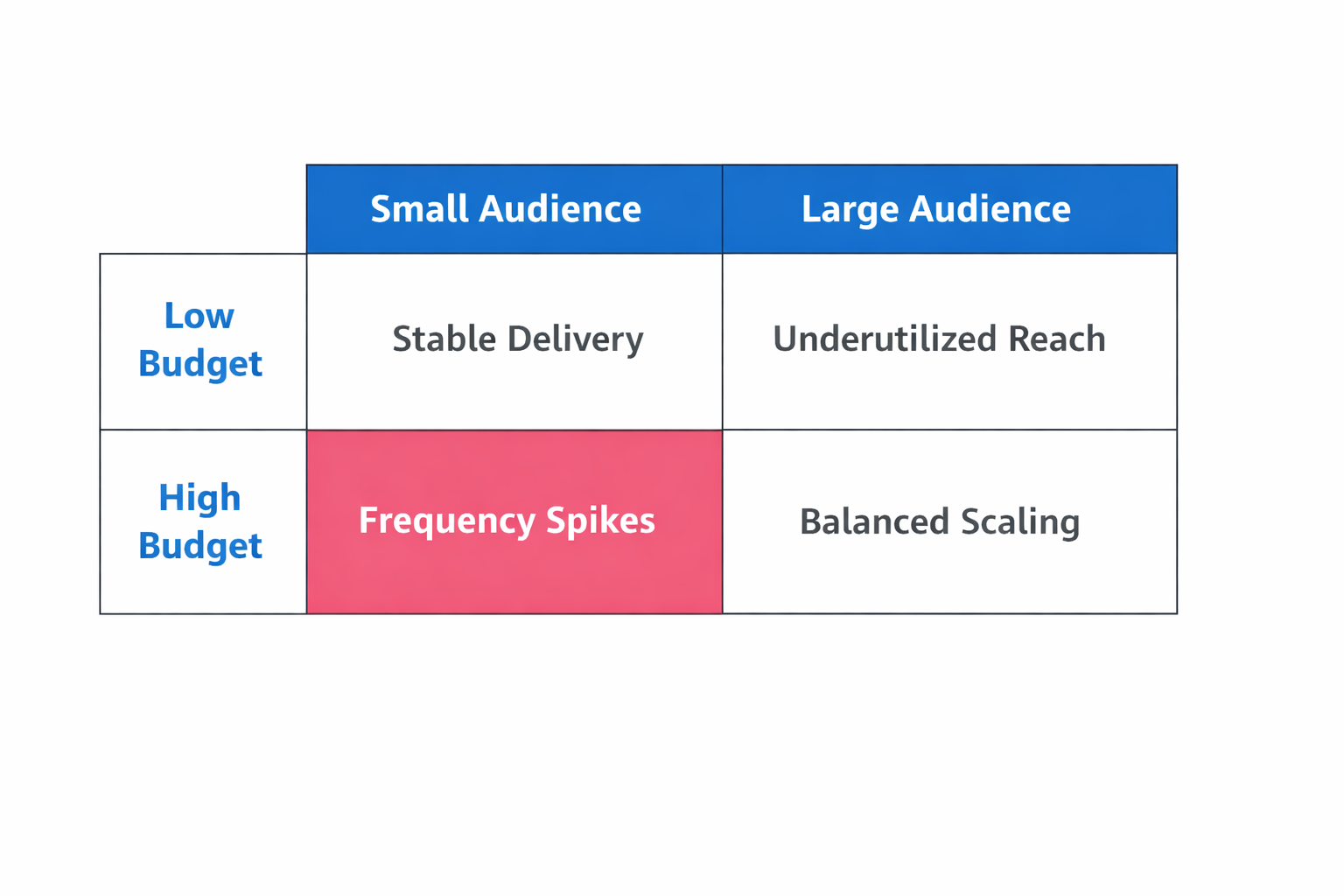
Facebook must spend the budget you assign to the campaign. If the available audience signals are limited, the platform increases frequency within the most responsive users rather than expanding aggressively into lower-probability segments.
This often happens when:
-
The daily budget is high relative to the audience size.
A campaign targeting a few hundred thousand users with a large budget will naturally cycle through the same people more often. -
The optimization event is difficult to achieve.
When Facebook struggles to find conversions, it repeatedly targets users who have previously shown intent. -
The campaign has already saturated the highest-quality segment.
Once the best users have seen the ad several times, the algorithm keeps returning to them because the alternative options perform even worse.
This dynamic explains why increasing budget without expanding signal diversity often leads to higher frequency rather than broader reach. A deeper breakdown of cost dynamics can also be found in what influences CPM on Facebook Ads and how to keep it low.
4. Limited Creative Variety Reinforces Repetition
Creative diversity also influences how widely Facebook distributes ads.
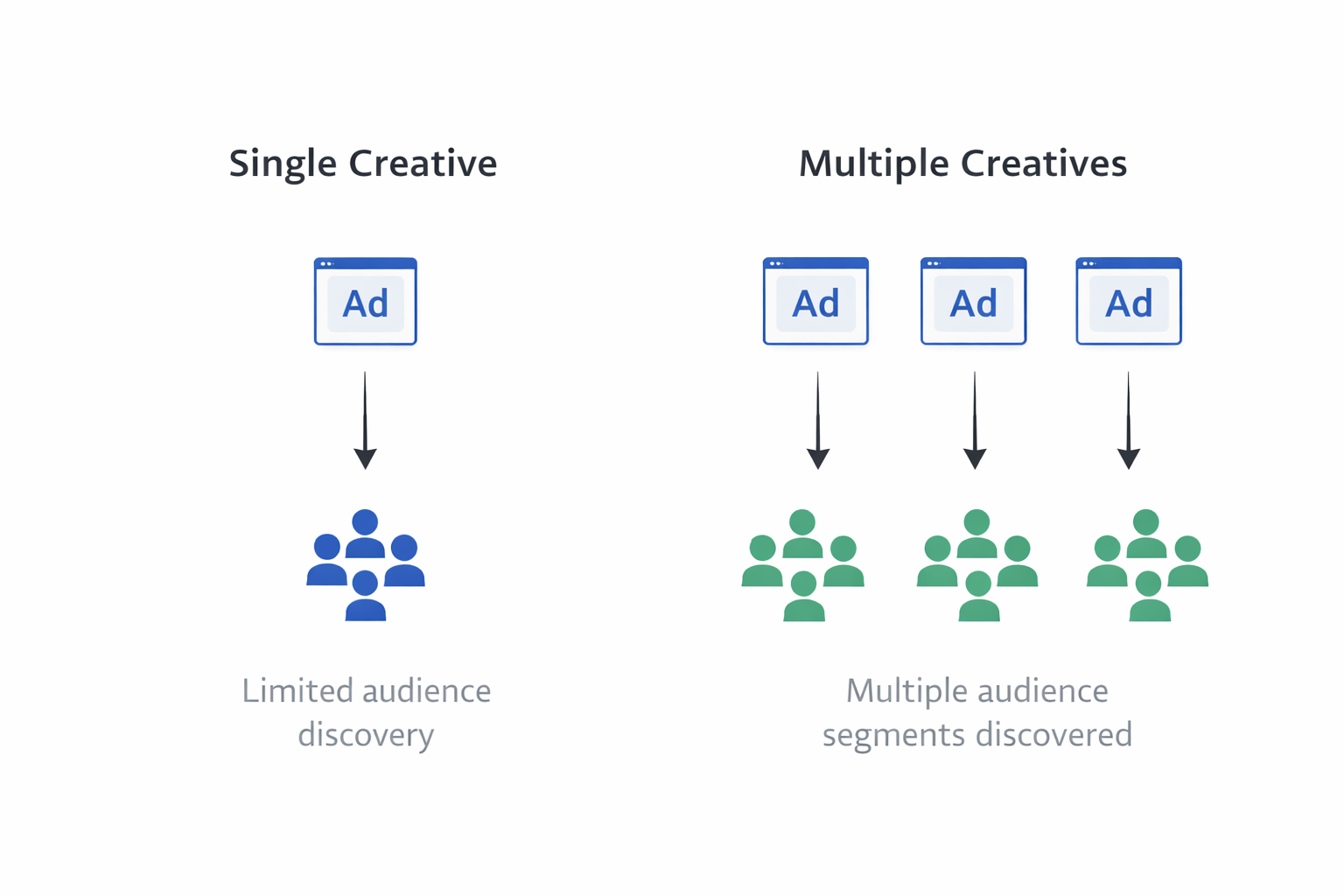
If a campaign runs only one or two similar creatives, the system has fewer opportunities to test different messaging angles across different segments.
This can lead to a feedback loop:
-
A single creative resonates with one specific audience segment.
The algorithm pushes impressions toward the group that responds best. -
Other segments receive fewer tests.
Without new creatives that appeal to different motivations, Facebook lacks the signal needed to expand delivery. -
Frequency climbs within the same group.
Because the campaign keeps reinforcing the same engagement pattern, delivery remains concentrated.
Over time, the same people see the ad repeatedly while other parts of the audience remain underexposed. This effect is closely related to ad fatigue, which is explained in more detail in how to avoid ad fatigue and keep optimal ads conversion rate.
How to Diagnose If This Is Happening in Your Campaign
Before changing targeting or budget, it helps to confirm whether delivery concentration is actually the issue.
Several signals inside Ads Manager typically indicate this pattern.
Rapid Frequency Growth
A frequency curve that rises quickly during the first few days often indicates that the algorithm has locked onto a small high-probability segment.
For example:
-
Frequency reaching 3–4 within the first week.
This often suggests the campaign is recycling impressions inside a narrow group of users. -
Performance declining as frequency rises.
When engagement or conversions drop while frequency increases, the core segment may already be saturated.
Monitoring frequency trends across multiple campaigns can reveal whether this pattern is structural or campaign-specific.
Stable CTR but Falling Conversion Rate
When the same users keep seeing the ad, click-through rates may remain stable while conversion rates decline.
This pattern often appears because:
-
Users who already clicked but did not convert continue seeing the ad.
-
Additional impressions reach people who are curious but not strongly motivated.
The result is a campaign that continues generating clicks but produces fewer meaningful outcomes. If you are evaluating this type of behavior, it helps to understand how different performance signals interact, which is explained in how to analyze Facebook ad performance beyond CTR and CPC.
How to Reduce Repeated Delivery
Once you confirm that the campaign is over-concentrating impressions, the solution is rarely a single adjustment. Most of the time, improving signal diversity and campaign structure produces better results.
Several changes can help broaden delivery.
Expand Signal Diversity
Instead of simply widening the audience size, focus on increasing the number of signals Facebook can test.
For example:
-
Introduce multiple creatives with different value propositions.
Each creative can attract slightly different segments, giving the algorithm more opportunities to explore. -
Test alternative messaging angles.
A creative focused on cost savings may attract a different audience than one focused on productivity or convenience. -
Use varied visual formats.
Video, static images, and carousel ads often engage different user behaviors.
This approach encourages the algorithm to discover additional conversion pockets rather than repeatedly targeting the same one.
Adjust Budget Relative to Audience Size
If frequency rises too quickly, budget pressure may be forcing the algorithm to recycle impressions.
Possible adjustments include:
-
Reducing daily budget temporarily.
Lower spend gives the algorithm more time to explore new segments before saturating the initial audience. -
Expanding the targeting pool strategically.
Broadening geographic regions or removing restrictive filters can introduce new potential users without abandoning relevance. -
Segmenting campaigns by audience intent.
Separate campaigns for cold, warm, and retargeting audiences can prevent one campaign from absorbing all delivery.
These changes help align budget with the realistic size of the effective audience.
Refresh Creative Before Saturation
Creative fatigue accelerates repeated delivery because the algorithm continues showing the same message to users who already saw it.
To avoid this:
-
Rotate new creatives regularly.
Fresh ads allow Facebook to re-test segments that previously ignored the campaign. -
Introduce new angles instead of minor visual tweaks.
Changing the core message usually produces stronger exploration signals. -
Monitor frequency alongside engagement metrics.
Rising frequency combined with declining engagement often signals that the creative is losing impact.
Creative renewal gives the algorithm new signals and reduces reliance on the same group of users.
A More Useful Way to Think About Frequency
High frequency is not automatically a problem. In some campaigns — especially retargeting — repeated exposure is expected and often necessary.
The issue arises when high frequency appears before the campaign has meaningfully explored the available audience.
When that happens, it usually indicates a structural imbalance:
-
The effective audience is smaller than assumed.
-
The budget is too aggressive for the available signals.
-
Creative diversity is insufficient for exploration.
Correcting these structural factors helps the algorithm distribute impressions more intelligently and prevents campaigns from becoming trapped in a small delivery pocket.