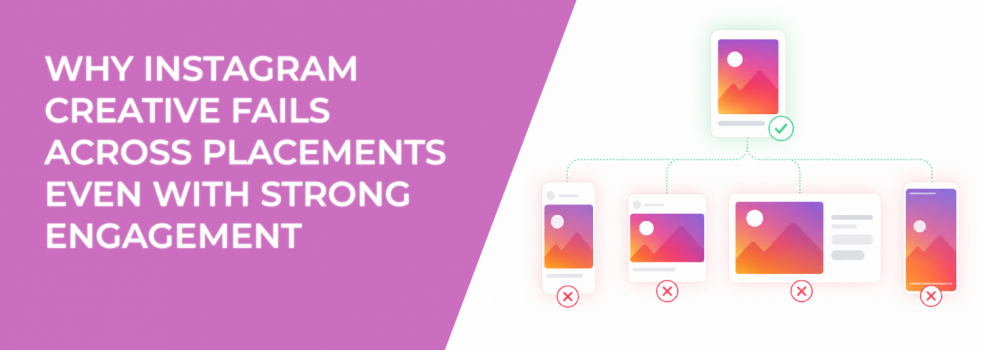
A creative can perform well in Instagram Feed and still fail completely inside Stories or Reels.
Many advertisers interpret strong engagement as proof that the creative is universally effective. Then the campaign expands placements, CPM rises, Story CTR weakens, Reels retention drops, and conversion quality becomes inconsistent.
The problem usually starts with placement behavior.
Instagram users interact differently with Feed, Stories, Reels, and Explore. A creative built for one environment often loses efficiency in another.
Problem: The same Instagram creative faces different attention conditions across placements
Feed users slow down selectively.
Story users move quickly and tap aggressively. Reels users expect constant motion and immediate stimulation. Explore users browse with weaker context and lower intent stability.
The same asset enters completely different consumption environments.
A static Feed creative with layered product details may generate strong saves because users pause naturally while scrolling. That same creative often underperforms in Stories because the message arrives too slowly before the next tap.
This becomes more obvious when advertisers use automated placements without restructuring the creative first. Many brands running Instagram Feed vs Story ads discover that the same asset produces completely different engagement depth depending on placement behavior.
Inside Ads Manager, the pattern usually looks like this:
- Feed engagement remains healthy.
- Story CTR declines after placement expansion.
- Reels watch retention collapses within the first seconds.
- CPM increases while conversion rate becomes unstable.
- One placement absorbs spend without producing downstream results.
Advertisers often label this “creative fatigue” even though the creative simply does not match the placement structure.
So, what to do?
1. Build placement-specific creative behavior instead of resizing assets
Most advertisers adapt placements incorrectly.
They resize the same asset vertically and expect performance consistency. Instagram placements do not reward the same creative mechanics.
Each placement prioritizes different engagement behaviors:
- Feed rewards visual clarity and slower information layering.
- Stories reward immediate communication inside the first second.
- Reels reward motion pacing, rapid scene changes, and visual interruption.
- Explore rewards visually distinctive hooks that separate from surrounding content.
A Feed creative relying on small text overlays or gradual explanation often collapses in Stories because users navigate too quickly.
The same issue appears when Feed-style creatives move into Reels. Static framing, slow cuts, and product-heavy visuals struggle against native short-form content designed for constant motion.
This is why advertisers need to adapt one ad concept for Reels, Stories, Feed, and Explore instead of treating placement expansion as a formatting task.
2. Analyze placement-level performance instead of blended engagement
Blended engagement often hides placement failures.
A campaign can appear stable overall while one placement quietly damages efficiency.
This happens frequently when Feed drives engagement volume while Stories or Reels absorb inefficient delivery.
Before scaling creatives across placements, review placement-specific signals:
- Story exit and tap-forward rates.
- Reels retention curves after the first seconds.
- CPM variation by placement.
- Placement-level CTR differences.
- Conversion rate by placement group.
These metrics reveal whether the creative survives outside its original environment.
For example, a product-focused Feed post may maintain strong engagement while Reels performance collapses because the pacing feels too slow for short-form consumption patterns.
This becomes easier to diagnose when advertisers understand Instagram navigation patterns and how users consume content differently across placements.
The advertiser sees “strong engagement” at campaign level while Meta continues allocating spend inefficiently across placements.
Final takeaway
Instagram creative does not fail equally across placements.
Feed, Stories, Reels, and Explore operate under different navigation speeds, attention patterns, and engagement behaviors. A creative built for one environment often loses efficiency when expanded without structural adaptation.
Strong engagement in one placement does not guarantee scalable performance across the rest of Instagram.