
Many Meta campaigns perform well during the first few days, then suddenly slow down or stop delivering impressions. Spend drops, reach declines, and results become inconsistent even though nothing obvious has changed.
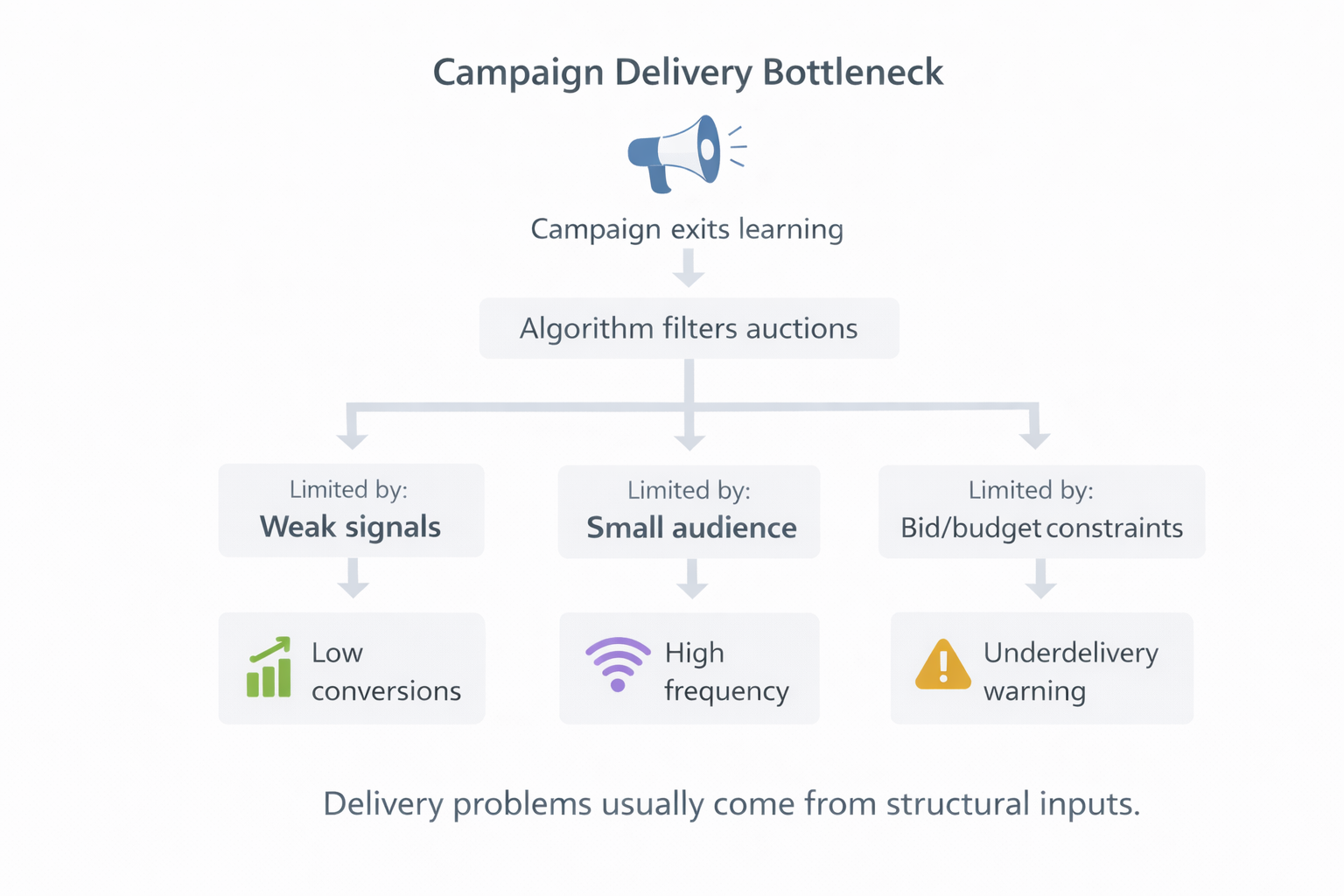
This pattern is often blamed on “algorithm instability,” but the real causes are usually structural. When a campaign exits the learning phase, Meta’s delivery system becomes far more selective about where it spends budget. If the campaign lacks enough conversion signals, audience breadth, or auction competitiveness, delivery begins to stall.
Understanding what changes after the learning phase helps explain why this happens.
What the Learning Phase Actually Does
During the learning phase, Meta aggressively explores the auction to collect performance data.
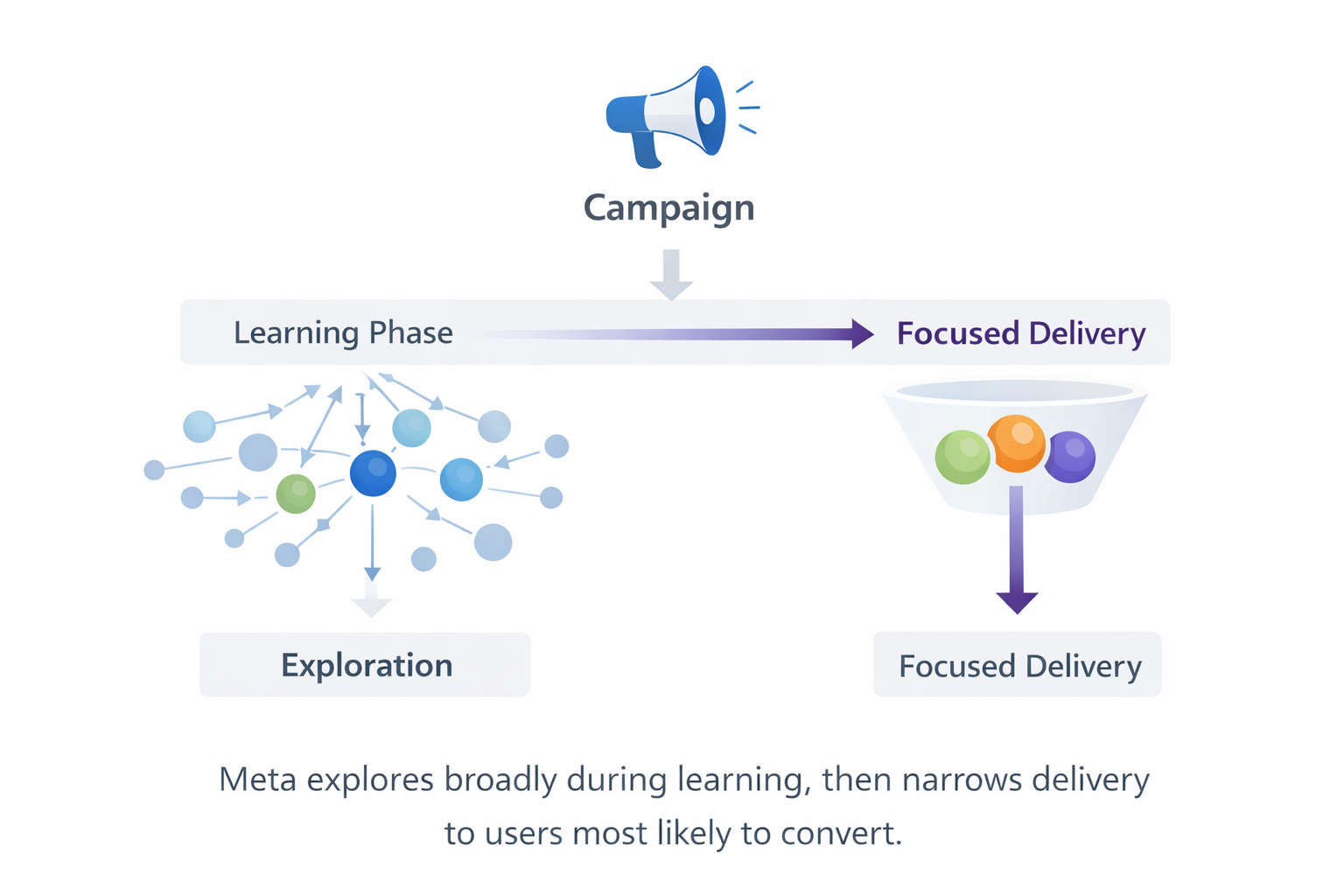
The platform tests different combinations of:
-
audience segments
-
placements
-
bidding opportunities
-
time-of-day delivery patterns.
At this stage, Meta tolerates higher volatility in performance because it is still mapping which user behaviors correlate with conversions.
You can often see this exploration inside Ads Manager:
-
spend distribution fluctuates hourly;
-
CPM varies widely across placements;
-
early conversions come from unexpected audience clusters.
Once roughly 50 optimization events occur within a week, the system begins narrowing delivery toward the patterns that appear most profitable.
If you want a deeper explanation of how campaigns exit this stage and stabilize, see this guide on how to finish the Facebook learning phase quickly.
This transition is where many campaigns start to lose momentum.
Why Delivery Often Drops After the Learning Phase
Once the learning phase ends, Meta becomes far more selective about which auctions it enters. Instead of exploring broadly, the system focuses on impressions where the predicted probability of conversion is highest.
If the model cannot identify strong conversion patterns, the pool of confident bidding opportunities quickly shrinks. In Ads Manager this often appears as:
-
declining impressions;
-
unspent budget;
-
unstable cost per result;
-
delivery concentrating in small audience pockets.
This does not mean the campaign stopped working. It means the algorithm cannot confidently predict who will convert.
Weak Signals and Fragmented Data
The most common cause of stalled delivery is weak conversion signals. Meta’s optimization system relies on repeated behavioral patterns, and when conversion volume is low the algorithm struggles to identify reliable user clusters.
Typical causes include:
-
Low event volume — too few purchases or leads to form reliable patterns.
-
Fragmented campaign structure — splitting budgets across many ad sets divides learning signals.
-
Incomplete tracking — missing pixel or CAPI events distort conversion data.
During the learning phase Meta still explores broadly. Once delivery becomes selective, these signal weaknesses become visible.
Structural Limits That Restrict Delivery
Delivery can also stall when the campaign reaches structural limits.
Small or saturated audiences.
If targeting is narrow, the algorithm quickly reaches users most likely to convert. After that, frequency rises, CTR declines, and delivery slows.
Budget or bid constraints.
If cost caps, budgets, or bid strategies are too restrictive, Meta may skip auctions entirely. This often appears as under-delivery warnings or partially spent budgets.
Creative Fatigue Can Narrow Delivery
Creative performance also affects how widely Meta distributes ads.
During early learning, the system tests the ad against many behavioral clusters. If engagement signals begin declining, Meta becomes more conservative about showing the ad to new users.
Early signs of fatigue include:
-
falling CTR;
-
rising CPM;
-
declining outbound clicks.
When these signals persist, Meta predicts lower engagement and reduces the number of auctions where the ad is competitive.
This process is closely related to ad fatigue on Facebook and how to spot it early.
In practice, this looks like the campaign gradually “running out of room” to scale.
Structural Fixes That Restore Delivery
When delivery slows after learning, the solution usually involves strengthening the campaign’s data and auction competitiveness.
Several structural adjustments often help.
Consolidate Data Signals
Reduce unnecessary ad set fragmentation so conversion events accumulate faster.
For example:
-
merge overlapping audiences;
-
move multiple ad sets into one broader targeting group;
-
concentrate budget into fewer learning systems.
More conversions in a single optimization pool improves the model’s confidence.
Expand Audience Reach
If frequency climbs quickly, the campaign likely exhausted its highest-intent users.
Expansion methods include:
-
broader interest stacks;
-
lookalike audiences with larger percentages;
-
Advantage+ audience expansion.
The goal is to introduce new behavioral clusters the algorithm can test.
Improve Signal Quality
Tracking problems quietly damage delivery.
Check whether:
-
purchase events fire consistently;
-
conversion API events match pixel events;
-
attribution windows capture delayed conversions.
When the system receives clearer signals, delivery often stabilizes.
Refresh Creative Assets
New creatives restore engagement signals and allow the algorithm to test different user groups.
Small variations are often enough:
-
different opening visual;
-
new hook or product angle;
-
alternate format such as video instead of static.
Even minor creative shifts can reopen auction opportunities.
The Key Takeaway
Campaigns rarely stop delivering because Meta’s algorithm fails.
More often, the learning phase temporarily masks structural weaknesses: low conversion volume, narrow audiences, weak signals, or restrictive bidding conditions.
Once the system exits exploration mode, those limitations become visible.
When delivery slows after learning, the correct response is not to restart the campaign or force a new learning phase. Instead, strengthen the inputs the algorithm relies on: clearer signals, broader audiences, and sufficient conversion data.
When those conditions are present, Meta’s delivery system usually recovers quickly.
