Marketing teams often build campaign structures that grow more complicated over time. As audiences multiply across channels, segments, and automation workflows, the logic behind targeting becomes harder to track.
Why Audience Logic Audits Matter
Modern marketing automation systems allow dozens or even hundreds of audience segments to operate simultaneously. Over time, campaign structures evolve through quick fixes, duplicated segments, and layered conditions.
According to marketing automation benchmarks, nearly 42% of marketing teams report that segment overlap and outdated targeting rules reduce campaign performance. Additionally, internal audits in enterprise marketing stacks frequently reveal that up to 30% of audience rules contain redundant or conflicting logic.
When audience logic becomes overly complex, it can lead to:
-
Incorrect targeting
-
Duplicate messaging
-
Inflated advertising costs
-
Inaccurate reporting
-
Reduced campaign ROI
Conducting regular audits helps marketing teams regain control over their campaign structures and maintain reliable segmentation.
Step 1: Map the Entire Campaign Architecture
Before auditing audience logic, document the full campaign structure. This includes:
-
All active campaigns
-
Audience segments
-
Trigger conditions
-
Exclusion rules
-
Automation workflows
Creating a visual map of campaign architecture allows teams to quickly identify overlapping or nested audience conditions.
Research from marketing operations teams shows that organizations using visual campaign mapping reduce segmentation errors by up to 35%.
During this step, identify:
-
Campaigns using the same audience rules
-
Segments created from duplicated logic
-
Conditions referencing outdated attributes
Step 2: Identify Redundant Segments
As campaigns scale, marketers often create new segments instead of reusing existing ones. This leads to duplicated targeting logic.
Common examples include:
-
Multiple segments targeting the same job titles
-
Geographic filters repeated across campaigns
-
Similar behavioral triggers with slight variations
Redundant segments increase maintenance complexity and raise the risk of inconsistent targeting.
Industry studies show that large B2B marketing teams maintain an average of 2.7 duplicate segments for every core audience definition.
When auditing segments:
-
Compare rule sets across segments
-
Merge segments with identical logic
-
Consolidate reusable audiences
Centralizing audience definitions improves consistency and simplifies future campaign management.
Step 3: Review Inclusion and Exclusion Conflicts
Audience logic often becomes inconsistent when inclusion and exclusion rules are layered across multiple campaigns.
For example, a campaign may include "Marketing Managers in SaaS companies" while another automation excludes "All marketing leaders" from certain workflows.
Conflicts like this can cause contacts to enter and exit campaigns repeatedly or miss critical communications.
A useful audit technique is building a rule conflict matrix that shows where segments overlap or contradict each other.
Key questions to ask during this stage:
-
Are exclusion rules overriding important segments?
-
Are contacts eligible for multiple campaigns simultaneously?
-
Do priority campaigns have clear suppression rules?
Eliminating logic conflicts improves targeting accuracy and customer experience.
Step 4: Evaluate Data Field Dependencies
Audience segments often depend on CRM or enrichment data fields. If these fields are incomplete or inconsistently populated, segmentation accuracy declines.
Data quality reports indicate that B2B databases lose around 22% of data accuracy each year due to company changes, role shifts, and outdated records.
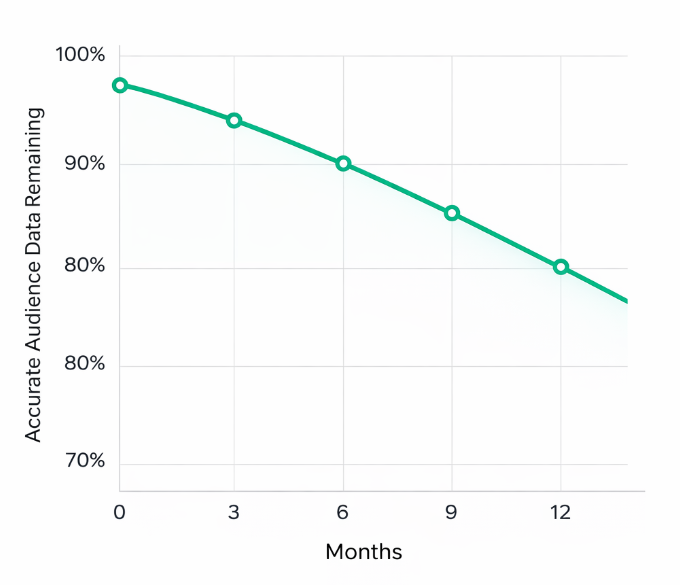
B2B contact data declines by roughly 2.1% each month, gradually reducing segmentation accuracy
When auditing audience logic, review:
-
Fields used in segmentation rules
-
Data completeness rates
-
Field standardization
Segments based on unreliable fields should be redesigned or supported with additional enrichment data.
Step 5: Test Audience Output
After reviewing rules and dependencies, validate the actual contacts entering each audience.
Testing methods include:
-
Running sample audience previews
-
Exporting contact lists for verification
-
Comparing audience sizes across similar segments
Unexpected spikes or drops in audience size often indicate hidden logic problems.
According to marketing operations benchmarks, audience testing during audits can uncover targeting errors in approximately 18–25% of segments.
Step 6: Implement Ongoing Governance
Audience audits should not be one‑time exercises. As campaign complexity grows, ongoing governance becomes essential.
Recommended governance practices include:
-
Maintaining a centralized audience library
-
Documenting segmentation rules
-
Assigning ownership for major segments
-
Conducting quarterly logic audits
Teams that implement structured segmentation governance report significantly lower campaign maintenance time and improved targeting accuracy.
Final Thoughts
Complex campaign structures can deliver powerful marketing results, but only when audience logic remains transparent and well maintained.
Regular audits help identify redundant segments, resolve rule conflicts, and ensure segmentation aligns with current data quality.
By mapping campaign architecture, reviewing segmentation rules, validating data dependencies, and implementing governance processes, marketing teams can maintain scalable and reliable targeting systems.
Continue Reading
If you want to explore more topics related to campaign targeting and audience management, consider reading: