Marketers often assume that interest naturally leads to clicks. In reality, the majority of online ads fail to convert attention into action—even when the audience finds the message relevant. Click-through rates remain low across industries, not because advertising is broken, but because user behavior has fundamentally changed.
Understanding why people don’t click ads is essential for designing strategies that work beyond surface-level metrics.
1. Banner Blindness Is Now the Default
The human brain is highly efficient at filtering out anything that looks like advertising. This phenomenon, known as banner blindness, causes users to subconsciously ignore ads—especially those placed in predictable locations.
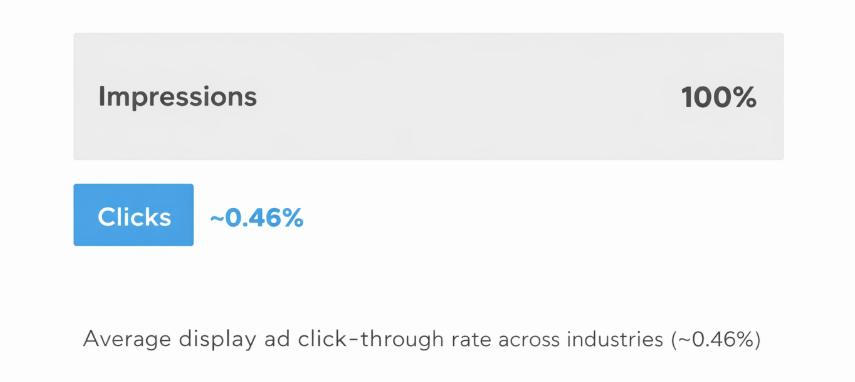
Average display ad click-through rate across industries (~0.46%)
Useful data points:
-
Average display ad click-through rates are around 0.35%, according to aggregated industry benchmarks.
-
Eye-tracking studies show that users often avoid areas of a page that resemble ad placements, even when the content is relevant.
The result: users may register the message peripherally, but clicking feels unnecessary or even intrusive.
2. Clicking Feels Risky or Costly
Clicking an ad represents a commitment. Users associate ad clicks with:
-
Being redirected away from their current task
-
Slow-loading pages or poor mobile experiences
-
Aggressive sales funnels or unwanted follow-ups
Research indicates that more than 60% of users prefer to research a product independently rather than click an ad, even if the ad sparked their interest. Many choose to open a new tab, search the brand directly, or return later—actions that never show up in click metrics.
3. Ads Compete With the User’s Intent, Not Attention
Most ads interrupt rather than align with user intent. Even a highly relevant offer can fail if it appears at the wrong moment.
For example:
-
A user researching a problem may notice a solution-focused ad but isn’t ready to evaluate vendors yet.
-
A decision-maker may recognize brand value but prefer peer reviews or long-form content before engaging.
This explains why view-through conversions and assisted conversions are often significantly higher than last-click attribution suggests. Some studies estimate that up to 70% of ad-driven influence happens without a direct click.
4. Trust Is Built Outside the Ad Unit
Ads rarely provide enough information to establish trust. Users often separate “ads” from “credible information,” regardless of how accurate or useful the message is.
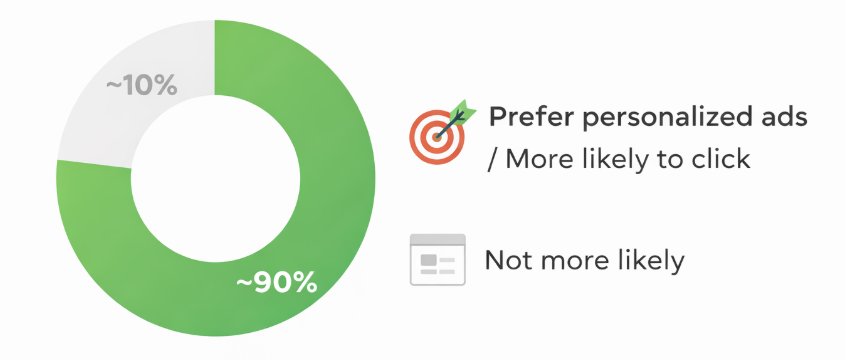
Percentage of consumers who say they’re more likely to click ads when they are personalized (~90%)
Notable insight:
-
Surveys consistently show that editorial content, expert articles, and peer recommendations are trusted 2–3 times more than paid advertising.
As a result, users may remember the brand or offer but choose to validate it elsewhere before taking action.
5. The Click Is No Longer the Primary Signal of Success
Modern digital behavior is multi-touch and non-linear. Users move between devices, platforms, and content types before converting.
Key implications:
-
Low click-through rates do not necessarily mean low impact
-
Brand recall, search lift, and downstream conversions often matter more than immediate clicks
-
Over-optimizing for CTR can lead to misleading creative choices that hurt long-term performance
In many campaigns, the real value of ads lies in shaping perception and demand—not driving instant action.
What This Means for Marketers
If most interested users don’t click, then success must be measured differently. Effective strategies focus on:
-
Message consistency across channels
-
Post-ad experiences that users choose to engage with
-
Metrics that account for delayed and indirect conversions
Rather than forcing clicks, high-performing teams design campaigns that support how people actually make decisions.
Recommended Reading
If you want to go deeper into modern demand and performance strategies, these articles may also be useful:
-
How View-Through Conversions Reveal Real Ad Impact
-
Why Attribution Models Often Undervalue Upper-Funnel Campaigns
-
Demand Generation vs Lead Generation: Key Differences Explained
Conclusion
People don’t avoid clicking ads because they aren’t interested. They avoid clicking because they are cautious, distracted, and selective—and because they have more control over how they gather information than ever before.
Understanding this gap between interest and action allows marketers to move beyond outdated assumptions and design systems that influence decisions even when no click occurs.