
Over the past few years, privacy has moved from a compliance checkbox to a core architectural principle of digital platforms. Apple’s App Tracking Transparency (ATT), the deprecation of third-party cookies, and tighter regulatory frameworks such as GDPR and CCPA have collectively reduced the availability of user-level data.
Meta has publicly reported that signal loss from ATT alone impacted ad revenue by an estimated $10 billion in a single year. At the same time, consumer sentiment reflects the shift: more than 70% of users globally say online privacy is a major concern, and a majority actively limit tracking where possible.
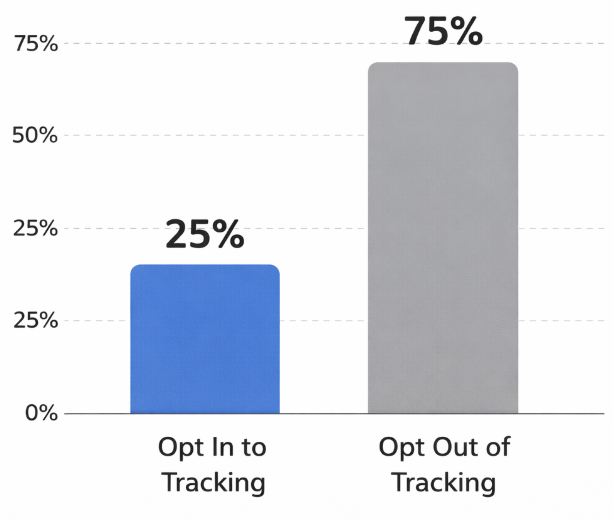
Percentage of users choosing to opt out of cross-app tracking under iOS ATT shows the scale of signal loss for advertisers
For advertisers, this means fewer deterministic signals, less granular attribution, and delayed or modeled conversion data. Optimization has not disappeared—it has changed shape.
What Optimization Means Now
In a privacy-first era, optimization is no longer about micro-targeting individual users. Instead, it focuses on:
-
Aggregated data over individual-level tracking
-
Statistical learning over deterministic attribution
-
Creative and offer performance over audience hacks
Meta’s ad delivery system increasingly relies on machine learning models trained on broad conversion patterns. Advertisers who align with this reality tend to outperform those who attempt to replicate pre-privacy tactics.
Rethinking Measurement and Attribution
Traditional last-click attribution is becoming less reliable. Conversion windows are shorter, reporting is delayed, and some events are modeled rather than directly observed.
Key data points illustrate the shift:
-
Modeled conversions can account for 20–40% of reported results in privacy-restricted environments
-
Platform-reported ROAS often diverges from analytics tools by 15–30%
-
Campaigns optimized on higher-funnel events can outperform bottom-funnel-only optimization by up to 25% in long-term value
A modern measurement stack prioritizes directional accuracy and trend analysis over exact point precision. Incrementality testing, geo-based experiments, and blended performance metrics are increasingly important.
Leveraging First-Party Data Responsibly
As third-party signals fade, first-party data becomes more valuable—but also more sensitive. The goal is not to collect more data, but to activate it effectively and compliantly.
Best practices include:
-
Using server-side tracking to reduce data loss
-
Passing high-quality conversion events rather than excessive parameters
-
Aligning CRM events with ad platform conversion schemas
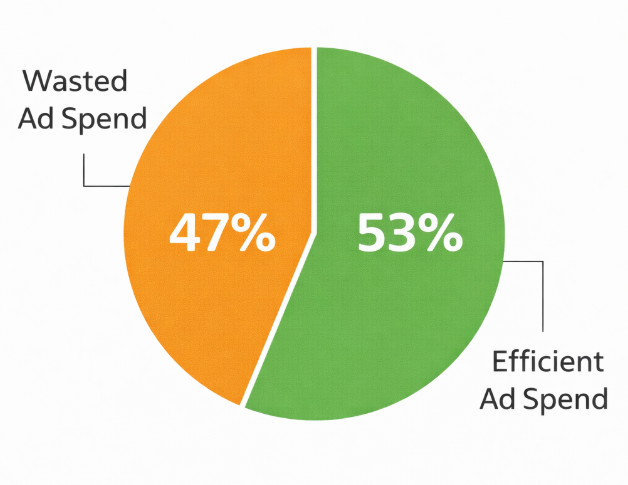
Proportion of marketing spend lost due to fragmented tracking highlights the need for strong first-party data infrastructure
Advertisers with clean, consented first-party data often see stronger model learning, faster campaign stabilization, and more resilient performance during algorithm updates.
Creative as the Primary Growth Lever
In privacy-first advertising, creative has overtaken targeting as the dominant optimization variable.
Meta’s internal studies have shown that creative quality can account for up to 56% of performance variance in campaigns. With broader audiences and fewer targeting constraints, messaging, format, and iteration speed matter more than ever.
Effective creative strategies include:
-
Rapid testing of multiple value propositions
-
Native, platform-aligned formats over polished brand assets
-
Clear problem–solution framing within the first three seconds
Creative fatigue now occurs faster, making structured testing and refresh cycles a core operational requirement.
Structuring Campaigns for Algorithmic Learning
Over-fragmentation is a common mistake in post-privacy account structures. Excessive campaigns, ad sets, or audience splits can starve Meta’s delivery system of the data it needs to learn.
High-performing structures typically feature:
-
Consolidated campaigns with fewer ad sets
-
Broader audience definitions
-
Stable budgets to allow learning phases to complete
Accounts that simplify structure often see improved delivery efficiency and lower cost volatility within weeks.
Looking Ahead
Privacy-first advertising is not a temporary phase—it is the new baseline. Meta Ads optimization now requires a strategic mindset that balances data limitations with algorithmic strengths.
Advertisers who invest in strong measurement frameworks, high-velocity creative testing, and simplified structures are better positioned to scale sustainably, even as signal availability continues to decline.
Recommended Reading
To deepen your understanding of performance marketing in modern ad ecosystems, consider exploring these related articles: