Advertisers often assume their social ads aren’t working because of targeting, creative fatigue, or algorithm changes.
But more often than not, the real issue is the offer.
You can have sharp creative, granular audience targeting, and optimized bidding. Yet, if your offer doesn’t resonate or motivate action, results will plateau.
The offer is the inflection point. It's where interest either becomes intent — or disappears. And even strong-looking ads can fail if the value exchange isn’t compelling or credible enough. Here’s why your best-looking Facebook ads may not convert.
What Does “Offer” Actually Mean in Paid Social?
Marketers tend to think of the offer as a discount or incentive. But in paid social, it’s far broader than that — and much more strategic.
Your offer is the complete value proposition presented in the ad experience. It includes the product promise, the friction level of the next step, the urgency to act, and the perceived value versus effort.
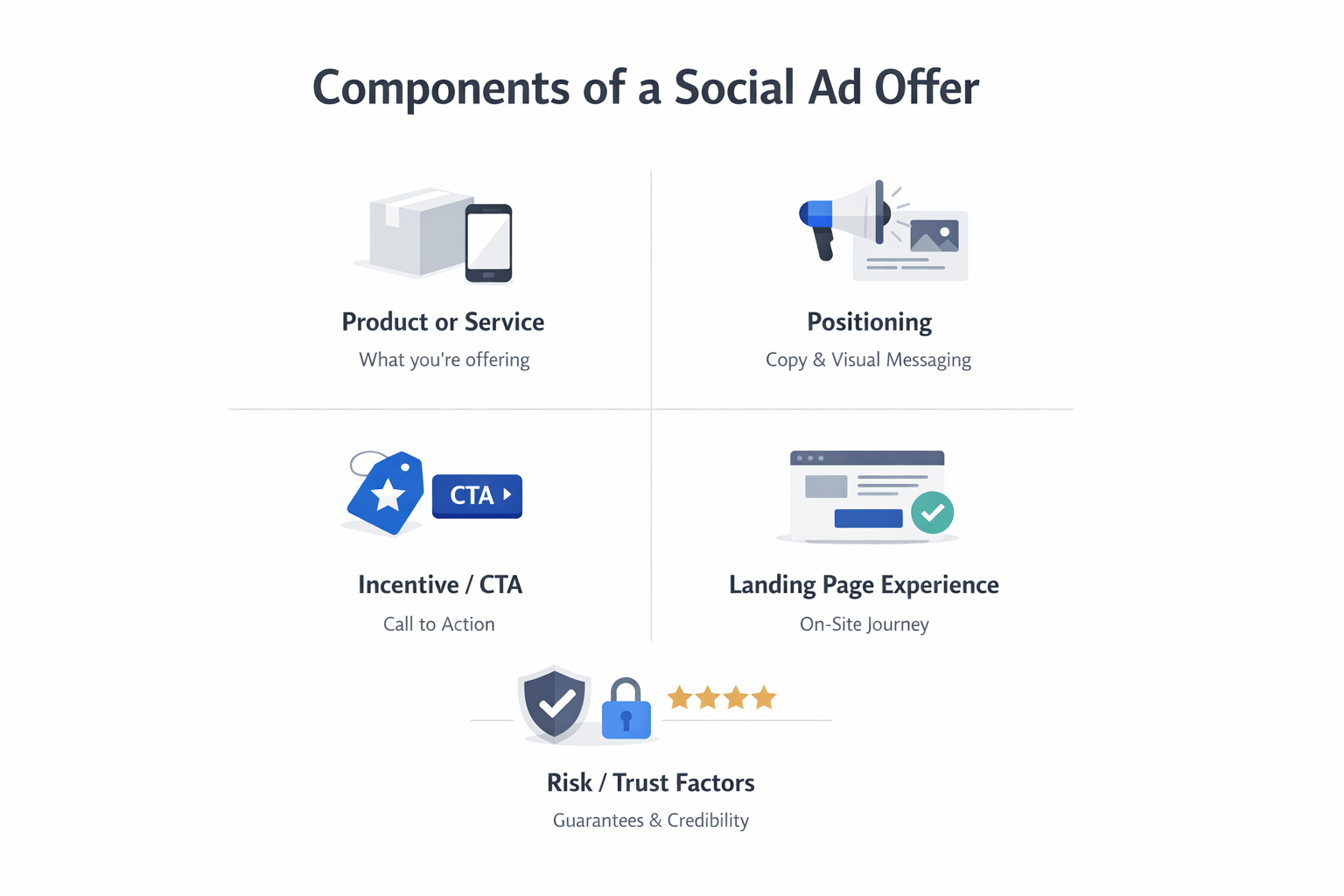
In Facebook and Instagram ads, the offer shows up through:
-
Your creative and copy — what you emphasize;
-
The call-to-action — what you ask them to do;
-
The landing page — what they find once they click;
-
The terms and conditions — what they’re required to commit to.
For example, a campaign promoting a free audit might look like a strong offer. But if the audit takes 60 minutes, requires a Zoom call, and the landing page buries the details, users won’t convert.
Why Most Social Ads Fail at the Offer Level
1. The Offer Is Unclear or Lacks Specificity
Facebook and Instagram users scroll fast and think in seconds. If your offer is vague, confusing, or overly broad, they will scroll past — no matter how beautiful your creative is.
Clarity is the first requirement. This means:
-
Users should immediately understand what the offer is;
-
They should know who it’s for;
-
And they should see what happens next if they click.
Let’s look at a few common clarity issues in real campaigns:
-
The CTA says “Get Started”, but users don’t know whether it leads to a sign-up, a purchase, or a download;
-
The ad copy promises results, but doesn’t explain the product or service behind those results;
-
There’s no mention of price or even price range, which creates suspicion — especially for B2B buyers or higher-ticket products.
For example, imagine you’re running a lead gen campaign for a software demo. If the ad simply says “Get More Done with Our Platform”, it’s not clear who it’s for or what the benefit is.
A better version would be: “Book a 15-Minute Demo to See How We Automate Client Reporting for Agencies”.
Specificity doesn’t just improve clicks — it improves the quality of traffic, too.
2. There’s No Built-In Reason to Act Now
On Facebook and Instagram, attention doesn’t last. Even users who are interested won’t convert if your offer lacks urgency.
This is especially true for non-impulse products, like software, coaching, or services. In these cases, your offer must create timely relevance — not just long-term value.
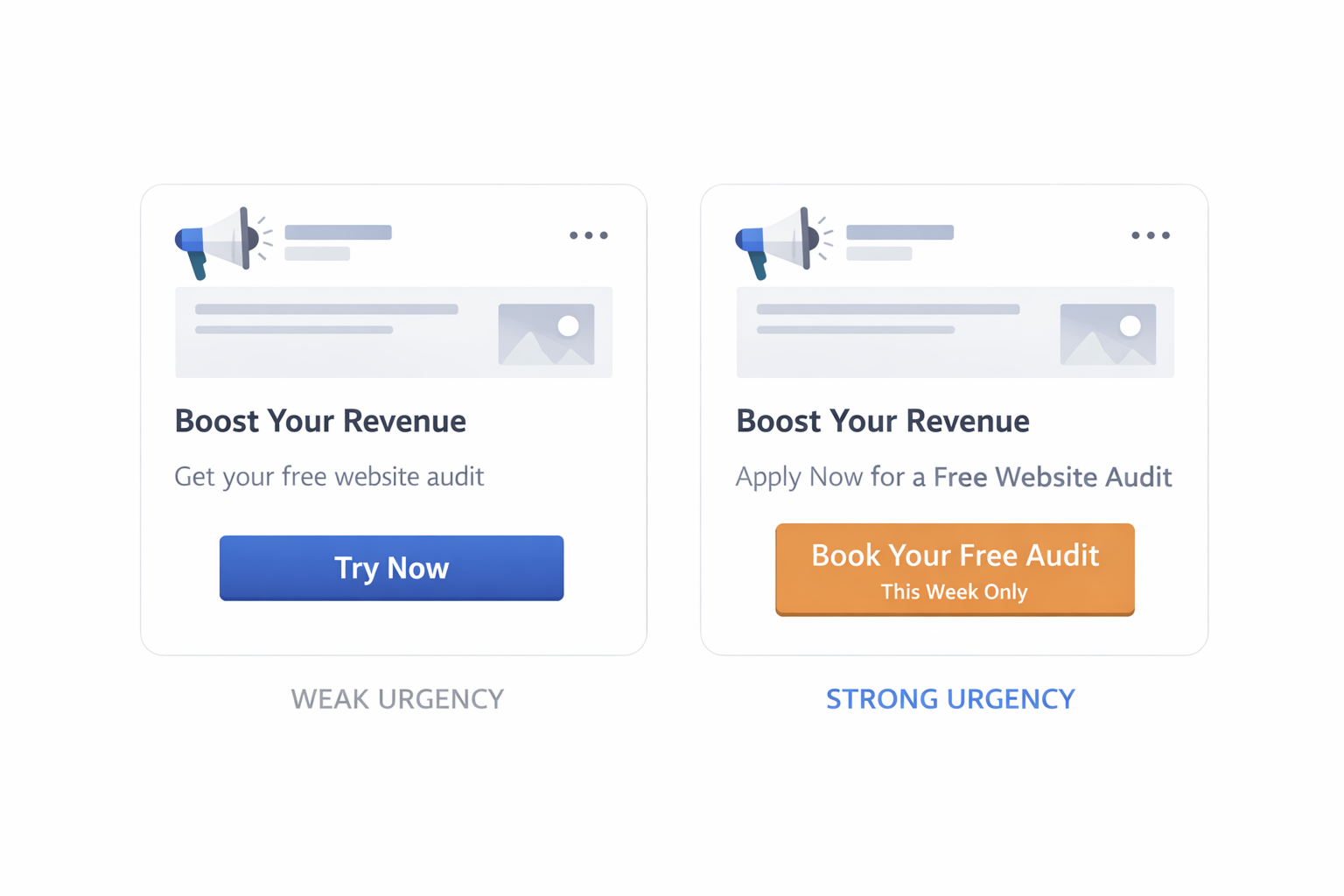
Strong urgency doesn’t always mean discounts. It can also come from:
-
Time-sensitive benefits — “Apply before January 31 to start onboarding in Q1”;
-
Limited availability — “Only 10 audit slots available this month”;
-
Seasonal positioning — “New Year, New Funnel — Free Setup Ends This Week”.
By contrast, weak urgency sounds like:
-
“Check it out”;
-
“We’re accepting new clients”;
-
“Try now” — with no reason to try today.
Smart brands build urgency directly into the structure of their offer. Learn how to craft this kind of “must-click” offer positioning here.
3. There’s a Disconnect Between Ad and Landing Page
Even if your ad generates a click, the offer can still fail if the next step feels like a bait-and-switch.
This disconnect is more common than most marketers realize. And it often happens when ads and landing pages are built by separate teams or optimized in isolation.
For example:
-
An ad headline promises “Free Website Audit”, but the landing page pushes a paid strategy session;
-
An Instagram carousel says “No Credit Card Required”, but the sign-up form has a billing step;
-
A Facebook ad promotes “30% Off Today”, but the user can’t find the discount code on the page.
This kills momentum and damages trust. You can’t just match the CTA — you have to match the message, value, and expectations.
Before launching, audit your entire flow from ad to page. Ask: “Is the story consistent?”
You can also read this detailed guide on creating seamless experiences between ads and landing pages to troubleshoot your setup.
4. The Perceived Value Isn’t High Enough
Users aren’t judging your offer in a vacuum. They’re comparing it to everything else in their feed — competitors, influencers, even entertainment.
This means the perceived value of your offer must be higher than the perceived cost of clicking (time, effort, attention).
Too many advertisers lean on features instead of outcomes. But Facebook and Instagram are outcome-driven environments — users act when they see what they’ll gain.
Instead of:
-
“Includes advanced analytics dashboard”, say “Track campaign ROI in real time without spreadsheets”;
-
“Built-in integrations”, say “Save hours each week by syncing your stack automatically”.
If your ad is offering a lead magnet or free trial, explain exactly what the user gets and why it matters — now. Even low-cost offers must feel like a win to work.
How to Build a High-Converting Offer for Social Ads
Getting the offer right isn’t guesswork. Use a framework that checks for the four pillars of offer confidence.
The Offer Confidence Framework
Before launching, pressure-test your offer against:
1. Clarity
Can users instantly understand what the product or service is, who it’s for, and what happens after they click?
2. Relevance
Is the offer timely or seasonal?
Does it speak to a specific behavior, pain point, or funnel stage?
3. Perceived Value
Is the value of the offer obvious — not just the price or discount, but the benefit of saying yes?
4. Trust Signals
Are there testimonials, guarantees, brand logos, or visual cues that reduce doubt?
Bonus: Offers that pass all four filters are also less likely to fatigue quickly. See how to avoid ad fatigue while maintaining conversion rates.
Final Thought: Strong Offers Multiply Ad Performance
If your social ads aren’t converting, don’t start by blaming the platform, the algorithm, or your audience. Start by scrutinizing the offer.
Even with perfect targeting, creative, and bidding — a weak offer will underperform. But a strong, specific, and timely offer can outperform average creative, every time.
Before your next campaign, ask:
Is the offer clear, relevant, valuable, and trustworthy enough to convert a cold user — right now?
Until the answer is yes, no amount of optimization will get you the results you’re after.