Advertisers often rely on metrics like CTR, CPM, ROAS, or conversion rates to judge success. But metrics in isolation can lead you down the wrong path.
A high click-through rate might seem like a win. But what if those clicks never turn into purchases? A low CPM might feel efficient. But what if you're reaching people who were never going to buy?
The truth is, data only makes sense when you understand the bigger picture around it.
What Context Really Looks Like
When we say “context,” we mean everything that shapes and influences a campaign’s results. It’s not just what’s in the Ads Manager, but what’s behind the numbers.
Some of the most important things to consider are:
-
Your campaign objective. For example, a brand awareness campaign isn’t supposed to bring in sales right away. Comparing it to a conversion campaign doesn’t make sense.
-
Audience intent. Cold traffic clicks less and buys less than people who already know your brand. A lower conversion rate can still be strong if the audience is unfamiliar.
-
Where the ad sits in your funnel. Reach and engagement matter at the top. Sales and ROAS matter at the bottom. You can’t expect the same outcome from every stage.
-
Creative format and message. A video ad might drive more views and clicks, while a product carousel may convert better. Different creative styles perform differently.
-
Timing. One bad day doesn't mean the campaign failed. What matters is the pattern over time — not a single spike or dip.
Looking at your metrics without any of this context is like trying to read a book by skimming only the numbers on each page.
What Happens When You Ignore Context
When marketers make quick decisions based only on surface-level numbers, they often make the wrong call.
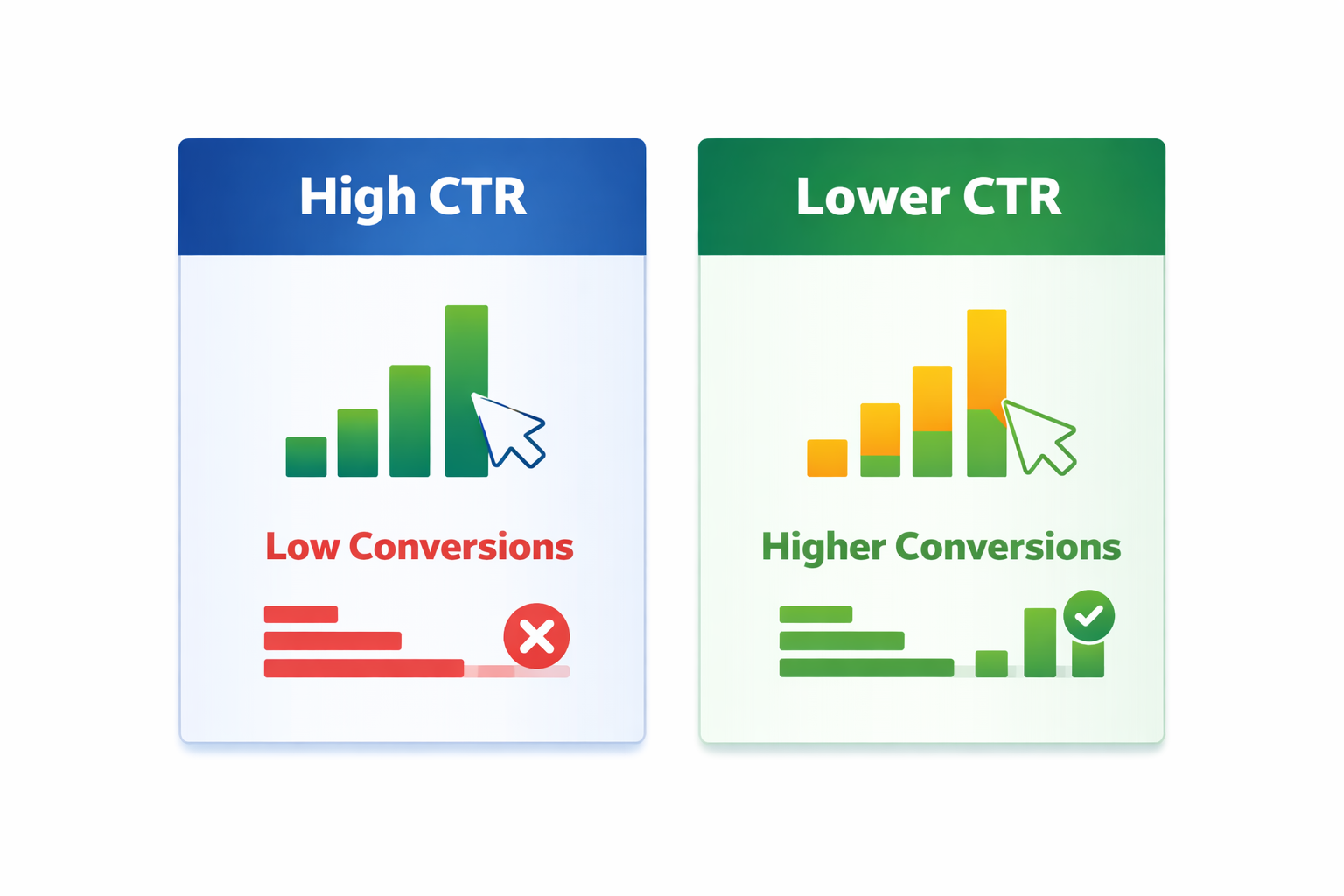
For example, a high CTR doesn’t always mean more conversions — deeper analysis is key.
These are some common mistakes:
-
Turning off ads because of high CPMs — even if those same ads are bringing in your most profitable customers.
-
Scaling campaigns based on early ROAS numbers — before Meta’s algorithm has time to stabilize delivery.
-
Chasing CTRs — even when those clicks don’t turn into leads or sales.
These decisions feel logical in the moment, but they usually lead to wasted budget and missed growth. Also see: What to Do When Your Best-Performing Ad Set Suddenly Fails.
How to Add Context to Your Metrics
Instead of judging performance in isolation, build a habit of reading your results in layers. The goal is to match what you’re seeing with where and how your campaign is running.
1. Match Metrics to Funnel Stage
At every funnel stage, you’re looking for different outcomes. So the right metrics to track will change too.
Top of funnel: Focus on CPM, CTR, and video views. These help you understand how many people you're reaching and engaging.
Middle of funnel: Look at metrics like clicks, time on site, and add-to-carts. These show if people are interested but not ready to convert yet.
Bottom of funnel: Prioritize cost per purchase and ROAS. This is where sales happen, so the numbers should reflect actual revenue impact.
If you judge a top-of-funnel video ad by its ROAS, it will always look like a failure. But that’s not what it was built to do. For more information, see How to Analyze Campaign Performance Beyond ROAS: The Full Funnel View.
2. Compare Audiences Side by Side
Don’t lump all your results together. Break them out by audience type to see who’s actually driving performance.
You might compare:
-
Lookalikes vs. retargeting audiences;
-
New vs. returning customers;
-
Manual targeting vs. Advantage+ placements.
This lets you stop guessing and start seeing which audiences are really working — and which aren’t.
3. Watch for Outside Influences
Not every change in performance is caused by your ad.
A spike in ROAS might be due to a holiday sale. A sudden drop might happen because of a Meta algorithm update or a competitor’s discount.
The takeaway here is simple: don’t judge ads in a vacuum. Always ask what else might be affecting results.
Context Also Depends on Creative
Your creative plays a big role in how people respond — and what your metrics mean.
Imagine launching a broad cold-audience campaign using funny meme-style ads. CTR is high, but conversions are flat.
That’s not a performance problem. It’s a message mismatch. The creative is entertaining, but it doesn’t help someone understand the product or make a decision.
In other cases, the right message at the wrong time can also hurt results. A strong product ad won’t convert if someone hasn’t been warmed up first.
So before blaming the metric, ask if the creative and audience are truly aligned.
What You Can Do with Better Context
Context doesn’t just help you explain performance. It helps you make better choices, faster.
Here’s how it helps:
-
You know when to pause an ad — because it's truly underperforming, not just showing a temporary dip.
-
You know when to scale — because the creative, audience, and funnel all line up.
-
You know what to test next — because you understand why something worked or didn’t.
Better decisions mean less wasted time, lower ad costs, and stronger overall performance. Read Data-Driven Decisions: What Facebook Metrics Actually Predict Conversions for more details.
Final Thoughts
Performance metrics don’t work on their own. The numbers only tell you part of the story.
To get real insight, you need to step back and look at how your campaign is built, who it’s reaching, and what stage of the customer journey it supports.
When you understand the context, everything becomes clearer — and a lot more useful.