
Most ad platforms use a machine-learning delivery system. When you launch a new campaign (or make a major change), the system enters a calibration period where it tests who to show ads to, which placements to prioritize, and how to pace budget.
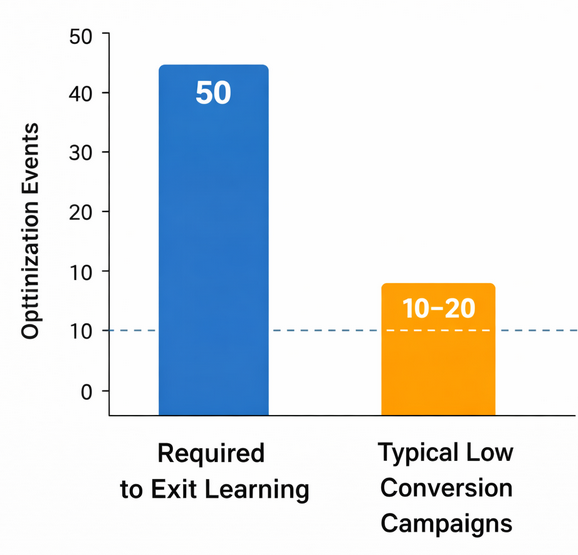
Comparison of required vs. actual optimization event counts illustrating why campaigns may remain in the learning phase
To stabilize, the algorithm needs a steady stream of high-quality, consistent conversion signals. Without that, results stay volatile: CPMs swing, CPAs drift, and performance feels random.
A useful benchmark
On Meta, a common rule of thumb is that an ad set needs about 50 optimization events within 7 days to reliably exit learning. If you’re optimizing for purchases but only generate a handful per week, the system may never reach statistical confidence.
The real reasons campaigns get stuck
Below are the most common causes—ranked by how often they show up in real accounts.
1) Not enough conversion volume (the #1 reason)
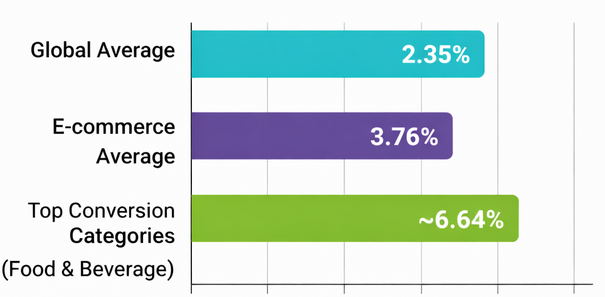
Average conversion rates across digital campaigns and sample top-performing categories for context on typical conversion performance
Learning is event-driven. If the campaign can’t generate enough of the event you’re optimizing for, it can’t learn.
Common ways this happens:
-
Optimizing for an event that’s too rare (e.g., purchase) when the business is still low-volume
-
High CPA + low budget (the math doesn’t allow enough weekly conversions)
-
Too many segments splitting the same limited demand (many ad sets, each starving)
Fixes that work:
-
Temporarily optimize for a higher-volume event (lead, initiate checkout, add to cart) until purchase volume grows
-
Consolidate ad sets to concentrate conversion signals
-
Budget to match your goal (a practical heuristic is a daily budget that can realistically generate multiple conversions per day)
2) Frequent “significant edits” that keep resetting learning
Learning isn’t only about new campaigns. Big changes can force the system to re-learn.
Edits that often trigger re-learning:
-
Large budget changes
-
Major targeting shifts
-
Creative swaps across too many variables at once
-
Optimization event changes
Fixes that work:
-
Batch changes: adjust one major variable at a time
-
Keep budgets stable for a full measurement window before judging results
-
Use structured testing (rotate creatives in a controlled way instead of constant swapping)
3) Targeting is too narrow or overly constrained
When the eligible audience is small—or when you stack too many restrictions—the system can’t explore.
Common constraints that choke delivery:
-
Small audiences (especially with multiple exclusions)
-
Tight geo + strict age + layered interests
-
Aggressive schedule restrictions (limited hours)
Fixes that work:
-
Broaden targeting and let the algorithm find pockets of efficiency
-
Reduce exclusions and unnecessary layering
-
Keep delivery windows wide, especially early on
4) Conversion tracking is noisy, missing, or delayed
If your tracking is inconsistent, the system receives weak or contradictory signals.
Common issues:
-
Pixel/conversion API misconfiguration
-
Broken or duplicated events
-
Conversion events firing late or not at all
-
Long conversion cycles (the platform waits longer to see the “true” result)
Fixes that work:
-
Audit event setup and deduplicate events
-
Confirm the correct optimization event is firing consistently
-
Use a shorter attribution setting if it matches your buying cycle and reduces signal delay
5) The campaign structure splits learning across too many “lanes”
Even if your total account volume is decent, learning can stall when it’s divided across:
-
Many ad sets targeting similar users
-
Too many creatives launched at once with low spend per creative
-
Multiple campaigns competing for the same audience
Fixes that work:
-
Reduce the number of ad sets and let budget concentrate
-
Limit the number of new creatives introduced at one time
-
Avoid launching many near-identical ad sets that compete with each other
6) Cost controls and bids restrict delivery
If you set cost caps or bid limits too aggressively, the system may not win enough auctions to generate events.
Fixes that work:
-
Loosen caps/limits during calibration (or start without them)
-
Increase budget flexibility until a stable baseline is reached
A quick diagnostic checklist
Use this to identify the most likely bottleneck in minutes.
-
Are you getting enough conversions for the event you optimize for?
-
If you’re far below the ~50/week benchmark per ad set on Meta, learning may remain unstable.
-
-
Did you make major edits in the last 7 days?
-
If yes, you may be constantly restarting calibration.
-
-
Is your audience large enough to explore?
-
If delivery is constrained, broaden before you “optimize.”
-
-
Is tracking clean and timely?
-
If events are missing, duplicated, or delayed, fix signals before adjusting creative.
-
-
Is the structure too fragmented?
-
If spend is thinly spread, consolidate.
-
What to do when you can’t hit the conversion threshold
Some businesses simply don’t have the volume (yet) to feed the algorithm the ideal number of weekly conversions. You still have options:
-
Climb the funnel temporarily
Optimize for a higher-volume event until purchase volume increases. -
Concentrate spend
Fewer ad sets, fewer campaigns, fewer variables—more data per “decision unit.” -
Extend the learning runway
Avoid frequent edits and judge performance over a longer window so the system has time to collect signals. -
Improve pre-click quality
If clicks don’t convert, learning won’t complete. Tighten message–landing page alignment, speed up the page, and reduce friction in the first steps.
Common symptom-to-fix map
| Symptom | Most likely cause | Fastest fix |
|---|---|---|
| “Learning” for weeks | Too few optimized events | Optimize for a higher-volume event or consolidate spend |
| “Learning limited” despite decent traffic | Traffic isn’t converting, or tracking is weak | Fix tracking + landing friction; validate the event |
| Results swing wildly after tweaks | Constant significant edits | Stop changing variables; lock a stable test window |
| Spend is low, delivery is restricted | Audience too small or caps too tight | Broaden targeting; loosen caps temporarily |
Outcome: stable learning is a volume and consistency game
Campaigns don’t exit learning because the system is “confused”—they stay there because signals are too scarce, too fragmented, or too inconsistent.
If you focus on three fundamentals—enough conversion volume, clean tracking, and a stable structure—most learning problems resolve without any fancy hacks.