When an ad underperforms, it’s easy to blame the creative. But it’s rarely just the design or copy.
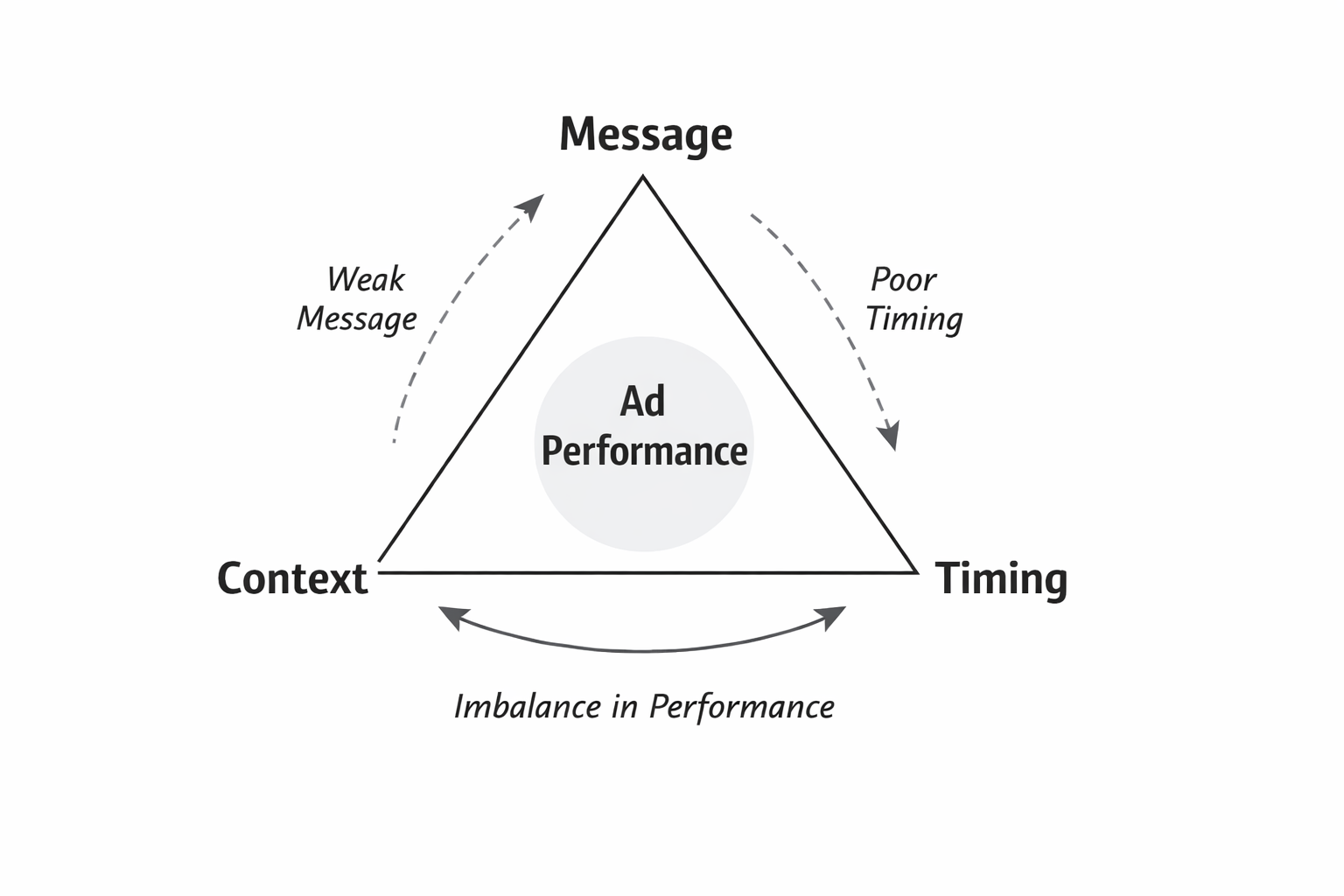
What actually causes the drop-off is often a deeper misalignment. The message doesn’t match the audience’s mindset. The ad shows up in the wrong context. Or it hits at a time when no one’s ready to act.
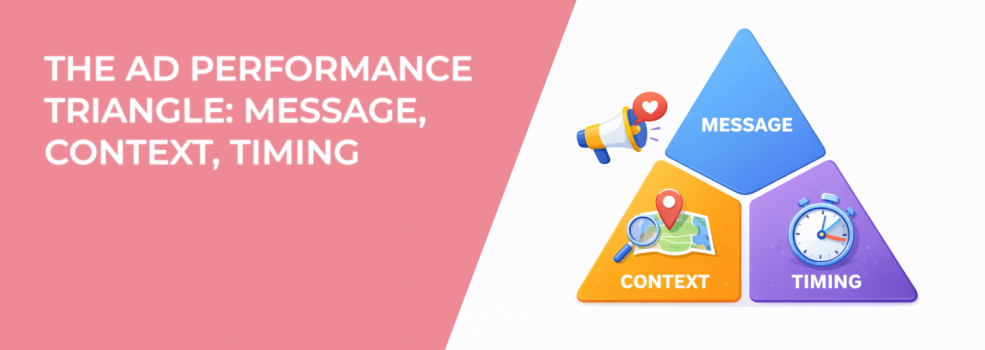
That’s where the Ad Performance Triangle comes in — a framework built around Message, Context, and Timing. These three elements work together. If one is weak, the entire campaign slips.
The Three Elements Behind Every High-Performing Ad
1. Message: What You Say, and What It Feels Like
Your message is more than a headline. It shapes how the user interprets your offer in the first few seconds.
To strengthen it:
-
Make the benefit specific, not broad. Instead of “Streamline your workflow,” try “Cut admin time by 4 hours per week.”
-
Anchor the message in the user’s real pain or urgency. A CRM ad shouldn’t focus on dashboards. Focus on missed deals, disorganized follow-ups, or revenue loss.
-
Use tone that fits the platform and audience. Casual, confident, and clear language outperforms corporate jargon on social feeds.
Avoid general phrases like “all-in-one solution” or “we help you grow.” These aren’t wrong — they’re just invisible. Users scroll past them because they don’t feel concrete or relevant.
Before you write an ad, ask: What’s the real-world problem this solves? And how does that problem feel to the user right now?
If you're not sure why your messaging isn't converting, this guide can help you diagnose why good-looking Facebook ads still don’t sell.
2. Context: Where and How the Ad Is Seen
Context is more than targeting. It includes the platform, the placement, the audience’s mindset, and even their physical environment.
To improve ad-context fit:
-
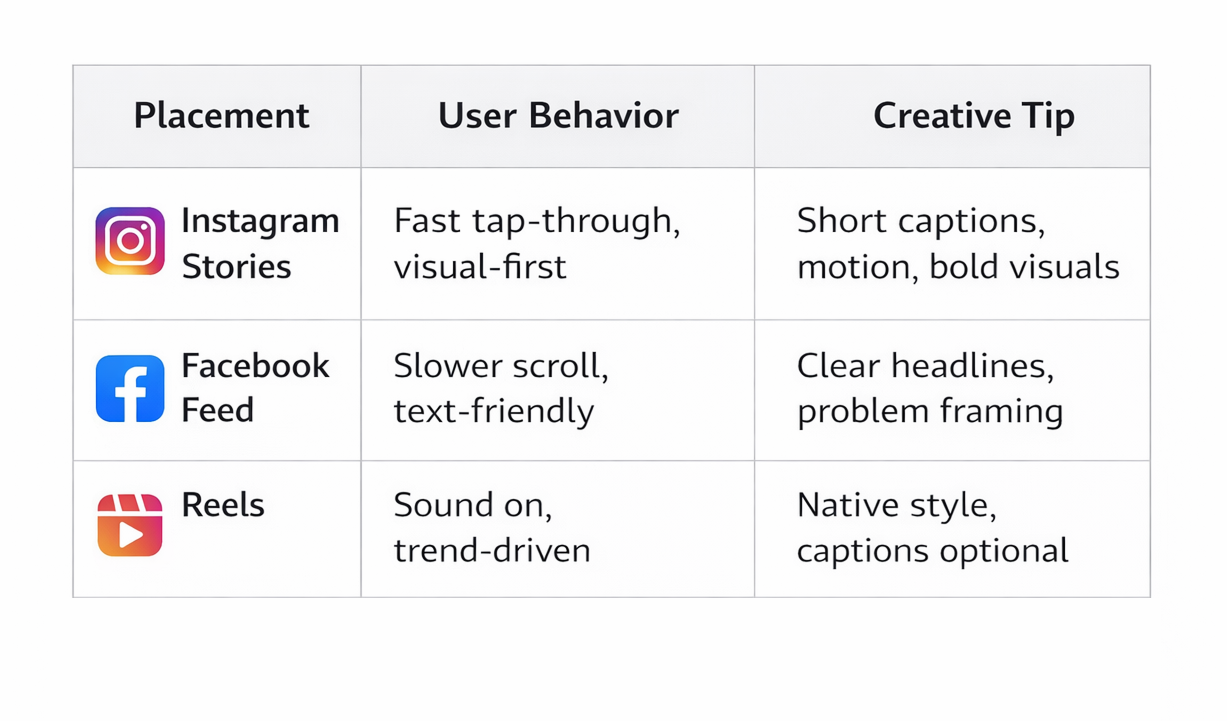
Match creative to placement behavior.
On Instagram Stories, people tap quickly. Use bold visuals and fast pacing.
In Facebook Feed, users scroll slower. Use clearer headlines and lead with strong opening visuals. -
Segment based on audience awareness.
Cold traffic needs clarity and relevance. Warm traffic responds better to urgency, comparison, or credibility signals.
If you're using LeadEnforce, start with Facebook and Instagram sources that reflect real-world interest and behavior. -
Factor in platform usage patterns.
People scroll differently at work than at home. A campaign aimed at marketers may perform better in the early morning or around lunch when they’re between tasks.
Also consider user alignment with competitors. For example, you can reach Instagram followers of rival brands using group-based audience modeling. These users often reflect real buying intent, not just passive interest.
Instead of building one campaign and pushing it across channels, adapt creative and messaging to fit how users behave in each space.
For more advanced tips, learn how to tailor your message to buyer awareness levels on Facebook.
3. Timing: When the Ad Shows Up
Timing isn’t just about the hour of day. It includes market conditions, user behavior, seasonality, and even your competitor's activity.
Ways to improve timing:
-
Run hourly and daily breakdowns in your reporting.
You’ll often see consistent performance drops or spikes. Use this to adjust delivery times manually or via rules. -
Trigger campaigns around real-world signals.
If a competitor launches a product, consider running a feature comparison ad.
If pricing changes in your category, run urgency or value-based messages while awareness is high. -
Use recency as a signal of intent.
If someone visited your pricing page yesterday, show them a focused offer today.
Avoid showing that same message to someone who engaged three weeks ago but never returned.
Timing also applies to creative fatigue. If an ad performs well for 5 days and then slows down, don’t wait a full month to change it.
How to Spot Weak Points in Your Campaigns
You don’t need to overhaul every campaign. Instead, isolate which part of the triangle is misaligned.
Here’s a quick diagnostic table:
| Area | What to Check | Common Fixes |
|---|---|---|
| Message | Does the ad clearly solve a current pain? | Rewrite from the user’s perspective. Strip jargon. Add clarity. |
| Context | Does the creative suit the placement and audience behavior? | Adjust tone, format, or segmentation. |
| Timing | Are you hitting when users are most responsive? | Test delivery times. Layer in urgency based on recency or trends. |
Often, it’s not that your ad is “bad.” It’s just mismatched with what the user needs — in that moment, on that platform, in that mindset.
When Something Works, Don’t Just Scale It — Study It
Scaling successful campaigns without understanding why they worked is a missed opportunity. Patterns only emerge when you break things down.
Ask:
-
Which audience segment responded most strongly?
-
Was one placement driving most of the clicks or conversions?
-
Did response rates shift at a specific time of day or week?
For example, if a remarketing campaign outperforms cold traffic, study the message. Was it clearer? More urgent? Did it use social proof?
Final Thoughts: High Performance Comes from Alignment, Not Just Creativity
Most advertisers think in terms of “winning creatives.” But creative alone won’t save a campaign if the context and timing are off.
Focus on the interplay between all three elements. That’s where long-term, scalable performance comes from.
Once you start building campaigns with alignment in mind, you’ll notice:
-
Better click-through rates, even on simple ads.
-
Lower cost per result, without dramatic creative overhauls.
-
More reliable scaling, because you understand what makes an ad work and when.