Many Facebook Ads campaigns perform well at small budgets but stop improving once spend increases. You raise the budget, expand targeting, or duplicate ad sets — yet conversions stop growing while CPA begins to rise.
This situation is often described as a scaling problem, but the underlying cause is usually structural. Campaigns hit a ceiling when one of the system inputs — creative signals, audience depth, or conversion feedback — cannot support larger delivery.
Understanding which mechanism limits the campaign makes scaling far more predictable.
What a Scaling Ceiling Actually Looks Like
A scaling ceiling rarely appears as a sudden collapse. Performance usually deteriorates gradually as delivery expands.
Common signals include:
-
Cost per acquisition rises disproportionately as spend increases.
A campaign generating $30 CPA at $150 per day might reach $60 CPA after scaling to $700 per day. The campaign produces more impressions but fails to generate proportional conversions. -
Frequency grows quickly even within large audiences.
If an audience containing several million users reaches frequency 3–4 within a few days, the delivery system has likely concentrated impressions on a small cluster of responsive users. -
Conversions stop increasing despite higher reach.
Impression volume grows, but incremental conversions flatten. This indicates the algorithm is repeatedly showing ads to users who already resemble previous converters. -
Creative engagement begins to decline.
CTR and engagement signals weaken as the same users see the ads repeatedly.
When these signals appear together, the campaign has likely reached a delivery ceiling.
How Meta’s Delivery System Actually Scales Campaigns
Meta does not scale campaigns by simply increasing the number of impressions. Instead, the system expands delivery by identifying behavioral patterns among users who interact with the ad.
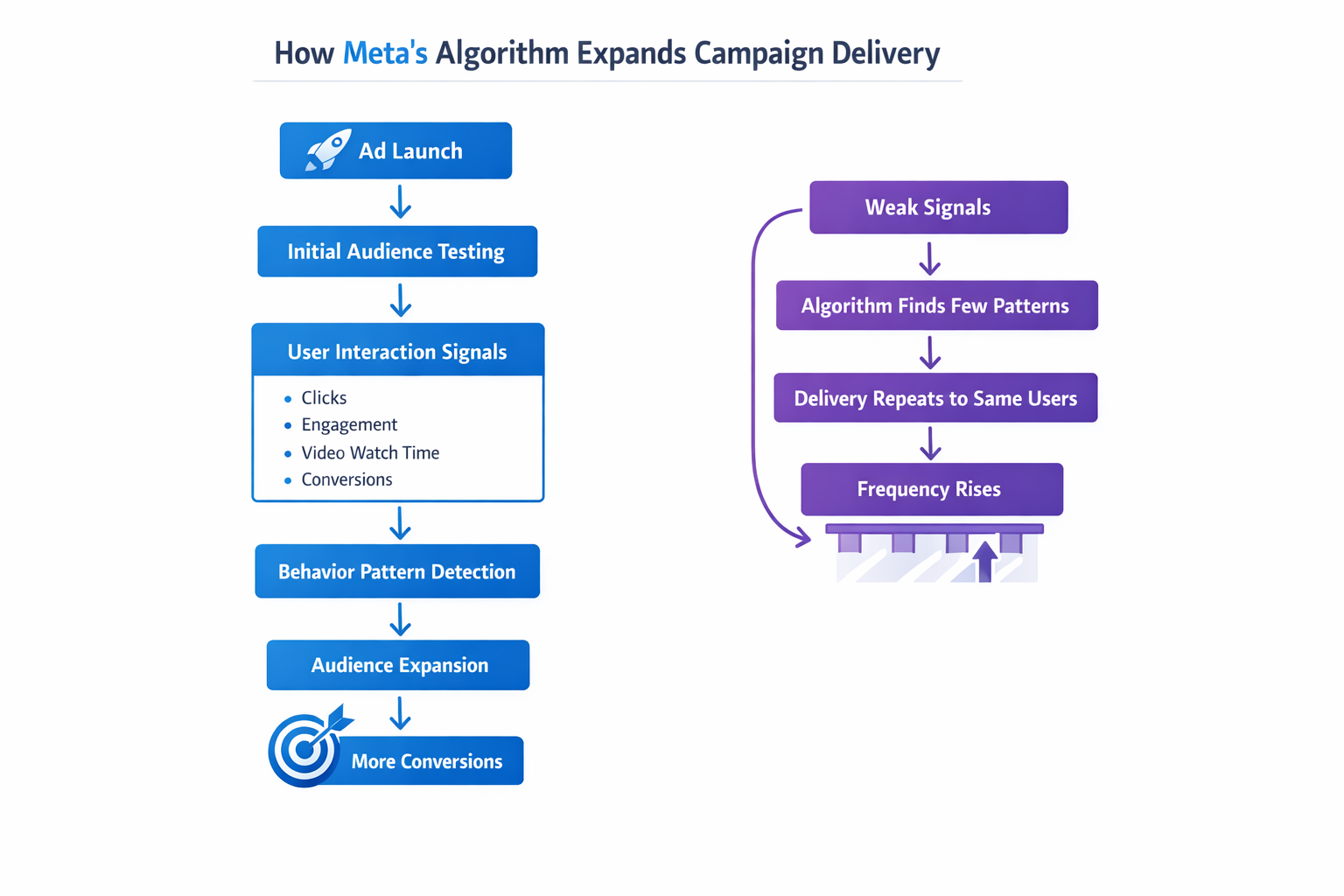
When a campaign launches, the algorithm analyzes signals such as:
-
click behavior and engagement activity;
-
browsing behavior across Meta’s platforms;
-
similarity to previous converters;
-
historical ad interaction patterns.
The system then expands delivery toward users with similar signals.
This process works only when the algorithm receives consistent and diverse feedback signals. If the dataset becomes narrow, delivery repeatedly returns to the same cluster of users.
Audience structure strongly influences this process. Strategies described in How to Create High-Converting Facebook Custom Audiences often determine how much behavioral diversity the algorithm can analyze when optimizing delivery.
Creative Fatigue Often Creates the First Ceiling
Creative quality has a larger impact on scalability than many advertisers expect. Weak creative limits the algorithm’s ability to collect strong engagement signals.
When ads fail to generate interaction, two structural issues appear:
-
The learning system receives fewer positive signals.
Low engagement rates reduce the behavioral feedback needed to identify new high-probability users. -
Delivery becomes increasingly concentrated.
The algorithm repeatedly shows ads to the same group of users who already interacted with the ad.
As a result, frequency rises quickly and CTR declines.
You can diagnose this situation by reviewing performance across multiple creatives within the same audience. If every ad produces weak engagement, increasing the budget will rarely solve the problem.
Instead, test variations that strengthen early engagement signals, such as:
-
alternative hooks within the first few seconds of video ads;
-
different problem framing or value propositions;
-
visual formats that create stronger contrast in the feed.
Creative that generates stronger interaction signals gives the delivery system more data to expand into new audience segments.
Weak Seed Data Limits Lookalike Expansion
Lookalike audiences can scale campaigns effectively, but their performance depends heavily on the seed data used to generate them.
If the seed audience contains only a small number of conversions, the behavioral patterns inside the dataset will be narrow. The lookalike model will then identify only a limited number of similar users.
This often creates a scaling ceiling.
Typical indicators include:
-
lookalike audiences performing well at 1% but deteriorating quickly at 2–5%;
-
delivery concentrating within a narrow demographic or geographic segment;
-
unstable performance when budgets increase.
Improving the seed dataset usually solves the problem. Instead of relying only on recent purchases, you can expand the seed pool with signals such as:
-
high-intent website visitors, including pricing page views;
-
a longer historical window of purchase events;
-
engaged users from social interactions or CRM lists.
For a deeper breakdown of how seed audiences influence scaling potential, see Lookalike Audiences: How to Seed, Train, and Scale.
Retargeting Campaigns Reach Natural Audience Limits
Retargeting campaigns often produce strong early performance but struggle to scale over time.
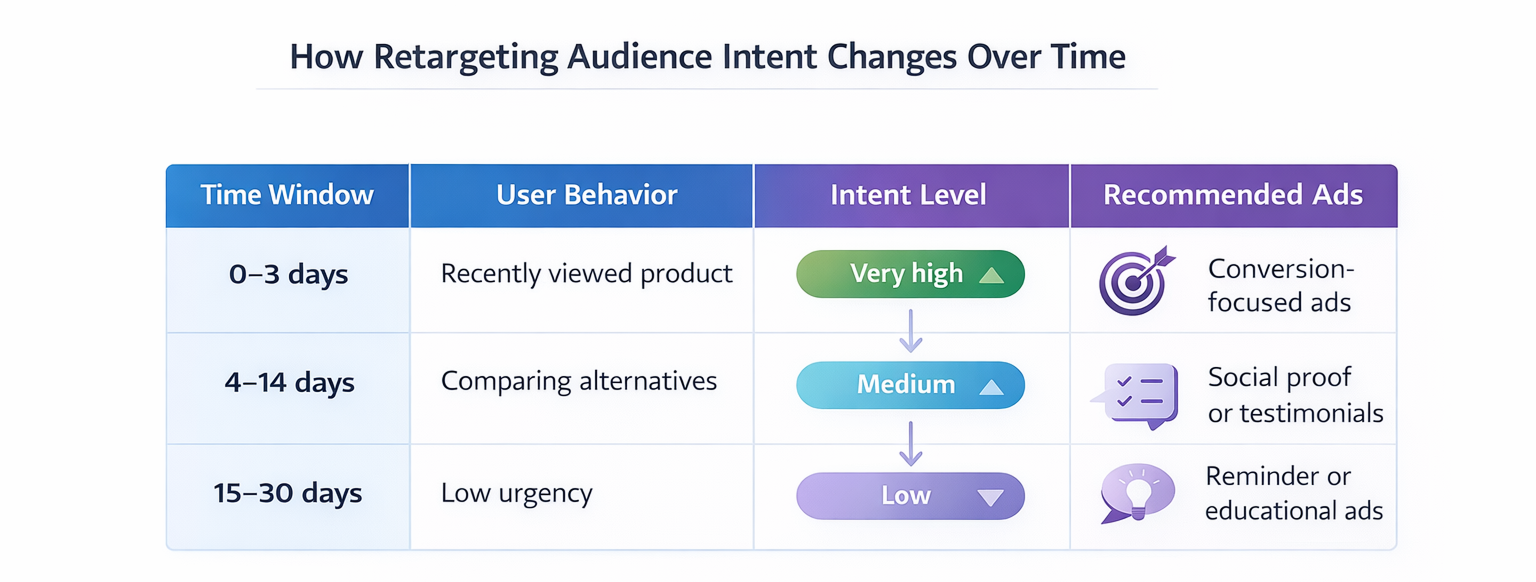
The reason is simple: the eligible audience is finite.
A typical retargeting pool may include:
-
website visitors within the past 30 days;
-
users who interacted with ads or social content;
-
cart abandoners or product viewers.
Even when the audience size appears large, the portion with active purchase intent may be relatively small. As impressions accumulate, the algorithm cycles through the same users repeatedly.
This pattern becomes visible through several signals:
-
frequency rising above 5–7 within a short time frame;
-
CTR declining while impressions continue to increase;
-
conversion volume stabilizing despite higher spend.
At this stage, increasing retargeting budgets rarely improves results. Sustainable growth usually requires expanding the prospecting campaigns feeding the retargeting pool.
Audience structuring techniques explained in Maximizing ROI through Facebook Audience Segmentation often help extend the effectiveness of these campaigns.
Conversion Signal Quality Can Restrict Scaling
Meta’s optimization system relies heavily on conversion feedback. When tracking signals are incomplete or delayed, the algorithm struggles to expand delivery confidently.
This situation commonly appears in two cases:
-
Long purchase cycles.
If conversions occur several days after the click, the algorithm has difficulty linking the conversion to the original ad interaction. -
Incomplete tracking configuration.
Missing pixel events or poorly configured server-side tracking reduce the reliability of optimization signals.
Campaigns experiencing this issue often show:
-
strong CTR but inconsistent CPA;
-
significant fluctuations in daily conversion reporting;
-
difficulty exiting the learning phase.
Improving signal reliability requires verifying event tracking and ensuring that key conversion signals are prioritized correctly. Privacy changes have made this even more important, which is discussed in How to Build Privacy-Safe Facebook Audiences Without Cookies.
How to Diagnose the Real Scaling Constraint
Before increasing budgets, it helps to identify which component of the campaign limits growth.
A practical diagnostic process looks like this:
-
Evaluate creative engagement signals.
Review CTR, engagement rate, and video watch time. Weak engagement across multiple ads usually indicates a creative limitation rather than a targeting issue. -
Check audience saturation indicators.
Rapid frequency growth and declining CTR often show that delivery has concentrated on a narrow group of users. -
Review the depth of conversion datasets.
If lookalike audiences stop scaling beyond 1–2%, the seed dataset likely lacks behavioral diversity. -
Audit conversion tracking signals.
Delayed or inconsistent conversion reporting weakens the algorithm’s ability to identify new high-probability users.
This diagnostic process usually reveals the structural bottleneck behind the scaling ceiling.
The Real Perspective Shift on Scaling
Campaign scaling is rarely a budgeting problem. In most cases, it is a signal problem.
The algorithm expands delivery only when it receives consistent engagement and conversion signals from new users. When those signals weaken — because of creative fatigue, narrow datasets, or audience saturation — growth slows down.
Instead of pushing budgets higher, sustainable scaling usually requires strengthening the system inputs:
-
creative that generates stronger engagement signals;
-
broader datasets for lookalike modeling;
-
larger prospecting audiences feeding retargeting pools.
When these inputs improve, the scaling ceiling tends to rise naturally.