Retargeting is often seen as the easiest part of paid social advertising. You are showing ads to people who already know your brand, visited your website, or interacted with your content. In theory, these users should convert faster and at a lower cost than cold audiences.
In reality, many retargeting campaigns fail to deliver meaningful results. Costs rise, performance plateaus, and ads start to feel repetitive.
When this happens, the problem is rarely Facebook or Instagram themselves — it is almost always the way retargeting is planned, structured, and messaged.
What Retargeting Is Actually Meant to Do
Retargeting is not meant to endlessly repeat your best prospecting ad. Its real purpose is to help users move forward in their decision-making process by reducing doubt and increasing confidence. Each impression should answer a question or remove a barrier that stopped the user from converting earlier.
Effective retargeting reacts to user behavior. Someone who viewed a product page, added an item to their cart, or engaged with a lead form is giving you a clear signal. Your ads should acknowledge that signal and respond appropriately.
If the campaign foundation is weak, even strong messaging will struggle. That is why a proper setup matters, as explained in this guide on how to set up Facebook retargeting.
Strong retargeting campaigns usually aim to:
-
Address hesitation, such as price concerns, uncertainty about value, or lack of trust.
-
Match the buying stage, so early users see education while high-intent users see reassurance.
-
Reduce friction, by making the next step feel easier and safer.
When these goals are clear, retargeting stops feeling repetitive and starts supporting real decisions.
The Most Common Reasons Retargeting Ads Fail
Treating All Retargeting Audiences as One Group
A common mistake is putting all website visitors and engagers into one retargeting audience. While they are technically warm, their intent levels can be very different. Someone who casually read a blog post is not in the same mindset as someone who abandoned a checkout.

When everyone sees the same ad, the message often feels off. High-intent users may feel slowed down, while low-intent users may feel pushed too hard. This mismatch leads to wasted impressions and weaker performance.
| Retargeting Audience | Typical User Intent | Recommended Ad Focus | Example Message Angle |
|---|---|---|---|
| Blog readers | Low to medium | Education and relevance | “Learn how this solves your problem” |
| Product page visitors | Medium | Benefits and differentiation | “Why this option stands out” |
| Cart abandoners | High | Reassurance and friction removal | “Free shipping and easy returns” |
This approach fails because:
-
Users have different intent levels, even if they are all considered warm.
-
One message cannot serve every stage, especially in longer buying cycles.
-
Budget is wasted on ads that do not match user expectations.
Segmenting audiences by behavior allows you to speak more clearly to each group and improve efficiency.
Repeating the Same Creative Until Performance Drops
Creative fatigue happens faster in retargeting than in prospecting. Audiences are smaller, which means users see the same ad more often. When the message does not change, people stop noticing it.
Many advertisers keep running the same creative because it once performed well. Over time, engagement drops, costs rise, and frequency increases. At that point, the ad no longer adds value — it simply reminds users that they are being followed.
Common signs of creative fatigue include:
-
Lower click-through rates, even though reach stays consistent.
-
Rising frequency, especially above comfortable levels.
-
Negative feedback, such as hiding ads or marking them as irrelevant.
Refreshing creative does not mean changing strategy. It means presenting the same value in new ways so the message stays visible.
Pushing for the Sale Too Early
Another frequent issue is assuming that warm traffic is ready to buy. This often leads to aggressive retargeting ads that rely on urgency, discounts, or strong calls to action too early in the process.
Many users are still evaluating options, comparing brands, or looking for proof. When ads jump straight to selling, they can feel pushy and create resistance. This is especially common when advertisers treat retargeting as the opposite of broad targeting, instead of a complementary strategy. The difference is explored in this breakdown of
retargeting vs. broad targeting.
This strategy fails because:
-
Interest does not equal readiness, especially for higher-consideration products.
-
Urgency without trust creates doubt, not confidence.
-
Pressure can delay decisions, rather than speed them up.
Retargeting works better when it builds confidence first and asks for the sale second.
Using Retargeting Windows Without Strategy
Many advertisers rely on standard retargeting windows like 7, 14, or 30 days without adjusting messaging. As a result, users who visited yesterday and users who visited a month ago often see the same ads.
Intent changes over time. Recent visitors may only need a reminder, while older visitors may need a new angle or re-engagement message. When timing is ignored, retargeting becomes inefficient.
This is especially true for leads who did not convert initially, which is covered in detail in retargeting leads who didn’t submit.
| Time Since Last Visit | User Mindset | Ad Goal | Message Focus |
|---|---|---|---|
| 1–3 days | Still interested | Reminder | Product clarity and benefits |
| 4–14 days | Comparing options | Build confidence | Proof and differentiation |
| 15–30 days | Losing interest | Re-engagement | New angle or incentive |
Poor window strategy leads to:
-
Irrelevant messaging that no longer matches user intent.
-
Overexposure to users who have already disengaged.
-
Lower efficiency across the entire retargeting funnel.
Time-based messaging helps keep ads aligned with real user behavior.
Structural Issues That Undermine Retargeting Performance
| Structural Mistake | Why It Hurts Performance | Typical Outcome | Better Practice |
|---|---|---|---|
| Overlapping audiences | Causes internal bidding between ad sets | Higher costs and inconsistent delivery | Use clear audience exclusions |
| Too many ad sets | Splits limited data across campaigns | Slow learning and weak optimization | Consolidate related audiences |
| Frequent edits | Resets the learning phase repeatedly | Unstable and unpredictable results | Let campaigns stabilize before changes |
Audience Overlap and Internal Competition
Retargeting campaigns often suffer from overlapping audiences. When users appear in multiple ad sets at the same time, they end up competing against themselves in the auction.
This internal competition raises costs and makes delivery unpredictable. Users may see conflicting messages, and the platform struggles to prioritize which ad to show.
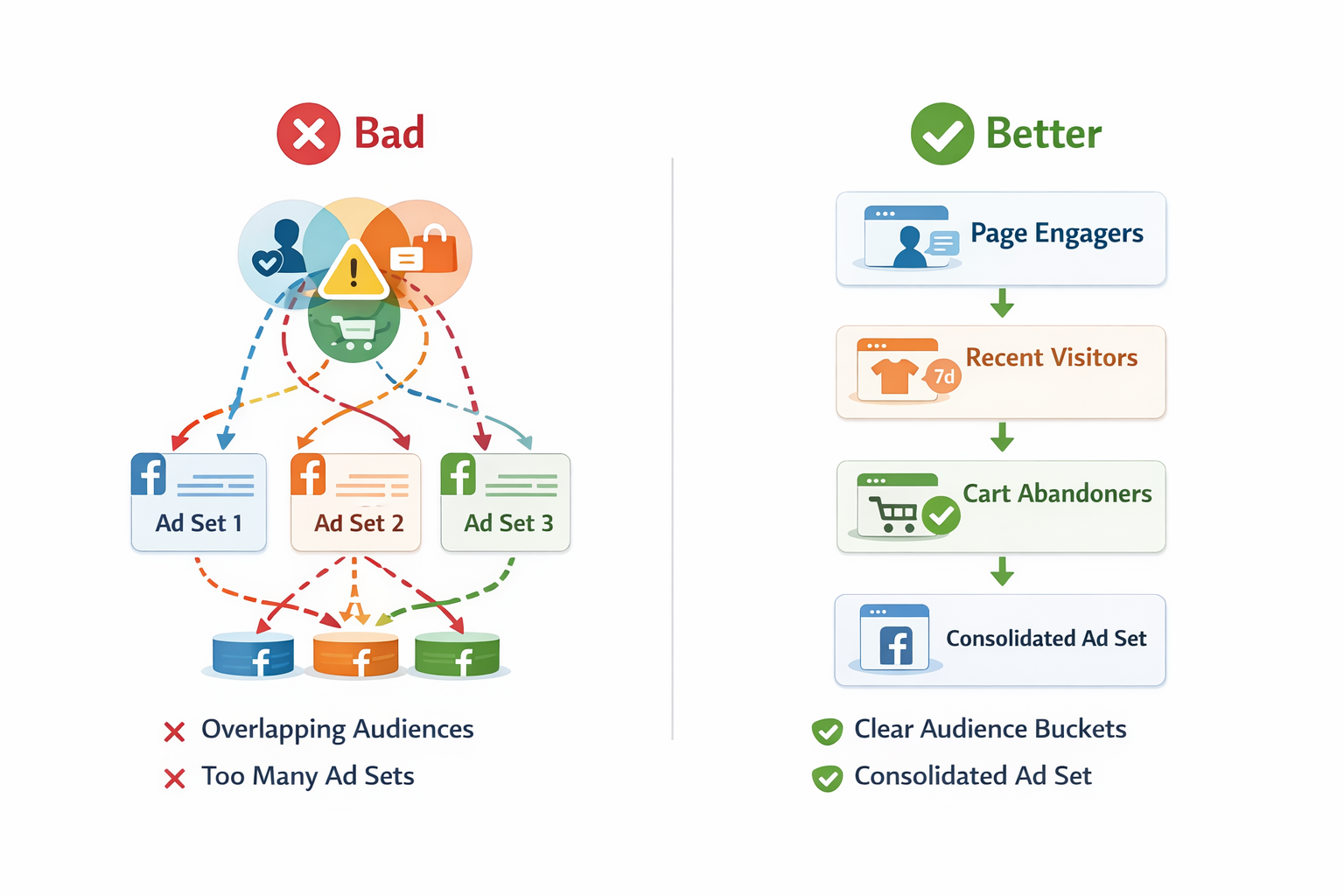
Audience overlap causes:
-
Higher costs, due to self-competition.
-
Inconsistent delivery, across ad sets.
-
Confusing signals, for optimization.
Clear exclusions and clean audience structure are essential for stable retargeting results.
Too Many Campaigns and Ad Sets
More ad sets do not mean more control in retargeting. Small audiences split across many ad sets rarely generate enough data for consistent learning.
This setup usually leads to:
-
Slow optimization, because each ad set has limited data.
-
Budget dilution, with spend spread too thin.
-
Unstable performance, that is hard to analyze.
Consolidated structures generally perform better and are easier to manage.
Messaging Mistakes That Hold Retargeting Back
Reusing Prospecting Messages
Prospecting ads introduce the problem. Retargeting ads should move the conversation forward. When the same messaging is reused, it feels repetitive and disconnected.
Retargeting ads should:
-
Assume familiarity, rather than reintroducing the brand.
-
Focus on clarity, not awareness.
-
Answer questions, instead of creating new ones.
This shift helps users feel understood rather than marketed to.
Ignoring Real Objections
Most users hesitate for predictable reasons. If retargeting ads do not address those concerns, users remain stuck.
Effective retargeting often focuses on:
-
Value, explaining why the product is worth the price.
-
Trust, using reviews, proof, or credibility signals.
-
Risk reduction, through guarantees or clear policies.
When ads speak directly to hesitation, conversions become more natural.
Final Thoughts
Retargeting ads fail when they are treated as an easy win or a last step. They succeed when they are built as a thoughtful layer that supports how people actually make decisions.
When structure is clean, messaging is aligned with intent, and timing respects the user’s journey, retargeting becomes one of the most reliable performance drivers on Facebook and Instagram.