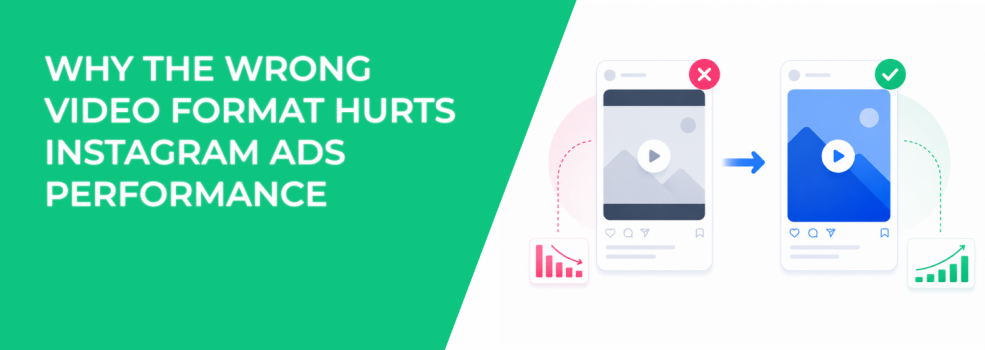
Many advertisers treat Instagram video placements as interchangeable. They create one video, upload it into Meta Ads Manager, and allow it to run across Reels, Stories, Feed, and Explore.
At first, this feels efficient. One asset is easier to produce, approve, and launch. It also gives Meta more placement flexibility, which can help delivery start faster.
The problem appears when performance starts splitting by placement. One surface may drive cheap views, another may generate clicks, and another may spend without meaningful conversions.
When that happens, advertisers often blame the audience or the offer. In many cases, the issue is simpler: the video was built for one viewing environment but forced into several others.
The Problem: One Video Format Is Being Used Across Every Instagram Placement
Each Instagram placement creates a different viewing pattern.
Reels compete with fast, entertainment-led content. Stories are consumed through quick taps. Feed gives users slightly more room to pause, read, and compare. Explore sits closer to discovery behavior, where the viewer may not know the brand or product category yet.
A video that works in one environment can become harder to consume in another because each placement creates different constraints:
- Reels needs fast movement because users compare the ad against native short-form content.
- Stories needs a clean vertical layout because interface elements can cover key text or CTAs.
- Feed needs a strong first frame because users may pause before deciding whether to watch.
- Explore needs quick category recognition because users often discover unfamiliar brands there.
The message might still be good, but the format creates friction before the viewer can process it.
This affects performance quickly. Users swipe before understanding the offer, CTR drops, and the campaign starts paying for impressions that never turn into qualified traffic. CPC can rise because fewer users click with intent. CPA can rise because the people who do click may not have understood the full value proposition.
For example, an online furniture brand might run a polished showroom video across all Instagram placements.
In Feed, the creative works because users can see the product, room layout, and caption together. In Stories, the same video loses important product details because the frame is too wide. In Reels, the pacing feels slow compared with native content.
The advertiser sees mixed results and assumes Meta is distributing budget poorly. The real issue is that the creative format does not match how users consume each placement.
The Solution: Create Placement-Specific Versions Of The Same Creative Concept
The fix is not to create completely different campaigns for every Instagram placement.
A better approach is to keep the same core concept and rebuild the execution for each environment. The message stays consistent, but the layout, pacing, framing, and CTA placement change.
This is where advertisers should adapt one ad concept for different Instagram placements instead of relying on one universal export.
For Reels, the creative needs immediate motion, fast context, and a first frame that feels native to vertical video. The viewer should understand the product or use case before the ad feels like an interruption.
For Stories, the message needs to be simpler. The layout should protect safe zones, avoid crowded text, and make the CTA easy to notice without blocking the product.
For Feed, the video can carry slightly more explanation. Users may spend more time with the caption, product shot, or visual comparison, but the first frame still needs to communicate value quickly.
For Explore, the ad should make the category obvious fast. The viewer may not be actively following similar content, so the creative has to create recognition before asking for action.
This is also why choosing between Feed and Story ads should depend on funnel stage, not only placement availability.
A local boutique promoting a seasonal collection might use one creative idea across placements: “three outfits for unpredictable spring weather.”
- The Feed version can show a carousel-style video with outfit details.
- The Stories version can use quick vertical cuts with one outfit per frame.
- The Reels version can show a fast transition sequence.
- The Explore version can open with the strongest outfit and a clear category cue.
The concept is the same, but each version respects the placement.
Before launch, advertisers should also check technical fit:
- Aspect ratio: Match the creative to the placement instead of relying on automatic cropping.
- Text placement: Keep important copy away from edges, buttons, and interface overlays.
- Product visibility: Make the product easy to recognize on a mobile screen.
- CTA clarity: Place the next step where it supports the message, not where it interrupts the visual.
Following correct Facebook and Instagram ad sizes prevents avoidable delivery waste caused by cropping or unreadable creative.
Final Takeaway
The wrong Instagram video format can weaken performance before the audience or offer gets a fair test.
When one asset is forced across every placement, the campaign may generate impressions and views, but those signals can be misleading. Format friction reduces attention, weakens click quality, and raises CPA.
The better approach is to build placement-specific versions of the same concept. When the video format matches how people behave in Reels, Stories, Feed, and Explore, the creative becomes easier to consume and the campaign has a better chance of converting efficiently.