A creative that performs well at $200/day can suddenly lose efficiency when the campaign scales to $2,000/day. CTR drops, CPA increases, and the same ad that produced consistent conversions now looks exhausted.
This shift often gets blamed on “creative fatigue.” In reality, the creative itself usually hasn’t changed. What changes is how the algorithm distributes the ad once the budget expands.
Understanding this distinction is important because replacing creatives prematurely often makes the problem worse rather than better.
Scaling Changes the Auction Environment
When you increase campaign budgets, the system does not simply show the same ads to more people in the same audience clusters. Instead, the algorithm must enter additional auctions to spend the larger budget.
Those auctions frequently contain users who are less behaviorally aligned with the initial conversion signals.
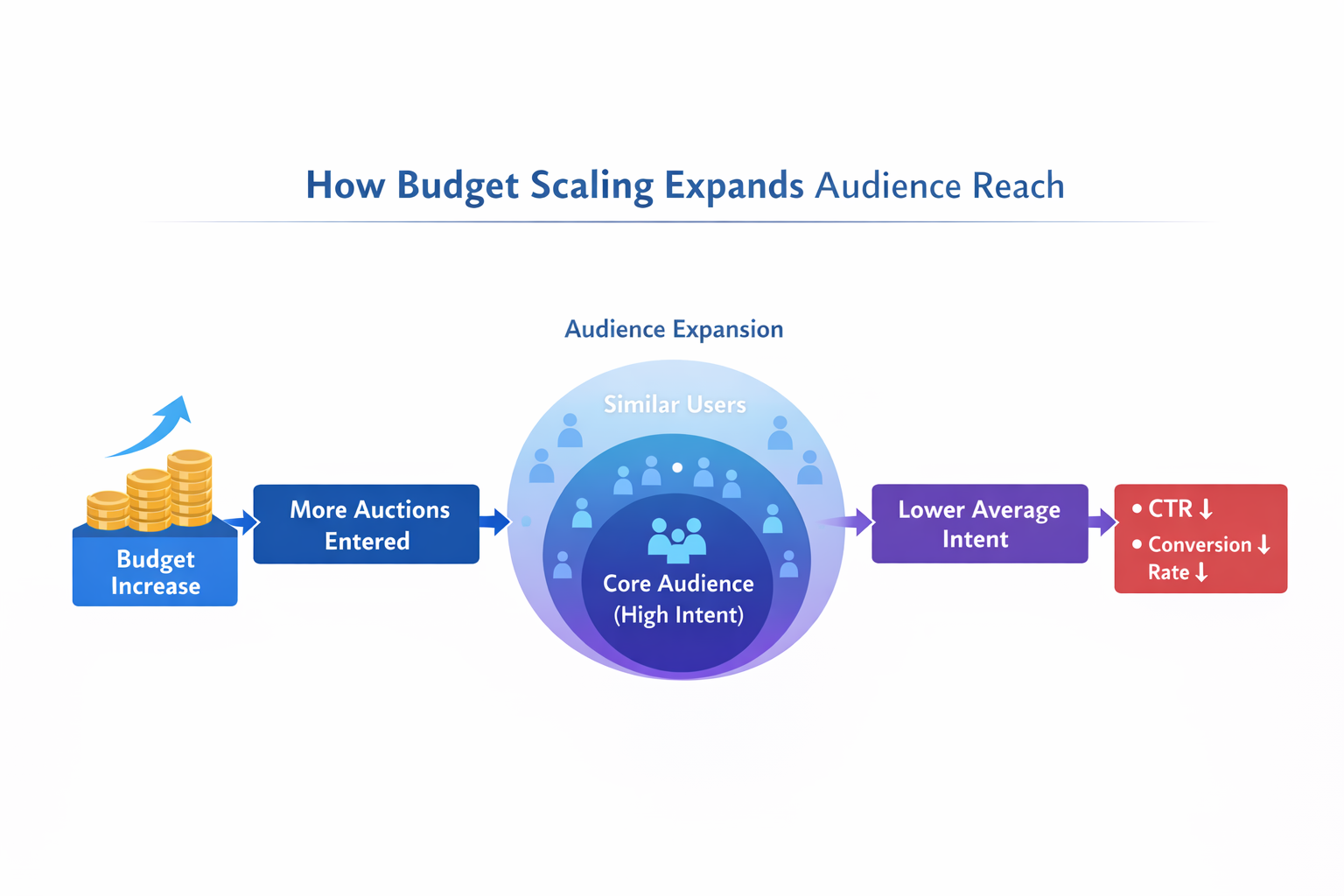
At smaller budgets, delivery concentrates in a narrow group of high-probability users. These users share strong intent signals:
-
recent product research;
-
category browsing behavior;
-
historical purchase patterns;
-
interactions with similar ads.
When budgets expand, the algorithm begins reaching users who only partially match these signals. The creative message remains the same, but the audience’s baseline interest declines.
This change alone can create the appearance that the creative stopped working.
Inside Ads Manager, this often shows up as:
-
CTR gradually declining as spend increases;
-
CPM rising due to broader auction participation;
-
conversion rate dropping even though landing page behavior remains stable.
None of these signals indicate that the creative has suddenly become ineffective. They indicate that the campaign is now competing in different auctions.
For a deeper breakdown of how auction dynamics affect delivery and cost, see Crack the Code: What You Need to Know About the Facebook Ad Auction.
High-Intent Clusters Get Saturated Quickly
Strong creatives tend to concentrate delivery inside a relatively small group of users who already demonstrate category interest. These clusters are where the algorithm finds the easiest conversions.
However, those users can be reached only a limited number of times before saturation occurs.
As spend grows, two delivery dynamics start to appear:
-
Frequency rises in the core audience.
Ads are shown repeatedly to the same high-intent users because the algorithm knows they convert. -
Delivery expands outside the original cluster.
Once frequency approaches the practical limit, the system begins testing new behavioral segments.
The result is a split audience environment:
-
a small group that has already seen the ad multiple times;
-
a larger group that is less qualified but required to absorb additional spend.
This creates a visible performance pattern in scaling campaigns:
-
frequency climbs above previous levels;
-
CTR declines gradually;
-
CPA increases even though the creative remains unchanged.
If you want to understand the mechanics behind this phenomenon, the article Why Your Ad Frequency Matters More Than You Think explains how repeated exposure affects campaign efficiency.
Scaling Increases Exposure to Less Relevant Users
Creative performance is tightly connected to how precisely the algorithm identifies potential buyers.
When the campaign starts, the model often relies on a compact set of conversion signals. Those early conversions form a pattern that guides delivery toward similar users.
Once spend grows, the campaign must find additional impressions beyond that initial pattern.
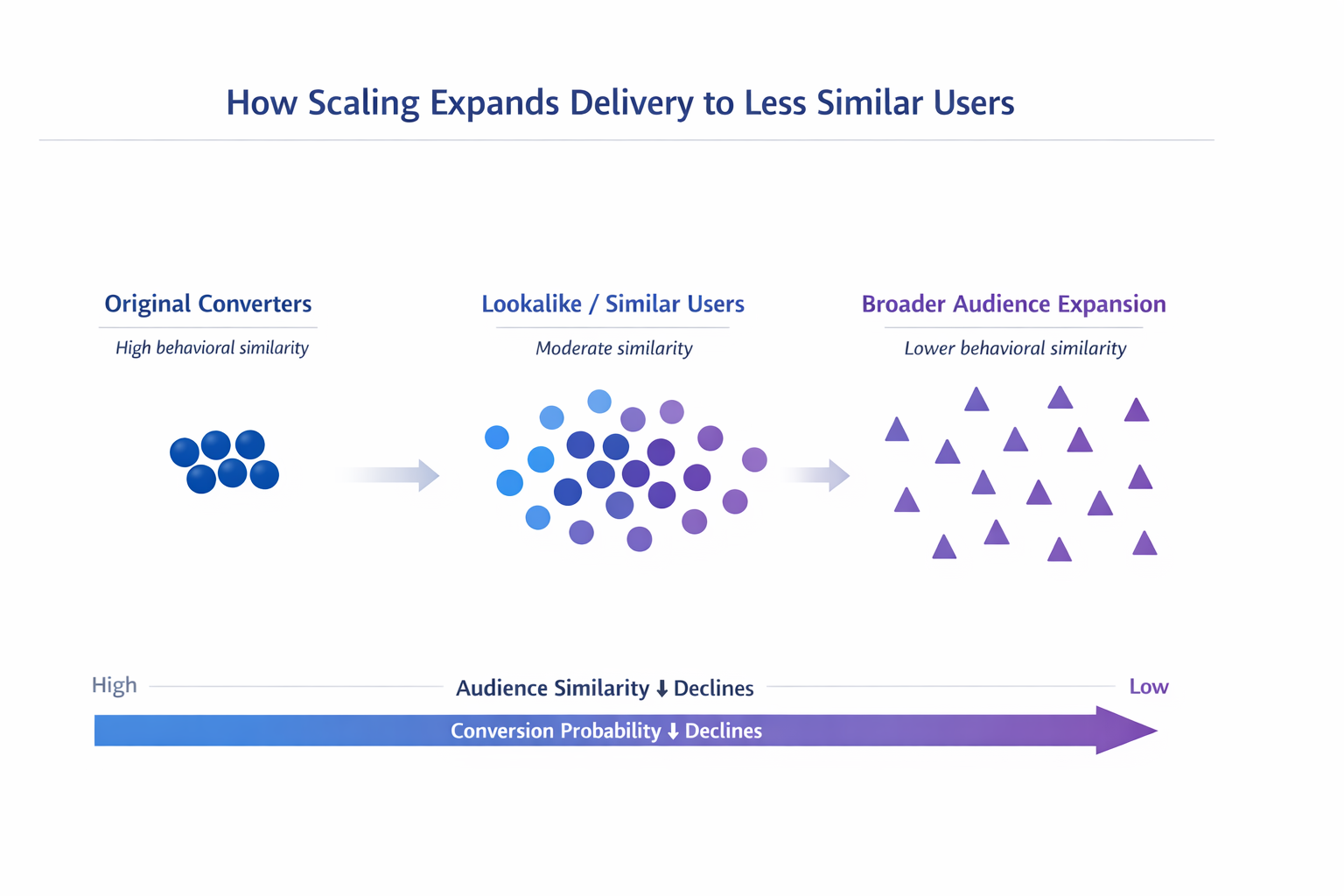
Several changes typically occur:
-
Behavioral similarity weakens.
New users share fewer characteristics with the original converters. -
Interest signals become broader.
The algorithm begins testing adjacent behaviors instead of direct category engagement. -
Auction competition shifts.
The campaign enters placements and audiences where different advertisers dominate.
From the advertiser’s perspective, this often looks like the creative suddenly losing appeal.
But the underlying problem is usually distribution quality, not messaging.
You can often verify this by checking conversion breakdowns across audiences or placements. Performance usually remains strong in the original clusters while declining in newly expanded segments.
The Algorithm Needs New Signals After Scaling
Scaling also affects the learning stability of the optimization model.
The algorithm constantly updates its predictions based on observed conversion events. When spend grows rapidly, the system receives impressions from new user groups that may behave differently.
Until enough new data accumulates, the model temporarily operates with weaker predictive confidence.
This period often produces several operational signals:
-
inconsistent daily CPA;
-
fluctuating CPMs across placements;
-
uneven hourly spend distribution;
-
learning phase resets in extreme cases.
During this stage, the creative itself may appear inconsistent even though the real issue is signal dilution.
The model must observe enough conversions from the newly expanded audience before it can re-stabilize delivery.
If conversions occur slowly in those segments, the campaign may temporarily over-deliver impressions to users who never convert.
If you want a deeper explanation of how learning phases affect delivery, see How to Finish the Facebook Learning Phase Quickly.
Frequency Can Mask Creative Effectiveness
One reason scaling often triggers premature creative changes is that frequency becomes the most visible metric.
Advertisers see frequency climbing and assume the creative has become stale.
However, frequency alone rarely explains performance decline.
Consider a typical scaling pattern:
| Spend Level | Frequency | CTR | Conversion Rate |
|---|---|---|---|
| $200/day | 1.3 | 2.8% | 5.2% |
| $800/day | 1.8 | 2.4% | 4.6% |
| $2,000/day | 2.5 | 1.9% | 3.7% |
At first glance, the creative appears to be losing effectiveness.
But the deeper explanation is usually that delivery expanded into weaker behavioral clusters.
The original audience still responds to the ad. The system simply has to reach many more users to spend the increased budget.
Replacing the creative at this stage can actually reduce performance because the algorithm loses the historical engagement signals tied to the existing ad.
Creative Fatigue vs. Audience Expansion
True creative fatigue does happen, but it produces different patterns than scaling-related decline.
| Signal | Creative Fatigue | Audience Expansion |
|---|---|---|
| CTR drop | across all audiences | mostly new audiences |
| Retargeting performance | declines | stable |
| Frequency | high | moderate |
| Cause | message exhaustion | delivery expansion |
Creative fatigue usually looks like this:
-
CTR drops across all audiences simultaneously;
-
engagement metrics fall even in retargeting segments;
-
frequency continues rising while conversions decline sharply.
In contrast, scaling-related performance changes typically show:
-
stable performance in retargeting or high-intent audiences;
-
declining metrics only in newly expanded segments;
-
CPA increase proportional to budget growth.
This distinction matters operationally. If performance drop comes from audience expansion, replacing the creative will not solve the problem.
Instead, the campaign may need:
-
more diversified creatives for broader audiences;
-
improved signal quality from conversion tracking;
-
more gradual budget increases to stabilize learning.
The mechanics behind scaling decisions are explained in more detail in The Science of Scaling Facebook Ads Without Killing Performance.
Why High-Performing Creatives Appear Fragile
A creative that wins early often works because it speaks directly to the most motivated buyers in the audience.
These users require very little persuasion. The message simply confirms an existing need.
Once the campaign expands, the same creative reaches people who:
-
are earlier in the decision process;
-
have weaker category awareness;
-
may not recognize the problem the product solves.
The creative still communicates effectively, but the audience’s readiness to buy is lower.
This difference creates the illusion that scaling “breaks” creatives.
In reality, the creative was optimized for a high-intent subset of the market, not the broader population the campaign eventually reaches.
Creative Strategy Should Evolve With Audience Expansion
Instead of replacing winning creatives immediately, scaling campaigns usually benefit from creative layering.
This means introducing additional messages that match different levels of audience awareness.
For example, a campaign that originally converts high-intent users might expand its creative mix with:
-
problem-identification ads for earlier-stage prospects;
-
product education ads explaining workflows or use cases;
-
comparison creatives addressing alternatives in the market.
Each creative type supports a different segment of the audience the algorithm begins reaching as the campaign scales.
This approach allows the original high-performing creative to continue converting the most qualified users while new creatives handle broader discovery traffic.
Practical Signals That a Creative Isn’t the Real Problem
Before replacing a winning ad after scaling, check a few delivery indicators inside Ads Manager.
Several signals suggest that the creative is still effective:
-
Retargeting CTR remains stable.
If retargeting audiences still engage with the ad, the message likely remains strong. -
Conversion rate on the landing page does not change significantly.
If landing page behavior stays consistent, the issue is usually audience quality rather than messaging. -
Performance decline aligns with budget increases.
If CPA rises immediately after scaling events, delivery expansion is the likely cause. -
Audience breakdowns show uneven performance.
Strong results often persist in the original clusters while new segments underperform.
These patterns indicate that the system is adjusting to broader delivery conditions, not that the creative has suddenly stopped working.
The Key Takeaway
Winning Facebook ad creatives rarely fail because the message itself stops working.
More often, scaling changes the auction environment, audience composition, and signal stability around the campaign.
The creative that worked at smaller budgets was optimized for a narrow group of high-intent users. When budgets expand, the algorithm must find impressions outside that group, and performance metrics adjust accordingly.
Understanding this dynamic prevents one of the most common scaling mistakes: replacing strong creatives too early.
In many cases, the better strategy is to keep the winning creative active while adding new messaging that supports the broader audiences the campaign begins reaching.