If you’re generating leads consistently but your sales team keeps saying, “These aren’t the right people,” the problem usually isn’t volume. It’s alignment.
Wrong leads are rarely random. They are the predictable outcome of how your account is structured, what event you optimize for, how your creative qualifies intent, and how your targeting signals are interpreted by the platform.
Fixing this requires more than tightening interests. It requires understanding the mechanics behind why the algorithm is finding the people it finds.
What “Wrong Leads” Actually Mean
When advertisers say they’re getting bad leads, they usually mean one of three things:
-
People can’t afford the offer.
-
People don’t match the ideal customer profile.
-
People are curious but not serious.
These outcomes feel like a targeting issue. In many cases, they’re actually optimization or messaging issues that push the system toward shallow intent pockets.
The platform is not trying to sabotage you. It is optimizing precisely for the signals you feed it.
If you optimize for cheap form fills, it will find users who frequently submit forms. If your creative emphasizes “free,” it will attract free-seekers. If your landing page asks for minimal commitment, you will get minimal-commitment prospects.
The system behaves logically. Misalignment happens when your business objective and your optimization signals diverge.
Optimization Depth Determines Lead Quality
Most lead quality problems start at the event level.
When you optimize for a top-of-funnel event like “Lead” or “Submit Form,” you are telling the system that every submission is equal. The algorithm does not know which leads close unless you give it that data.
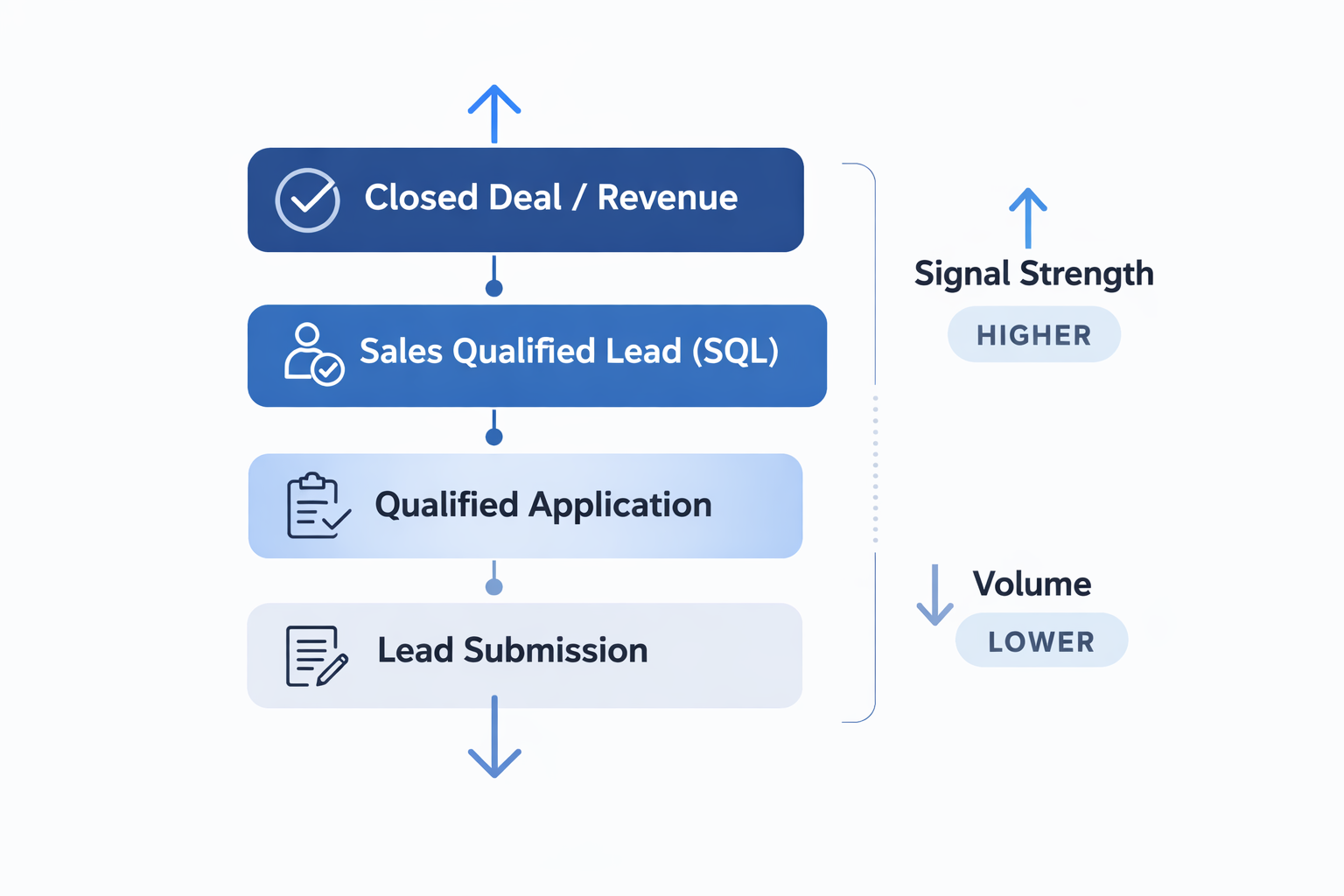
Over time, it learns who converts at the lowest friction point, not who becomes a customer.
Consider how optimization depth influences quality:
-
Shallow event (e.g., lead submission): The system optimizes for users likely to complete short forms. This favors habitual submitters and low-friction responders.
-
Mid-depth event (e.g., qualified application start): The system prioritizes users who tolerate moderate friction and show higher intent.
-
Deep event (e.g., closed deal or SQL): The system begins clustering around real buyers, assuming volume is sufficient for learning.
If your cost per lead looks strong but revenue per lead is weak, your event is probably too shallow.
If you're running Lead Ads, the fastest way to improve quality is often to build audiences that encode intent before the form even happens. See: How to Create High-Intent Custom Audiences for Facebook Lead Ads.
Realignment often means pushing optimization deeper in the funnel, even if cost per conversion initially increases. That increase is frequently offset by higher downstream efficiency.
Creative Messaging Shapes Who Clicks
Targeting does not operate in isolation. Creative filters your audience before the algorithm even starts optimizing.
If your ad promises simplicity, speed, and “no commitment,” you will attract users who value convenience over seriousness. If your messaging emphasizes strategic investment and long-term ROI, you will filter out casual browsers.
Creative alignment works in two directions:
-
It attracts your ideal customer.
-
It repels low-fit prospects.
Many advertisers underuse the second function. They attempt to maximize click-through rate and unintentionally widen the intent spectrum.
For example:
-
Adding pricing context discourages unqualified buyers.
-
Referencing required budget levels filters out small accounts.
-
Stating who the product is not for reduces noise.
Higher friction in messaging often lowers CTR but improves sales efficiency. If your team is overwhelmed by poor-fit leads, your ads may be too universally appealing.
Audience Expansion Can Dilute Intent
Broad targeting is not inherently flawed. In fact, modern ad systems often perform best with minimal restrictions.
However, when you combine broad targeting with shallow optimization and low-friction creative, the algorithm has no guardrails.
It will expand toward the largest available pool of cheap conversions.
This usually happens when:
-
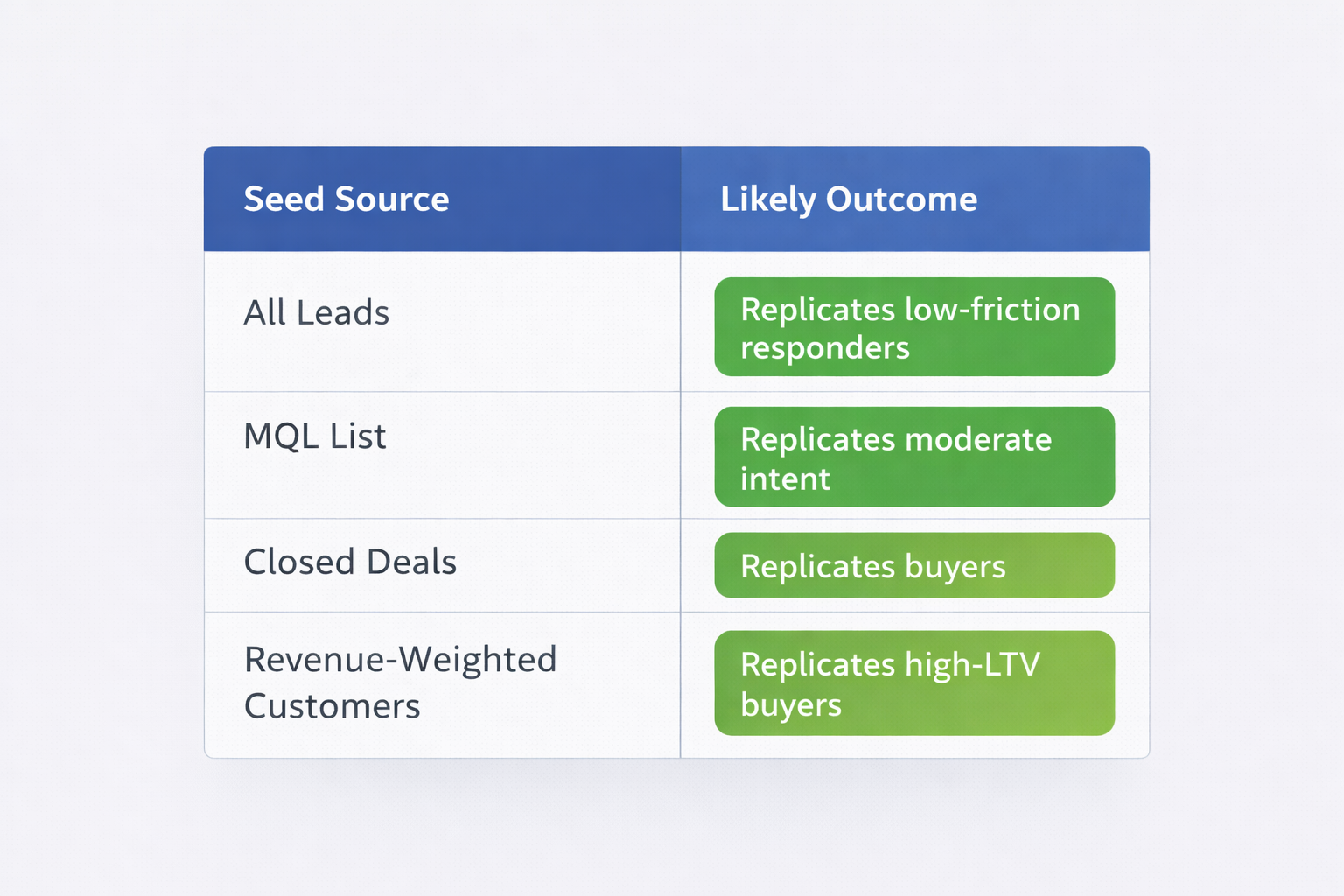
Lookalike audiences are built from unqualified lead lists.
-
Broad campaigns optimize for early events.
-
Multiple ad sets compete with overlapping signals.
-
Exclusions are incomplete, allowing recycled low-intent users.
If lookalikes are underperforming, the problem is often the seed quality rather than the audience size. The mechanics behind that process are explained here: Lookalike Audiences: How to Seed, Train, and Scale.
The issue isn’t breadth alone. It’s breadth without qualification.
If you’re unsure whether you should be leaning on custom audiences or lookalikes at this stage, this comparison is the cleanest mental model: Custom vs Lookalike Audiences: What Works Best for Facebook Campaigns?
If you want to run broad, you must anchor the system with high-quality conversion data and clear creative filters. Otherwise, it drifts toward affordability over suitability.
Landing Page Friction Controls Lead Quality
Even with proper targeting and optimization, a low-friction landing page can undo alignment.
Short forms, vague value propositions, and minimal qualification fields increase volume but reduce signal clarity.
Consider the difference:
-
A three-field “Get More Info” form attracts curiosity.
-
A structured application asking about budget, role, and timeline filters for intent.
The second option reduces total leads but improves signal density. Over time, that higher-quality feedback loop improves algorithmic matching.
If your close rate is declining while CPL improves, your form friction may be misaligned with your sales cycle.
Diagnosing the Root Cause
Before making changes, isolate where misalignment originates. A simple diagnostic framework can clarify the source.
Evaluate the following areas:
-
Event depth: Are you optimizing for an outcome that correlates strongly with revenue?
-
Lead-to-sale ratio: Is the drop-off happening immediately or later in the pipeline?
-
Creative qualification: Does your messaging attract everyone or a defined segment?
-
Audience seed quality: Are lookalikes built from buyers or just leads?
-
Form structure: Does your form gather meaningful buying signals?
Each of these components feeds the learning system. Weakness in any one of them can shift the audience composition.
If you want the broader foundation for audience architecture (and the common traps that produce low-fit traffic), use this as the hub: Facebook Custom Audiences Guide: Everything You Need to Know.
Changing interests without addressing structural issues often produces temporary fluctuations but not durable improvement.
Realigning Targeting With Revenue Signals
Once you identify the weak link, realignment becomes more systematic.
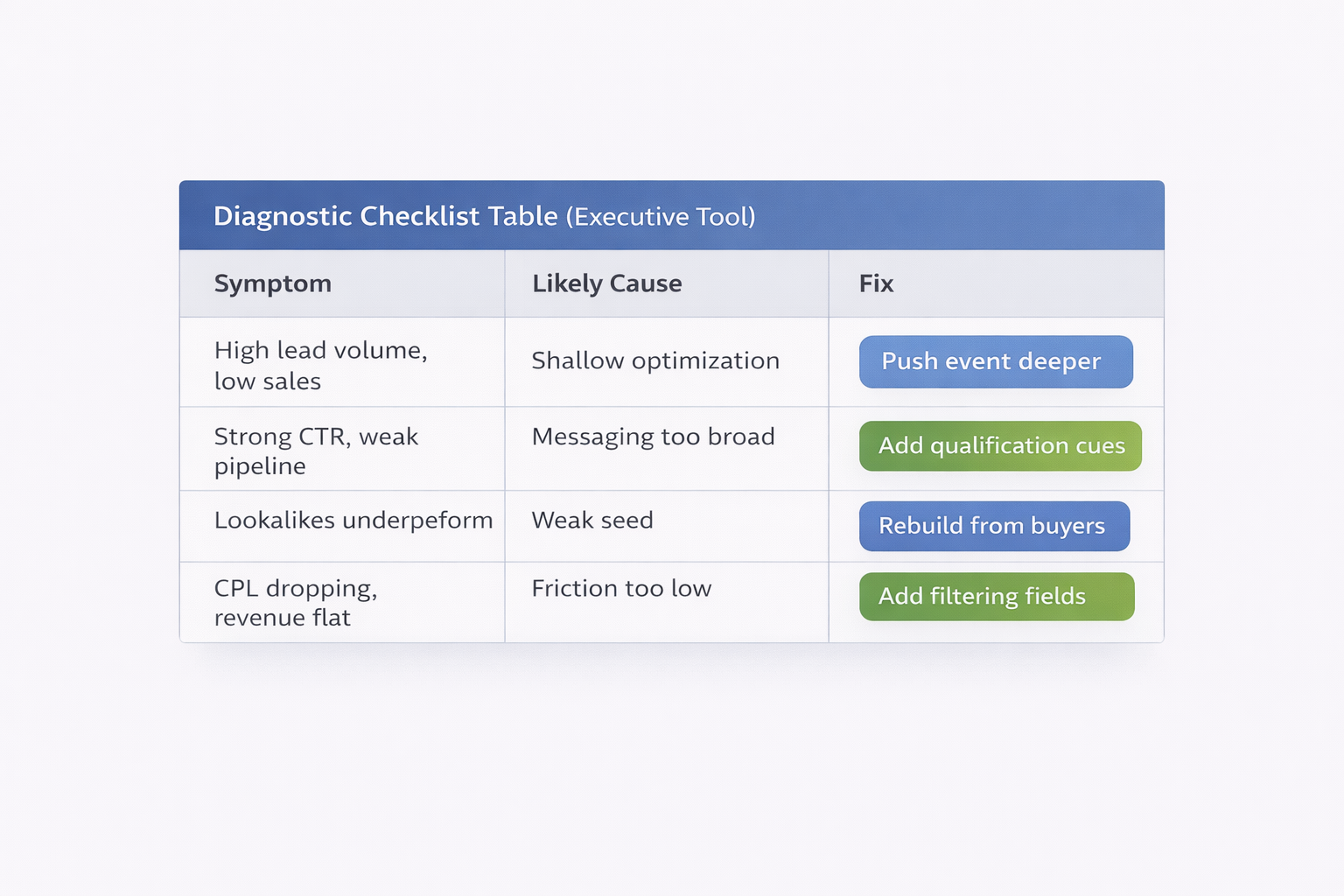
1. Push Optimization Deeper
If feasible, shift toward:
-
Qualified lead events.
-
Sales-qualified lead imports.
-
Offline conversion uploads.
-
Revenue-based value optimization.
Even partial downstream feedback improves clustering accuracy.
Expect short-term volatility. Long-term performance typically stabilizes around higher-quality cohorts.
2. Rebuild Lookalikes From Buyers
If you rely on lookalike audiences, ensure they are seeded from:
-
Closed deals.
-
High-LTV customers.
-
Revenue-weighted lists.
A lookalike from generic leads replicates generic behavior. This is also why custom audiences usually need to be the structural “base layer” first: Why Custom Audiences Should Be the Core of Your Ad Strategy.
3. Increase Intent Friction Strategically
Introduce filters where appropriate:
-
Budget qualification.
-
Role-based gating.
-
Timeline selection.
-
Clear pricing signals in ads.
This may reduce lead volume but increases signal density. That density improves learning stability over time.
4. Simplify Structure
If multiple ad sets target similar segments with limited conversion volume, consolidation often improves signal clarity.
Fragmented data slows learning and increases variability in audience matching.
The Structural Shift That Changes Lead Quality
Wrong leads are not a random platform flaw. They are usually the outcome of shallow optimization, overly broad messaging, or weak downstream feedback loops.
You are not targeting demographics. You are training a prediction system.
That system learns from:
-
The event you optimize for.
-
The users who complete it.
-
The friction required to complete it.
-
The data you feed back after the sale.
When those inputs align with revenue, lead quality improves naturally. When they align with convenience, volume increases but intent drops.
If your ads are attracting the wrong leads, start by examining what the system is being trained to value. Adjust that signal first. Everything else follows.