It’s a situation many advertisers recognize. A campaign performs consistently for weeks, then costs suddenly jump. CPM increases, cost per purchase rises, and Ads Manager shows no obvious changes to targeting, budget, or creative.
In most cases, the campaign settings are not the real cause. Facebook Ads performance depends on an auction system that changes continuously. Competition levels shift, audience behavior evolves, and Meta’s delivery algorithm adjusts to new signals.
Understanding these mechanics helps you diagnose whether the spike is temporary auction pressure or a deeper campaign issue.
The Facebook Ad Auction Changes Constantly
Every impression on Facebook or Instagram is allocated through a real-time auction. When a user opens the app, Meta evaluates which advertisers are eligible to show an ad and ranks them based on expected performance.
Three factors determine whether your ad wins the impression:
-
Bid pressure from competing advertisers.
If more advertisers target the same audience segment, auctions become more expensive. Even when your campaign settings remain identical, higher competition forces the system to bid more aggressively to win impressions. -
Estimated action rate.
Meta predicts the probability that a user will complete the campaign’s optimization event, such as a purchase or lead submission. If the predicted conversion probability decreases, the algorithm must enter more auctions to generate the same number of conversions. -
Ad quality and engagement signals.
Ads that receive higher engagement (clicks, reactions, or video views) tend to receive auction advantages. When engagement weakens, the ad’s ranking score falls and CPM can rise.
If you want a deeper explanation of how Meta evaluates audiences in this process, the article Ultimate Guide to Facebook Audience Targeting explains how targeting signals influence delivery decisions.
Competition in the Same Audience Can Shift Overnight
A cost spike often happens when additional advertisers begin targeting the same users.
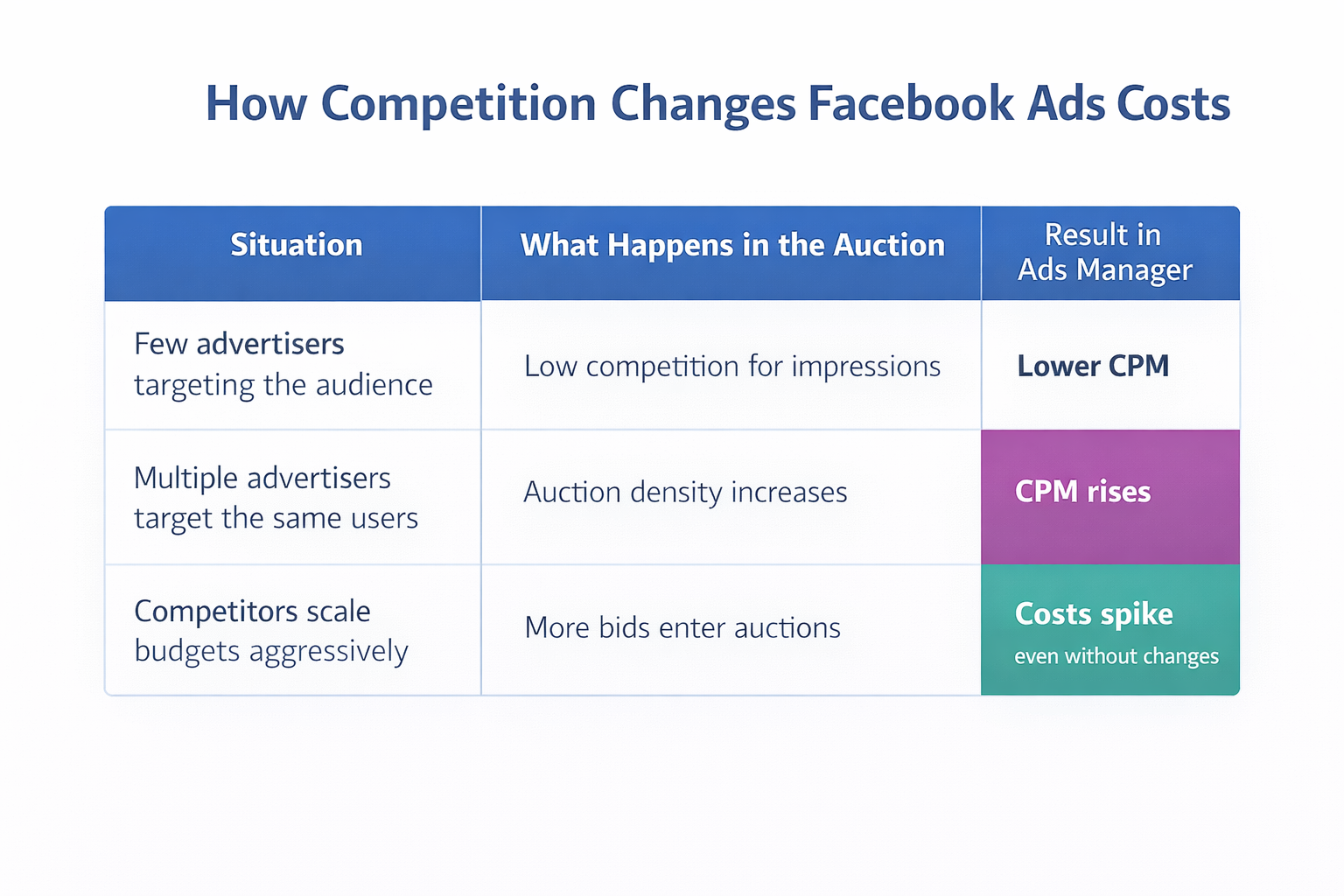
Several common situations increase auction competition:
-
Seasonal campaigns or product launches.
During high-demand periods, multiple advertisers enter the same behavioral audiences. For example, ecommerce brands often compete heavily in purchase-intent audiences during promotional periods. -
Competitors increasing budget aggressively.
When another advertiser scales budget quickly, their campaigns begin entering more auctions across the same targeting pool. -
Audience overlap across similar campaigns.
Many advertisers rely on similar targeting strategies such as interest targeting or lookalike audiences. If multiple brands pursue the same behavioral signals, auctions become more competitive.
This pattern usually appears in Ads Manager as rising CPM while CTR remains stable — indicating the ad itself is still performing normally but the auction price has increased.
For a deeper explanation of how Meta structures audience types inside campaigns, see The Complete Guide to Warm, Cold, and Custom Audiences in Meta Ads.
Audience Saturation Gradually Reduces Efficiency
Cost spikes can also happen when a campaign begins exhausting the highest-intent users within its audience.
Meta’s delivery system prioritizes users most likely to convert first. As delivery continues, the algorithm expands toward users with weaker behavioral signals.
Two delivery patterns typically follow:
-
The most responsive users convert early.
Once those users have already purchased or seen the ad multiple times, the campaign must reach less responsive segments. -
Frequency begins to increase.
If the target audience is limited, the same users receive impressions repeatedly, which gradually reduces engagement.
In Ads Manager, saturation usually appears through several signals:
-
frequency gradually increases;
-
CTR slowly declines;
-
conversion rate begins falling.
When audiences are segmented correctly, this effect becomes easier to manage. The guide Maximizing ROI through Facebook Audience Segmentation explains how separating behavioral groups can help maintain delivery efficiency.
Algorithm Learning Can Drift After New Conversions
Meta’s delivery algorithm continuously adjusts targeting based on recent conversion signals. If the characteristics of recent buyers change, the system may expand toward different user segments.
A common example occurs during promotions:
-
A campaign initially converts users who match a high-value customer profile.
-
A discount or limited-time offer attracts price-sensitive buyers.
-
The algorithm begins testing delivery toward similar bargain-focused users.
If those users convert less frequently after the promotion ends, costs can begin rising.
This shift often appears in Ads Manager as:
-
unstable CPA from day to day;
-
uneven spend distribution across ad sets;
-
sudden changes in hourly conversion patterns.
The campaign settings remain identical — but the algorithm is recalibrating based on new behavioral data.
Audience Quality Has a Direct Impact on Costs
Many advertisers focus heavily on creative optimization but overlook audience quality. When the targeting pool contains weak behavioral signals, Meta must enter more auctions to generate conversions.
This often happens when audiences are built only from broad interests or generic engagement data. Strong campaigns usually rely on structured audience sources such as customer lists, engagement-based segments, or high-intent behavioral groups.
For example, building audiences from active communities can reveal users already discussing relevant products. The article
How to Build Your Target Audience from a Facebook Group explains how group-based audiences can surface users with stronger purchase intent.
How to Diagnose a Cost Spike in Ads Manager
When campaign costs suddenly increase, reviewing several metrics together usually reveals the cause.
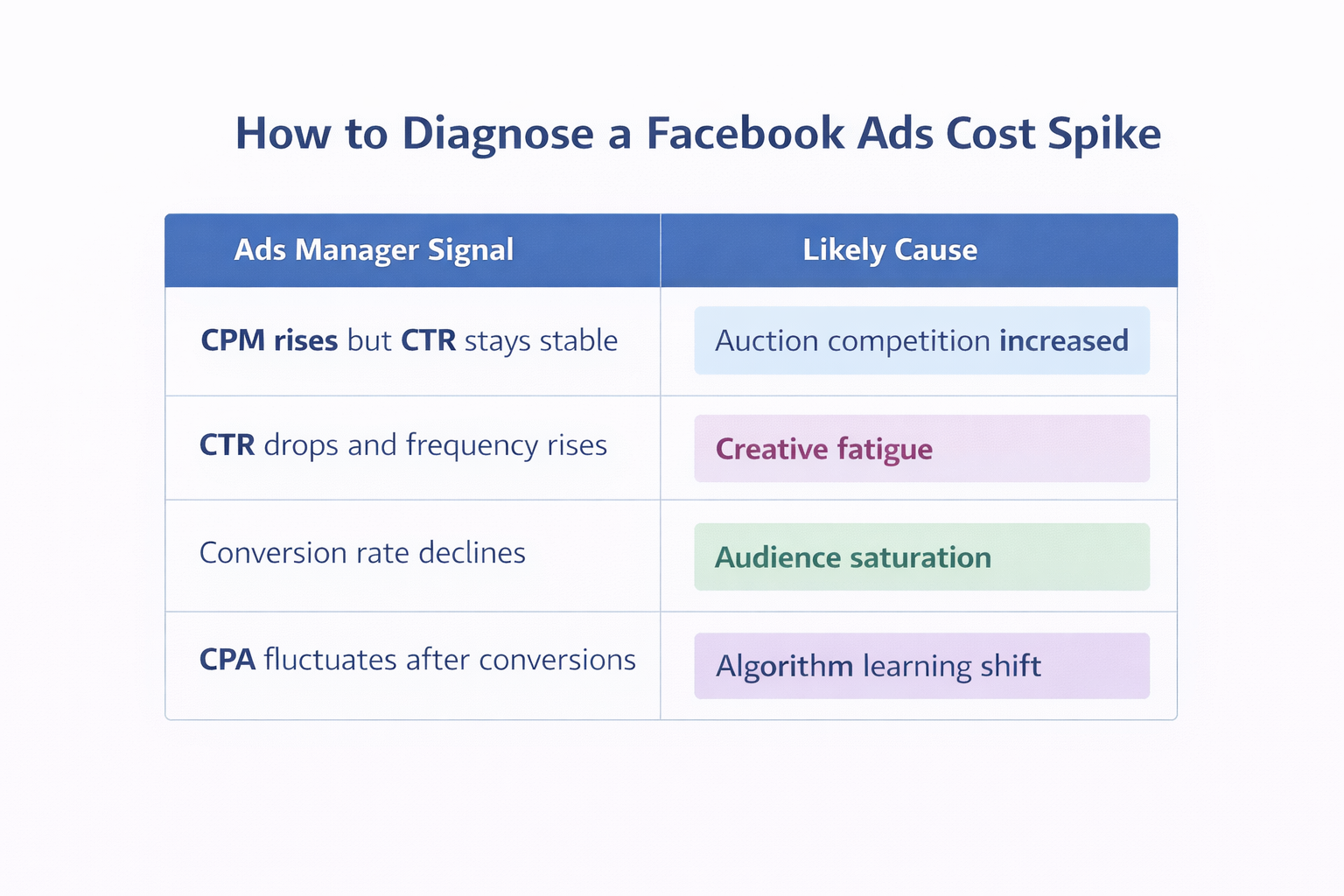
Focus on the following signals:
-
CPM increases while CTR stays stable.
This typically indicates stronger competition in the auction environment rather than a creative issue. -
CTR and conversion rate decline together.
The ad or the audience likely lost relevance, which often occurs during creative fatigue or audience saturation. -
Frequency increases rapidly.
A small audience is receiving repeated impressions, which weakens engagement and reduces click-through rate. -
CPA fluctuates heavily after new conversions.
The delivery algorithm may be recalibrating based on recent buyer signals.
Looking at these metrics together makes it easier to determine whether the issue comes from competition, targeting quality, or creative fatigue.
The Key Takeaway
Sudden Facebook Ads cost spikes rarely happen without a reason. The cause simply isn’t always visible in the campaign settings.
Most cost increases come from one of four structural changes:
-
stronger auction competition;
-
audience saturation;
-
shifts in algorithm learning signals;
-
declining creative engagement.
When you analyze the delivery patterns behind the spike, the explanation usually becomes clear. Once the underlying mechanism is identified, the next step becomes straightforward — refresh creative, expand the audience, improve targeting quality, or allow the algorithm time to stabilize.
Understanding these dynamics turns a confusing performance drop into a diagnosable system behavior.