Retargeting campaigns should convert better than most other ad types. The audience already knows your brand, visited your website, or interacted with your content.
Yet many advertisers see a frustrating pattern: the retargeting campaign delivers impressions and clicks, but conversions remain weak.
In most cases, the problem isn’t the idea of retargeting itself. The issue usually sits inside the audience structure, signal quality, or campaign setup behind it.
Your Retargeting Audience May Contain Mostly Low-Intent Traffic
A common setup is to build a retargeting audience from “All Website Visitors – 30 Days.” This creates a large audience quickly and allows the campaign to spend budget.
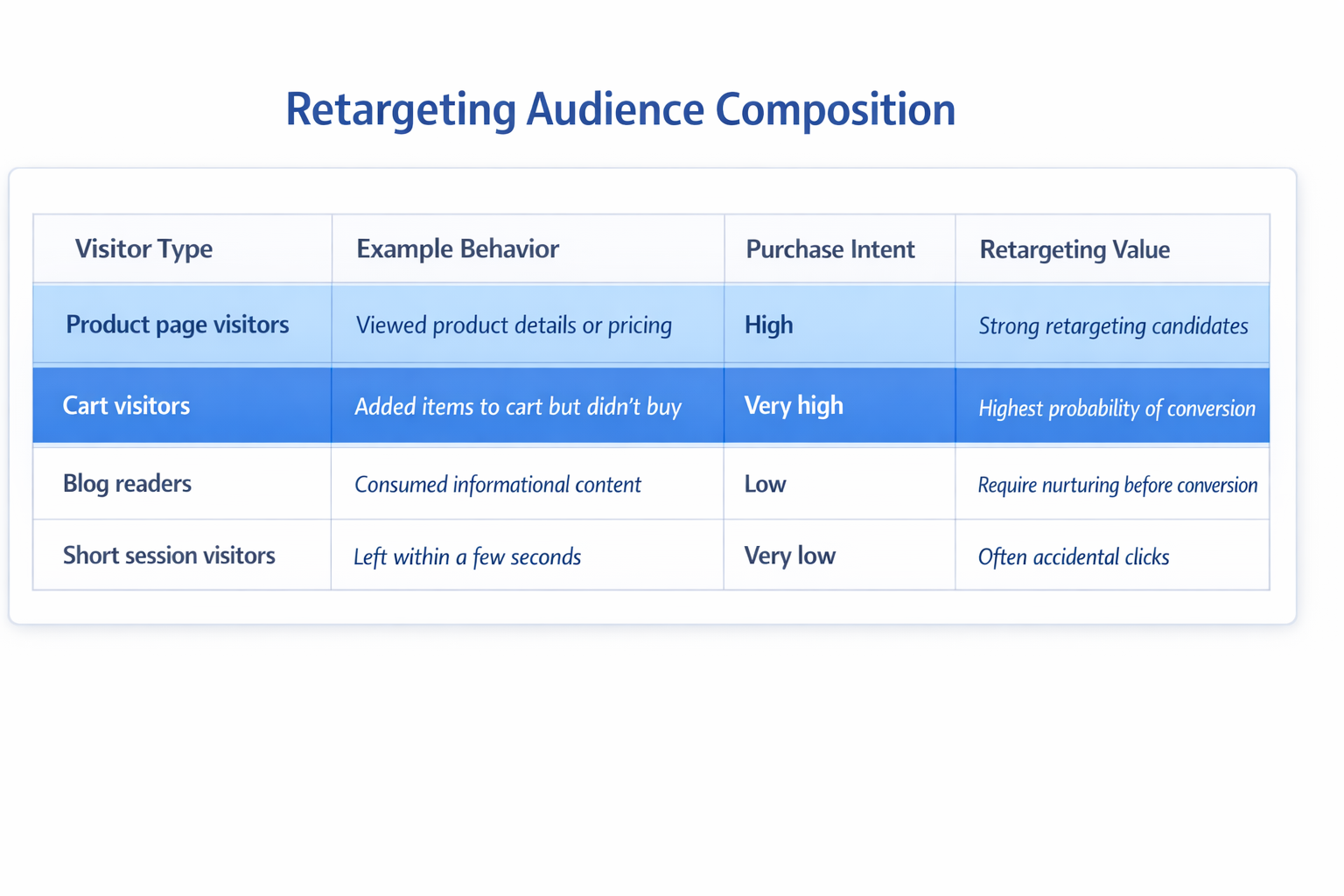
However, this audience often contains users with very different levels of intent. For example:
-
Visitors who viewed product or pricing pages. These users actively evaluated your offer and may still be considering it.
-
Visitors who consumed informational content. Someone who read a blog article or guide might simply be researching a topic rather than planning to buy.
-
Visitors who bounced immediately. Short sessions often come from accidental clicks or curiosity, not real interest.
When all of these behaviors sit inside the same retargeting audience, Meta optimizes delivery across the entire pool. The algorithm cannot reliably distinguish high-intent visitors from casual traffic.
As a result, the campaign often spends impressions on the largest segment — which is usually the lowest-intent one.
Advertisers who want stronger results usually separate audiences by behavior, such as product views, pricing visits, and cart activity. This type of segmentation is explained in How to Create High-Converting Facebook Custom Audiences.
The Audience Is Probably Saturated
Retargeting audiences are almost always smaller than advertisers assume.
If your website produces only a few hundred relevant visitors per week, your entire retargeting pool may contain just a few thousand users. Meta can reach most of them within a short period.
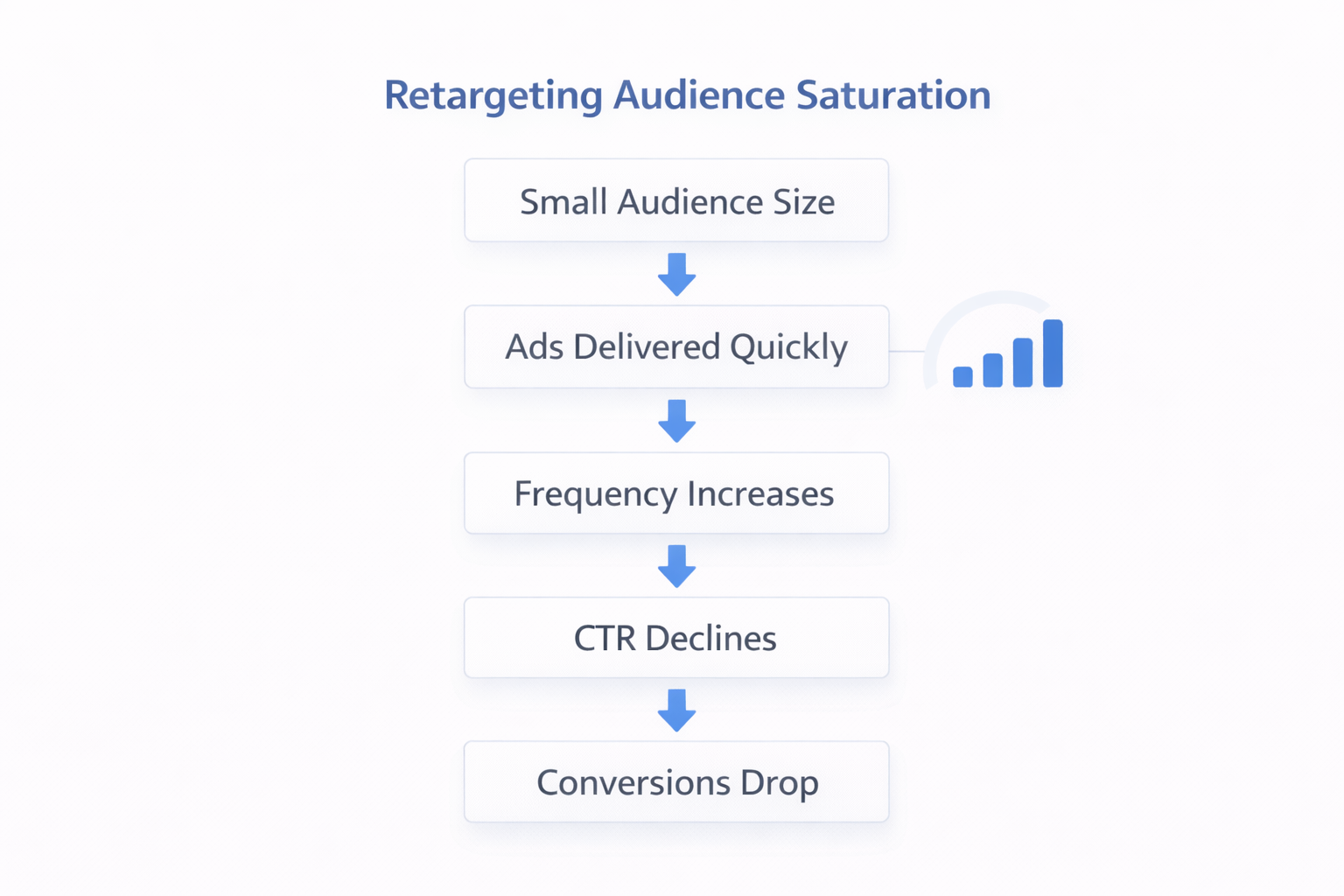
When this happens, several signals appear:
-
Frequency rises quickly. If frequency climbs above six or seven within a short timeframe, the same people are seeing the ad repeatedly.
-
Click-through rate gradually declines. Users who have already ignored the ad become less likely to interact with it again.
-
Conversions fall while impressions stay stable. The campaign continues delivering ads, but the audience has already made a decision.
This pattern is often misinterpreted as an algorithm problem. In reality, the campaign simply ran out of new users.
Managing frequency and refreshing creatives becomes essential at this stage, which is why advertisers monitor fatigue closely as described in Ad Fatigue on Facebook: How to Spot It Early and Fix It Fast.
Your Retargeting Window May Be Too Long
Many advertisers use default retargeting windows such as 30 days or 180 days.
These windows assume that purchase intent remains stable during the entire period. In reality, intent usually declines quickly.
A typical buying path often looks like this:
-
A user visits the website and checks the product page.
-
Over the next few days, they compare alternatives.
-
If they do not buy within a week, they often lose interest and move on.
If your retargeting audience includes visitors from the past 30 days, a large portion of the audience may already be outside the decision phase.
A more accurate structure usually separates visitors by recency:
-
0–3 days: users who recently interacted with product or pricing pages.
-
4–14 days: visitors still evaluating options or comparing alternatives.
-
15–30 days: low-intent traffic that may require different messaging.
This layered approach reflects how real buying behavior changes over time and fits the broader audience framework explained in The Complete Guide to Warm, Cold, and Custom Audiences in Meta Ads.
Other Campaigns May Be Competing With Your Retargeting
Retargeting campaigns rarely operate alone. Most ad accounts run them alongside prospecting campaigns, lookalike audiences, or broad targeting.
When audiences overlap, Meta must decide which campaign enters the auction for the same user.
Two issues can emerge:
-
Budget competition. Prospecting campaigns often have larger budgets. When both campaigns target the same user, the prospecting campaign may win the auction more frequently.
-
Signal fragmentation. If users convert through multiple overlapping campaigns, Meta receives mixed signals about which audience actually produced the sale.
This makes optimization harder and can reduce retargeting efficiency.
A clear separation between prospecting, warm audiences, and retargeting layers usually leads to more stable results. The logic behind this structure is covered in The Ultimate Guide to Facebook Audience Targeting.
Final Takeaway
When retargeting campaigns fail to deliver conversions, the cause is rarely the tactic itself.
Most problems come from structural issues such as:
-
Weak audience signals. The audience mixes high-intent visitors with casual traffic.
-
Audience saturation. The campaign repeatedly shows ads to the same small group of users.
-
Incorrect retargeting windows. Many users remain in the audience long after their intent has faded.
-
Campaign overlap. Prospecting and retargeting compete for the same users.
Once these issues are corrected, retargeting often becomes one of the most reliable parts of the advertising funnel.
Instead of treating retargeting as a single audience, the strongest campaigns treat it as a layered system of intent signals. When each layer receives the right message and budget, the same traffic that previously ignored ads often starts converting again.