Form fills are an easy metric to celebrate because they are immediate, countable, and often inexpensive to generate at scale. The issue is that a form submission is a signal of interest, not a signal of readiness. When marketing optimizes primarily for volume, three predictable outcomes follow:
-
Sales capacity gets diluted. Sales teams already spend a limited share of their week actually selling—Salesforce reports reps spend about 28% of their time on selling activities, with the rest consumed by admin and other work. When unqualified leads flood the queue, that selling time gets squeezed even further.
-
Speed-to-lead deteriorates. As response times rise, conversion collapses. The classic MIT/InsideSales lead response research found that the odds of qualifying a lead drop dramatically as response time increases—5 minutes vs. 30 minutes can reduce qualification odds by about 21x, and contact rates can fall sharply as well.
-
Marketing–sales trust erodes. When sales experiences low-quality leads, they disengage from marketing-sourced pipeline. Marketing responds by pushing for more volume to compensate, which worsens the problem.
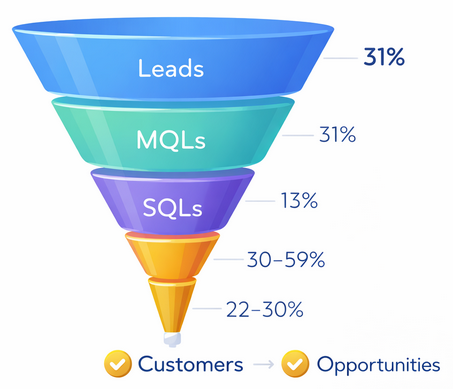
Most leads never become customers. Typical B2B funnels show that only a small share of initial leads convert into sales opportunities and closed deals, highlighting the importance of focusing on qualified leads rather than raw lead volume
The net effect is a system that maximizes activity while undermining throughput.
What “Sales-Qualified” Actually Means
A sales-qualified lead (SQL) is not “a lead sales touched.” It’s a lead that meets a shared, explicit standard indicating that sales engagement is likely to produce a legitimate opportunity.
A strong SQL definition typically includes four dimensions:
-
Fit: Firmographics and role match the ideal customer profile (ICP).
-
Need: There is a relevant use case or pain.
-
Intent: The behavior indicates near-term evaluation (not casual browsing).
-
Access: A path exists to a buying group or decision process.
Without these dimensions, “SQL” becomes subjective, and the organization slides back toward form fills as a proxy.
The Data Behind the Shift
If optimizing for SQLs sounds like “getting pickier,” that’s the point—and the data supports it:
-
Lead-to-revenue conversion is brutally low in many B2B motions. Forrester has noted research indicating that fewer than 1% of leads convert to closed deals in many environments—an indictment of lead-centric measurement when “lead” is defined too loosely.
-
Lead nurturing and qualification outperform brute-force volume. HubSpot has cited Forrester research that companies excelling at lead nurturing generate 50% more sales-ready leads at 33% lower cost.
-
Time-to-first-response is a multiplier. The MIT/InsideSales study’s findings (the 21x qualification differential tied to response speed) highlight that even good leads decay quickly when operations can’t keep up.
The common thread: organizations win by improving readiness, routing, and responsiveness, not by counting submissions.
The Hidden Cost of Optimizing for Form Fills
Optimizing for form fills creates a measurement trap:
-
CPL goes down when you broaden targeting, loosen qualification, and use frictionless forms.
-
CAC goes up when sales spends cycles on people who won’t buy, can’t buy, or won’t buy soon.
-
Attribution gets noisy because marketing claims credit for activity while sales measures outcomes.
If your dashboard celebrates cheap leads but your revenue team says “pipeline quality is down,” your system is working exactly as designed—just not for revenue.
A Practical Framework: Replace “Form KPIs” With “Revenue KPIs”
The best shift is not philosophical; it’s operational. Replace primary KPIs that reward volume with KPIs that reward revenue contribution.
Better primary KPIs than form fills
-
SQL rate (SQLs / total leads)
-
Qualified meeting rate (qualified meetings / total leads)
-
Opportunity creation rate (opportunities / total leads)
-
Pipeline per lead (pipeline value / total leads)
-
Time-to-first-touch (median minutes to first sales touch for inbound)
Guardrail KPIs (to avoid “too strict” qualification)
-
Lead volume by ICP segment (so you don’t starve the top of funnel)
-
Cost per SQL (not cost per lead)
-
Speed-to-lead by channel (so you can spot operational bottlenecks)
This reframing makes trade-offs visible: you might accept fewer leads if opportunity creation per lead rises significantly.
How to Increase Sales-Qualified Leads Without Killing Lead Flow
Below are the most reliable levers for improving SQL outcomes while keeping acquisition healthy.
1) Build a Shared Qualification Contract (and Enforce It)
An SQL definition should be documented, measurable, and auditable. The easiest way to make it real is to turn it into a “contract” between marketing and sales:
-
Marketing commits to delivering leads that match explicit criteria.
-
Sales commits to working those leads within a defined SLA and providing disposition feedback.
Key operational details:
-
Create a small set of disposition outcomes (e.g., Qualified, Nurture, Bad Fit, No Response, Competitor, Timing).
-
Require a disposition within a time window (e.g., 7 days).
-
Review outcomes weekly until quality stabilizes, then monthly.
If sales can’t disposition leads cleanly, marketing can’t improve targeting, messaging, or scoring.
2) Improve Speed-to-Lead With Routing That Matches Reality
If qualification odds collapse with delay, speed is not a “nice-to-have”; it’s a conversion lever.
Operational upgrades that typically move the needle:
-
Instant routing by territory, segment, or product line.
-
Queue balancing to prevent lead pile-ups during busy periods.
-
After-hours handling (even if it’s just scheduling a rapid next-day touch).
-
Priority rules so high-intent leads skip the line.
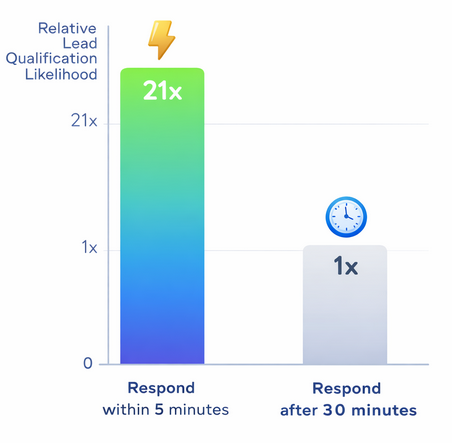
Lead response speed has a dramatic effect on qualification rates. Contacting a lead within five minutes can make sales teams about 21 times more likely to qualify the opportunity compared with waiting 30 minutes
If your best leads wait behind low-quality form fills, you’re paying premium acquisition costs and then letting the value decay.
3) Make Forms Work Harder—With Less Friction
The problem is rarely “forms exist.” The problem is “forms are treated as the goal.”
Use forms to increase SQL probability rather than maximize submission count:
-
Progressive profiling: Ask fewer questions up front, and collect more over time.
-
Conditional questions: Only ask complexity when the lead qualifies as ICP.
-
Stronger intent capture: Use questions that reveal buying stage (e.g., timeframe, current solution, evaluation status) rather than vanity fields.
-
Spam resistance: Add lightweight validation patterns that discourage bots without harming real users.
This reduces junk submissions while preserving conversion rate for the right audience.
A Simple Way to Diagnose Whether You’re Still Optimizing for Form Fills
Run this quick diagnostic on the last 30–90 days:
-
Which channel has the lowest CPL?
-
Does that same channel have the highest opportunity creation rate?
-
If not, are you scaling the wrong thing?
Many teams scale the cheapest lead source because it makes dashboards look good, even if it produces weak pipeline. The right answer is often to scale the channel with the best cost per SQL or best pipeline per lead—even if CPL is higher.
What to Expect After You Make the Shift
A successful transition usually looks like this:
-
Week 1–3: Lead volume drops, internal anxiety rises.
-
Week 3–6: Sales responsiveness improves because queues are cleaner.
-
Week 6–12: Opportunity creation rate rises, pipeline quality stabilizes.
-
Quarter 2+: Forecast quality improves because pipeline is less inflated with low-probability deals.
If volume doesn’t drop at all, you may not have changed the system enough—or you may already have strong qualification.