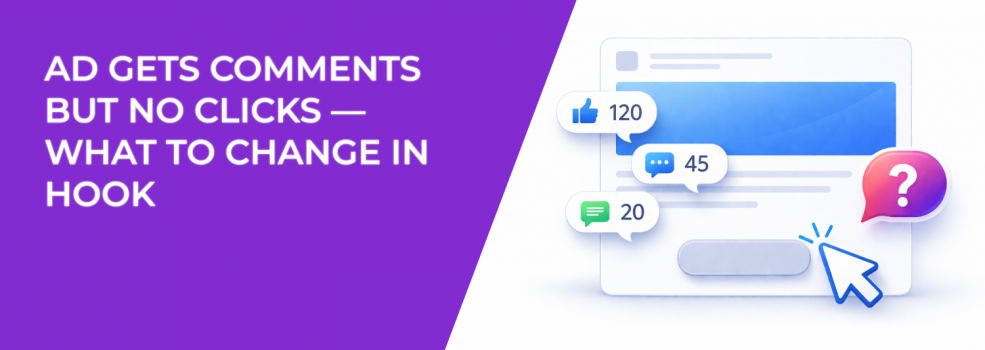
Comments without clicks are not a “creative success.” They’re a signal of misalignment between attention and intent.
At the surface, engagement looks strong. In Ads Manager, you’ll often see high post interaction rates, low CPC, and stable CPM. But link clicks lag behind, and downstream metrics — landing page views, conversions — barely move.
This is not a targeting problem. It’s a hook problem.
Why Comments Can Increase While Clicks Drop
You’ll usually see this pattern after a creative refresh or when testing more opinion-driven angles.
The ad attracts reactions, but not action.
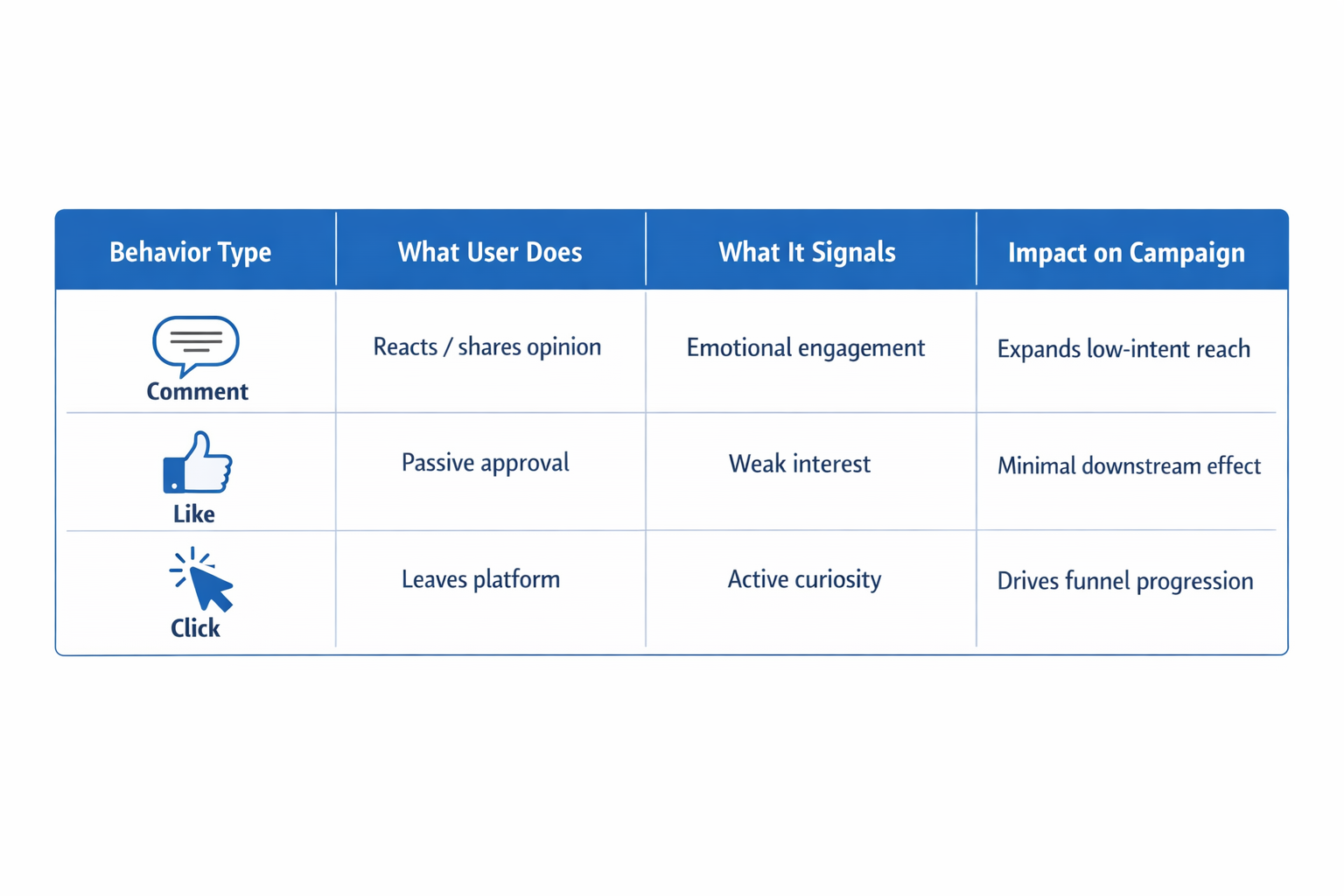
What’s happening is structural. The creative is optimized for interaction, not progression through the funnel.
-
The hook triggers emotional or social engagement, not commercial curiosity.
People react, agree, disagree, or share opinions. None of these behaviors require leaving the platform, so the interaction loop ends inside the feed. -
The algorithm reinforces the wrong signal.
When Meta sees high engagement, it expands delivery toward users who are likely to comment — not users likely to click or convert. -
The click becomes unnecessary.
If the core message is fully consumed inside the ad, the user has no reason to continue. The journey stops at the impression.
As a result, the campaign accumulates engagement signals that look positive but actively push delivery away from users with real buying intent.
The Core Issue: The Hook Resolves Instead of Creates Tension
A high-performing hook consistently creates a gap the user wants to close.
When ads get comments but no clicks, that gap is missing. The hook delivers a complete thought instead of opening a loop.
This usually shows up in three recurring formats. Each one feels effective on the surface but breaks the click path.
-
Opinion-driven hooks that invite agreement or disagreement.
These trigger responses because they are easy to react to, but they rarely create a need to learn more. -
Fully explained insights compressed into one sentence.
The user understands the takeaway instantly, so there is no unresolved question. -
Relatable pain points without direction.
Recognition happens, but there is no implied next step or mechanism to explore.
This is closely related to how weak framing affects performance, which is explored further in Why Your Ad Copy Might Be Hurting Lead Quality (And How to Fix It).
How to Diagnose a “Comment-Heavy” Hook
You don’t need to rely on intuition here. The pattern is visible in campaign data if you know where to look.
Start by isolating a few creatives with unusually high engagement and compare them against click behavior. Then validate the pattern using these signals.
-
High comment volume with low outbound CTR.
For example, 50–100 comments per day while outbound CTR remains below 0.8%. This indicates attention without intent. -
Stable or improving engagement ranking, but flat conversions.
The platform sees the ad as engaging and keeps delivering it, but downstream performance does not follow. -
Long comment threads discussing the idea — not asking for details.
Users debate, agree, or challenge the statement, but rarely ask “how does this work?” or “where can I learn more?” -
Low landing page view rate relative to clicks.
Even when users click, intent is weak. They drop off before the page loads because the click was not driven by genuine curiosity.
If you want a deeper framework for reading these signals correctly, this ties directly into How to Analyze Facebook Ad Performance Beyond CTR and CPC.
What to Change in the Hook
Fixing this requires shifting how the first line creates tension and direction. You’re not trying to increase engagement — you’re trying to make the next step necessary.
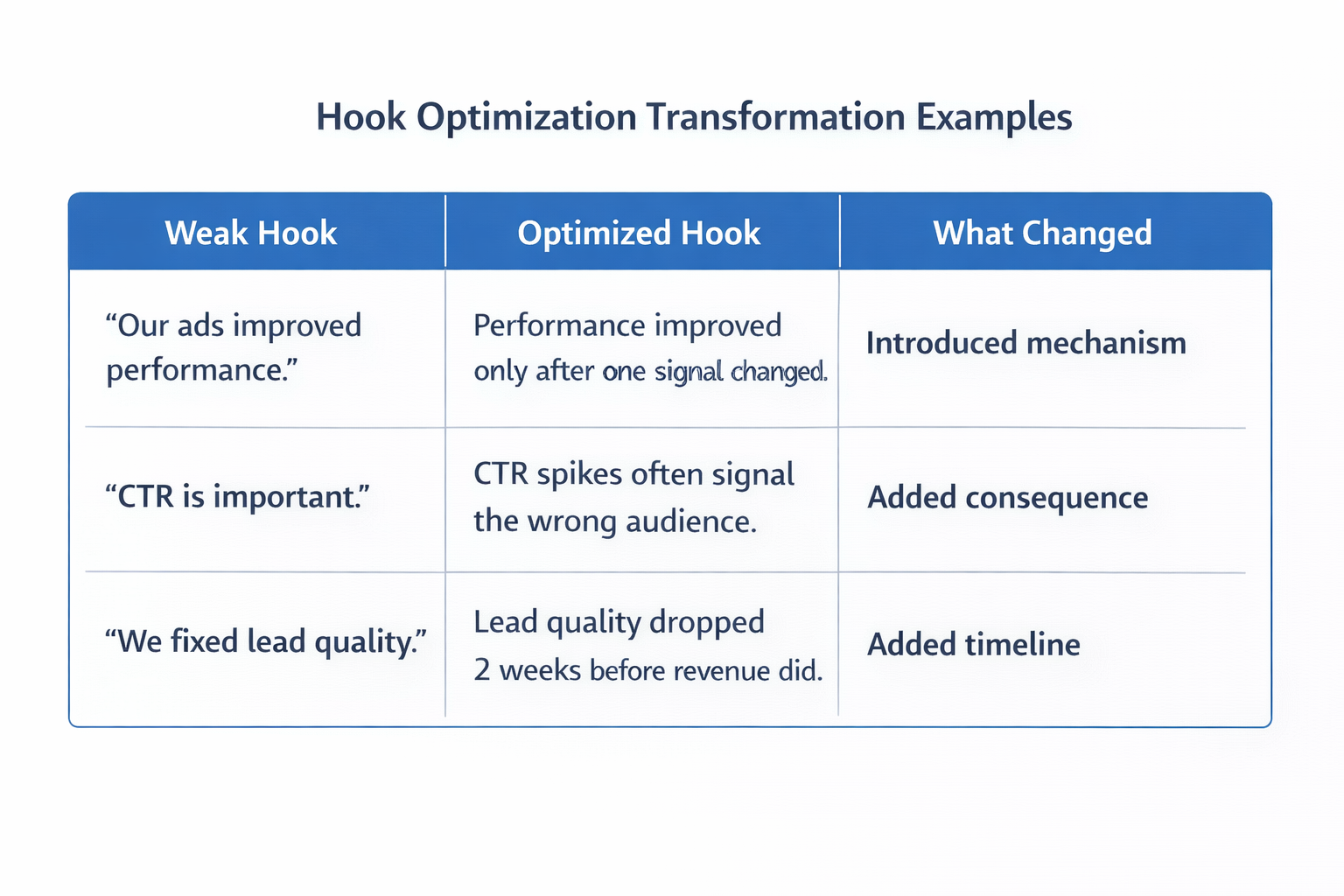
1. Shift from statements to incomplete mechanisms
A strong hook should introduce a system or pattern without explaining it fully. That missing piece is what drives the click.
Instead of delivering a finished conclusion, you want to expose part of the mechanism and stop there. This forces curiosity to carry the interaction forward.
Examples:
-
“Most B2B ads fail because they optimize for cheap leads.”
-
“Most B2B campaigns collapse when lead cost drops below a certain threshold.”
-
“High CTR means your ads are working.”
-
“High CTR often signals your ads are attracting the wrong behavioral cluster.”
-
“Retargeting is the most efficient channel.”
-
“Retargeting performance drops when audience recycling exceeds a certain frequency.”
In each improved version, the user sees a pattern but not the explanation. The click becomes the only way to resolve it.
2. Remove full explanations from the first frame
Many underperforming ads try to “deliver value” too early. The result is that users get the answer without needing to act.
You want to delay clarity slightly so that the user must continue. Think of the first frame as an entry point, not the full argument.
Examples of over-explained hooks and improved versions:
-
“We increased ROAS by improving audience targeting and creative testing.”
-
“We fixed this campaign after noticing a 3-day lag between lead generation and sales feedback.”
-
“Low-quality leads come from broad targeting without proper filtering.”
-
“Lead quality issues usually appear when broad targeting starts clustering similar low-intent users.”
-
“This landing page converts better because it has fewer fields.”
-
“Conversion rates drop when form friction crosses a certain threshold — most teams miss where that happens.”
The improved versions leave a gap. That gap is what drives the click.
3. Introduce consequence, not just observation
Observations generate agreement. Consequences create urgency and direction.
If the hook only describes what is happening, users react. If it shows what happens next, users investigate.
Examples:
-
“Low CPL doesn’t always mean good performance.”
-
“Lowering CPL can quietly reduce pipeline quality within two weeks.”
-
“Your ads may be reaching the wrong audience.”
-
“If your ads reach the wrong audience, your sales cycle usually doubles before you notice.”
-
“Creative fatigue affects performance.”
-
“When creative fatigue starts, CPM often rises before CTR drops.”
-
“High engagement is a good sign.”
-
“High engagement without clicks usually means your campaign will stall before scaling.”
The addition of consequence introduces risk. That shift alone often increases outbound CTR.
4. Align hook language with post-click value
Clicks drop when the hook and the landing experience feel disconnected.
If your landing page contains a structured explanation — a framework, diagnostic method, or tactical breakdown — the hook should hint at that structure without revealing it.
Examples:
-
“Here’s how to improve your ads.”
-
“There’s a 3-step pattern behind most failing ad accounts.”
-
“We optimized this campaign successfully.”
-
“This campaign broke because of one misaligned signal — fixing it required a specific sequence.”
-
“Learn how to scale ads.”
-
“Scaling stops when one metric plateaus before the others — most teams miss which one.”
This approach works because it signals depth. The user expects something structured behind the click.
5. Reduce “debate bait”
Hooks designed to provoke opinions often inflate engagement while reducing clicks. They create conversations, not progression.
This pattern appears frequently in ads trying to sound bold or contrarian.
Examples of debate-driven hooks:
-
“Cold email is dead.”
-
“Performance marketing is broken.”
-
“Most agencies don’t know what they’re doing.”
These generate comments because they are easy to respond to. But they don’t guide users toward learning anything specific.
Replace them with mechanism-driven or scenario-based hooks:
-
“Cold email response rates drop sharply when inbox clustering changes.”
-
“Performance marketing breaks when conversion signals lose consistency across campaigns.”
-
“Agency results often decline when reporting cycles don’t match sales feedback loops.”
If you want to push this further, combining mechanism with emotional trigger works well — a concept explored in The Psychology of Facebook Ads: How to Hook Your Target Audience in Seconds.
A Practical Rewrite Example
Take a simple, high-engagement but low-click hook:
-
“Most marketers don’t understand lead quality.”
This generates comments because it’s easy to agree or disagree with. There is no next step implied.
Now compare it with a rewritten version:
-
“When lead quality drops, sales teams usually feel it 10–14 days before marketing sees it in the data.”
This version introduces a timeline and a hidden signal. It suggests that something is happening behind the surface, but doesn’t explain it.
You can extend this approach further:
-
“Lead quality issues usually start when one audience segment begins dominating delivery.”
-
“You can often predict poor lead quality by watching how quickly frequency increases in the first 48 hours.”
-
“Campaigns that scale too fast often lose conversion consistency within the first week.”
Each version opens a loop instead of closing it. That’s the core change.
When Comments Are Actually Useful
Not all comment-heavy ads are a problem. In some cases, they serve a specific role within the campaign structure.
The key is understanding when engagement supports your objective and when it distracts from it.
-
Top-of-funnel amplification can benefit from engagement.
High interaction can expand reach at a lower cost, especially when followed by retargeting campaigns focused on conversion. -
Message testing becomes easier with visible feedback.
Comments reveal how users interpret your positioning and where misunderstandings occur. -
Objection discovery happens naturally in comment threads.
Repeated questions or pushback highlight friction points you can address in future creatives or landing pages.
The mistake is treating engagement as the final goal when the campaign is supposed to drive clicks or revenue.
The Structural Shift
You’re not trying to maximize attention. You’re trying to direct it.
A good hook does not fully communicate the idea. It creates a controlled gap between what the user sees and what they want to understand next.
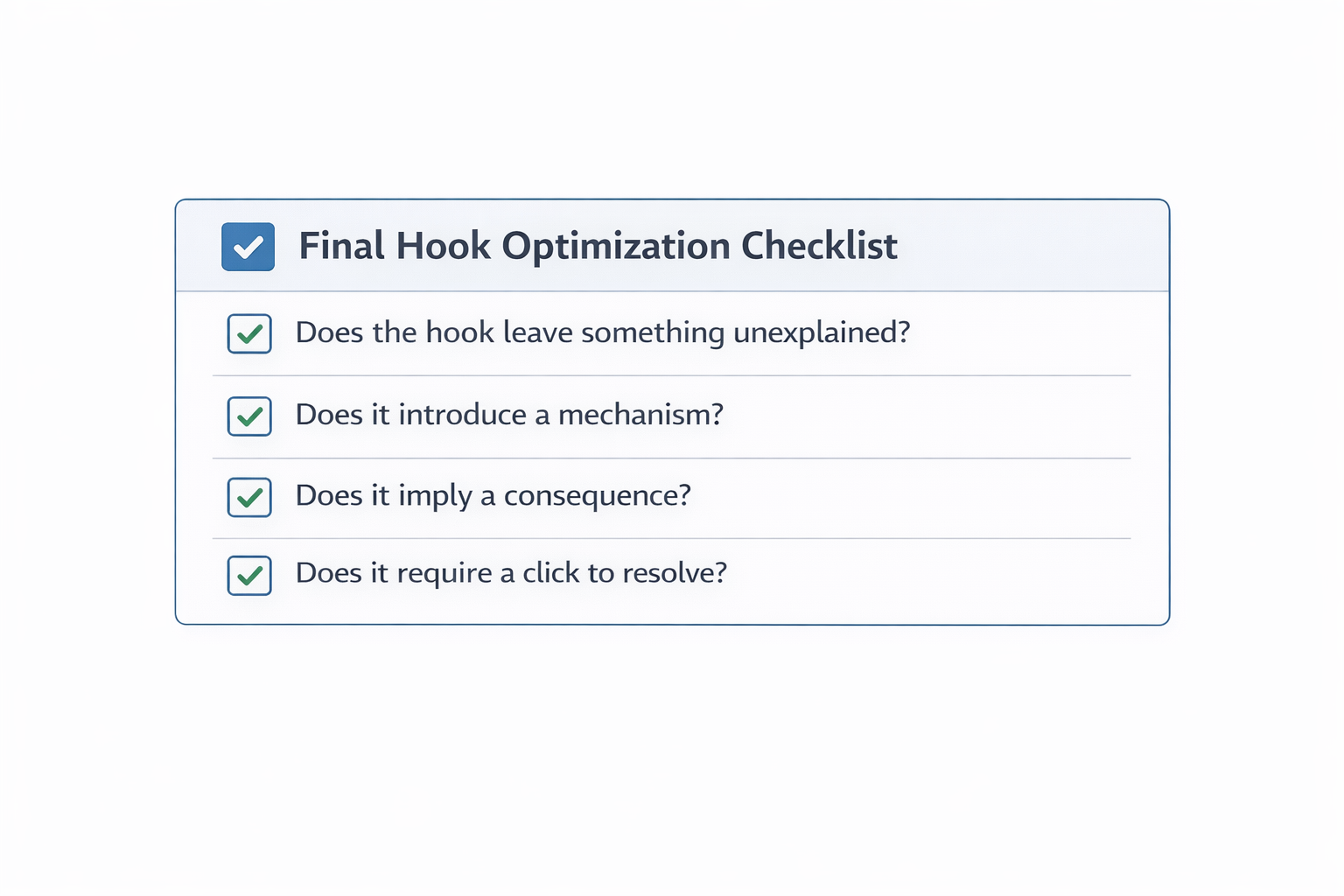
That gap is where clicks come from.
If your ads generate conversation but not movement, the fix is precise:
-
remove closure from the first line,
-
introduce a mechanism without explaining it,
-
and make the next step necessary.
This shift turns passive engagement into directional intent, which is what actually drives clicks and downstream results.