Meta automation can help campaigns scale, but it can also make advertisers nervous.
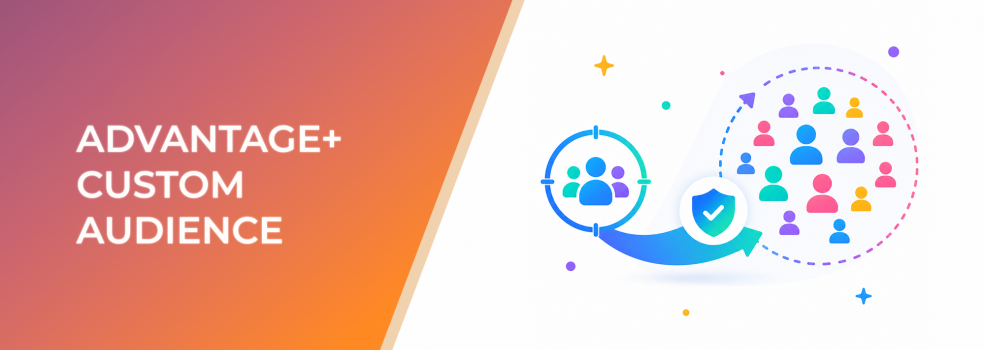
Advantage+ Custom Audience is a good example. Instead of treating your selected custom audience as a strict boundary, Meta can use it as a source signal and look for more people when it expects better performance.
That can be useful. It can also be risky if your source audience is weak.
For performance marketers, the question is not “Should automation be on or off?” The better question is: “What signal are we giving Meta to expand from?”
What Advantage+ Custom Audience changes
Traditional custom audience targeting is usually built around a defined audience: website visitors, customers, leads, app users, or engagement audiences.
Advantage+ Custom Audience changes the role of that audience. The audience becomes more of a starting signal than a hard limit. Meta can use it to guide delivery and may expand beyond it when the system predicts that doing so will help the campaign goal.
That creates more scale potential, especially when a custom audience is too small or has started to saturate.
But it also means the quality of your source audience matters more. If your custom audience contains poor-fit leads, stale website visitors, accidental clicks, or mixed intent signals, expansion can spread those weaknesses into a larger campaign.
Business impact on CPC, CPA, CAC, ROAS, and lead quality
Advantage+ Custom Audience can improve performance when it has strong inputs and a meaningful campaign objective.
Possible benefits include:
- More reach without manually building many ad sets.
- Better delivery when retargeting pools are too small.
- Faster discovery of adjacent high-intent users.
- Lower manual testing workload.
- More scale after a campaign has proven performance.
But there are also performance risks:
- Lower CPC that comes from less qualified users.
- Lower CPL but weaker qualified lead rate.
- Higher CAC if sales teams spend time on poor-fit leads.
- Lower ROAS if purchase quality or average order value drops.
- Less clarity about which audience source drove the result.
Automation can make a campaign look more efficient in Ads Manager while making the business economics worse. That is why downstream measurement matters.
Typical scenarios where this applies
Scaling a proven custom audience
If a customer list, website event audience, or high-intent engagement audience is performing but reaching its limit, Advantage+ expansion may help find similar users.
Lead generation campaigns
Lead gen teams may use Advantage+ Custom Audience to increase volume, but they should measure qualified leads, booked calls, sales acceptance, and pipeline, not just form fills.
Ecommerce retargeting and acquisition
Past buyers, cart abandoners, or product viewers can provide strong signals if they are recent and commercially relevant.
Agencies managing multiple accounts
Agencies may use Advantage+ Custom Audience to simplify structure, but each client still needs distinct source audiences, exclusions, and quality checks.
Early-stage testing with limited data
When an advertiser has limited first-party data, a carefully chosen source audience can help Meta explore without relying only on broad targeting.
Risks and considerations
The biggest risk is seed contamination.
If your custom audience includes people who are not representative of your ideal customer, Meta may expand from the wrong pattern. For example, a lead list full of unqualified form submissions may teach Meta to find more people who submit forms but never buy.
Another risk is over-trusting the campaign objective. If the objective rewards a shallow action, Meta may optimize toward users who complete that action cheaply.
Advertisers should also be careful with exclusions. Current customers, active opportunities, recent purchasers, employees, or irrelevant segments may need to be excluded depending on the campaign goal.
Finally, some industries face stricter advertising rules. Advantage+ settings do not remove the need to follow applicable Meta policies, privacy requirements, or special category restrictions.
Prerequisites and dependencies
Before using Advantage+ Custom Audience, advertisers should define:
- The source audience and why it represents quality.
- The campaign objective and whether it reflects business value.
- The exclusions required for the campaign.
- The downstream metrics that will determine success.
- The test budget and comparison benchmark.
- The creative message that qualifies users before they click.
The stronger your source audience and measurement plan, the more useful Advantage+ expansion becomes.
How LeadEnforce helps
LeadEnforce helps advertisers feed Advantage+ Custom Audience with stronger audience signals.
Instead of relying only on broad interests, weak engagement audiences, or generic website traffic, LeadEnforce lets advertisers build custom audiences from Facebook groups, Instagram profiles, Instagram followers and engagers, LinkedIn professional data, and custom social-profile sources.
This can give Meta a more relevant starting point.
A B2B advertiser can build an audience around professional fit. An ecommerce brand can use niche Instagram or competitor-related social signals. A local service business can start from communities that already discuss its category. An agency can create differentiated audience inputs for each client instead of reusing the same broad targeting logic.
LeadEnforce does not replace Meta automation. It helps improve the quality of the signal automation receives.
Practical recommendations
Audit the source audience first
Do not use Advantage+ expansion on a custom audience just because it is available. Ask whether the audience reflects the customers, leads, or behaviors you actually want more of.
Avoid expanding from weak lead lists
If your leads are cheap but unqualified, expansion can amplify the wrong signal. Use qualified leads, booked calls, closed-won customers, or high-intent audiences where possible.
Keep hard constraints clear
Use available controls for non-negotiable requirements such as geography, language, age, exclusions, or customer suppression.
Measure downstream performance
Review qualified lead rate, sales outcomes, purchase quality, refunds, repeat purchases, or pipeline contribution. Do not rely only on CPC, CTR, or CPL.
Compare against a benchmark
Run Advantage+ Custom Audience against a structured control when possible. The goal is to understand whether expansion improves business economics, not just delivery.
Improve seed quality with LeadEnforce
Use social-profile and community-based audience sources to give Meta a cleaner starting point before expansion begins.
Final takeaway
Advantage+ Custom Audience can help advertisers scale beyond narrow custom audiences, but it works best when the source signal is strong. If the seed is relevant, recent, and tied to real business value, expansion can support better reach and efficiency. If the seed is weak, automation can scale the wrong audience faster.
The quality of your input still shapes the quality of your output.
To give Meta stronger audience signals before your next Advantage+ Custom Audience test, join the free 7-day LeadEnforce trial period.
Related LeadEnforce Articles
- Advantage Custom Audiences: Why They Work and How to Use Them — Directly related to using Advantage+ custom audiences in Meta Ads.
- Advantage+ Audience: How to Use Meta Automation Without Losing Audience Quality — Explains how to pair Meta automation with better audience inputs and quality checks.
- Audience Controls vs Audience Suggestions: How to Guide Advantage+ Audience Without Wasting Spend — Useful for understanding how to guide automation without losing key boundaries.
- Tap Into New Audiences with the Power of Advantage+ Expansion — Provides broader context on Meta audience expansion and its trade-offs.
- LeadEnforce Audiences vs. Interest Targeting: Which Drives Better Results? — Helps compare LeadEnforce-built audience signals with standard interest targeting.