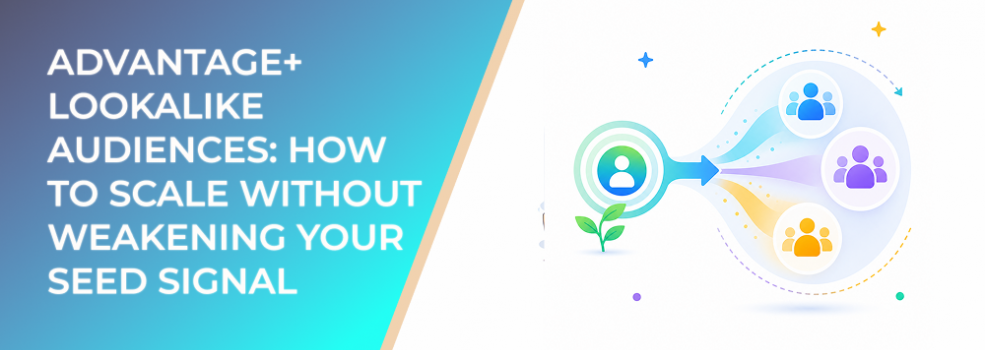
Lookalike audiences have long been one of the most practical ways to scale Meta campaigns. Instead of manually guessing interests, advertisers can start from a source audience and ask Meta to find people who resemble it.
Advantage+ lookalike changes how that expansion works.
Meta may use your lookalike as a signal and deliver beyond the selected audience when it believes doing so can improve performance. That can create more scale, but it also makes seed quality even more important.
If your source audience is strong, Advantage+ lookalike can help you find more qualified prospects. If your source audience is weak, stale, or filled with low-quality leads, expansion can spread that weakness across a larger budget.
The core issue: scale depends on the seed
A lookalike audience is only as useful as the audience it is modeled from.
If the seed audience includes high-value customers, qualified buyers, or genuinely engaged users, Meta has a better signal. If the seed audience includes cold leads, accidental clicks, unqualified form submissions, or mixed intent levels, Meta may optimize toward the wrong pattern.
This is especially important with Advantage+ lookalike because the system has more flexibility to find performance opportunities beyond the selected lookalike group.
The practical question is not only “Should we use lookalikes?” It is “What are we asking Meta to look alike to?”
Business impact on CPA, CAC, ROAS, and lead quality
A well-built lookalike strategy can improve scale without forcing advertisers into broad, unfocused targeting. It can help campaigns find more people similar to known converters.
But a poor source audience can create expensive growth.
For lead generation, the danger is scaling a lookalike based on people who submit forms but never qualify. The campaign may produce a good CPL while increasing CAC because sales teams waste time on poor-fit leads.
For ecommerce, a lookalike based on one-time discount buyers may not perform the same as a lookalike based on repeat purchasers or higher-value customers.
For B2B, a lookalike based on all website visitors may be too broad to identify the professionals who actually influence buying decisions.
The stronger the seed, the more useful the expansion.
Typical scenarios where Advantage+ lookalike applies
Scaling from high-value customers
If you have a customer list with meaningful purchase or revenue quality, a lookalike can help you find similar prospects. This works best when the list reflects your current best customers, not every person who has ever interacted with your brand.
Expanding from qualified leads
For B2B and service businesses, qualified lead lists are often better than raw lead lists.
A lookalike based on booked calls, sales-qualified leads, or accepted opportunities can be more useful than one based on all form submissions.
Moving beyond saturated retargeting
If your warm audience has high frequency or limited reach, lookalikes can help you extend into new prospecting pools while still using a familiar signal.
Testing social-intent audiences
Advertisers can build a source audience from people who follow, engage with, or participate in relevant social communities. This is useful when customer data is limited but market intent is visible in social behavior.
Risks and considerations
The main risk is seed contamination.
If your source audience includes mixed intent, old contacts, low-quality leads, or users from unrelated campaigns, the lookalike may reflect that noise.
Other risks include:
- Building lookalikes from audiences that are too small or too stale.
- Creating too many similar lookalike ad sets that overlap.
- Optimizing toward lead volume instead of qualified outcomes.
- Expanding before the offer, creative, or funnel is proven.
- Assuming a low CPL means the lookalike is commercially strong.
- Forgetting to exclude current customers or recent converters where appropriate.
Advantage+ lookalike can also make reporting feel less exact because Meta has more flexibility to deliver beyond the selected lookalike. Advertisers should evaluate performance at the campaign and business-outcome level, not only at the targeting-label level.
Prerequisites and dependencies
Before launching an Advantage+ lookalike test, you need a clean source audience.
That source should be recent, relevant, and tied to the business outcome you care about. For example, a qualified customer list is usually more useful than a broad website visitor list. A list of engaged niche profiles may be more useful than a generic traffic audience.
You also need a clear exclusion plan. If your goal is prospecting, exclude existing customers, active opportunities, or recent converters where appropriate.
Finally, define what success means before launch. Are you optimizing for low CPA, better lead quality, higher ROAS, pipeline creation, faster sales cycle, or a lower CAC? The answer should shape how you judge the lookalike.
How LeadEnforce helps
LeadEnforce helps advertisers improve the seed signal behind lookalike audiences.
With LeadEnforce, you can build custom audiences from Facebook groups, Instagram followers, Instagram engagers, LinkedIn professional data, and custom social-profile data. These sources can reveal intent and relevance that standard interest targeting may miss.
For example:
- A SaaS advertiser can build a source audience from professionals who match a relevant LinkedIn-style profile.
- A course creator can build an audience from members of niche Facebook groups.
- An ecommerce brand can use Instagram followers or engagers from category-relevant profiles.
- An agency can build differentiated audience seeds for multiple clients instead of reusing broad targeting templates.
This can make lookalike testing more strategic. You are not simply asking Meta to find “more people.” You are asking it to find people similar to a better-defined, higher-intent group.
Practical recommendations
Build lookalikes from quality, not convenience
Do not automatically use the biggest available source audience.
A smaller but cleaner seed can be more valuable than a large audience filled with mixed intent. Prioritize customers, qualified leads, meaningful engagers, and relevant professional profiles.
Refresh your source audience
Old source audiences can reflect past campaigns, outdated offers, or users who no longer match your ideal customer.
Refresh seed audiences regularly so Meta is modeling from current market behavior and current business priorities.
Compare multiple seed types
Test different seed audiences separately when budget allows.
For example, compare a customer-based lookalike against a LeadEnforce-built social-intent audience or a qualified-lead-based lookalike. This helps you understand which source signal drives better performance.
Watch lead quality after the conversion
For lead gen, review sales qualification, booked meetings, pipeline, and close rates.
For ecommerce, review purchase quality, repeat purchase behavior, and ROAS. Avoid scaling based only on CPC or CPL.
Avoid excessive overlap
Too many similar lookalikes can compete against each other. Keep your structure clean, and consolidate when audiences are not meaningfully different.
Final takeaway
Advantage+ lookalike can help advertisers scale beyond a narrow source audience, but the quality of the source signal remains the foundation. Cleaner, higher-intent seeds give Meta better patterns to model and help protect CPA, CAC, ROAS, and lead quality as campaigns expand.
To build stronger source audiences for your next lookalike test, join the free 7-day LeadEnforce trial period.
Related LeadEnforce Articles
- How to Use Advantage+ Lookalike Audiences to Expand Your Reach — Directly related to scaling with Advantage+ lookalike audiences.
- Custom vs Lookalike Audiences: What Works Best for Facebook Campaigns? — Helps advertisers decide when to use custom audiences versus lookalikes.
- How to Combine Custom and Lookalike Audiences for Multi-Step Funnels — Useful for building funnel-based audience strategies with lookalikes.
- Smarter Lookalikes: How to Use LeadEnforce to Reach High-Intent Audiences — Explains how LeadEnforce can improve source audience quality.
- The Ultimate Guide to Facebook Lookalike Audiences — Provides broader lookalike audience fundamentals.