If you’ve been running campaigns for a while, you’ve probably noticed something that doesn’t quite match the old playbook: broad targeting often performs better than carefully defined audiences.
That used to be a red flag. Now it’s normal.
The reason is simple, but easy to overlook. Platforms like Meta are no longer relying on your audience definition as the primary filter. They’re making real-time predictions about who is likely to convert, based on patterns that go far beyond what you can manually select.
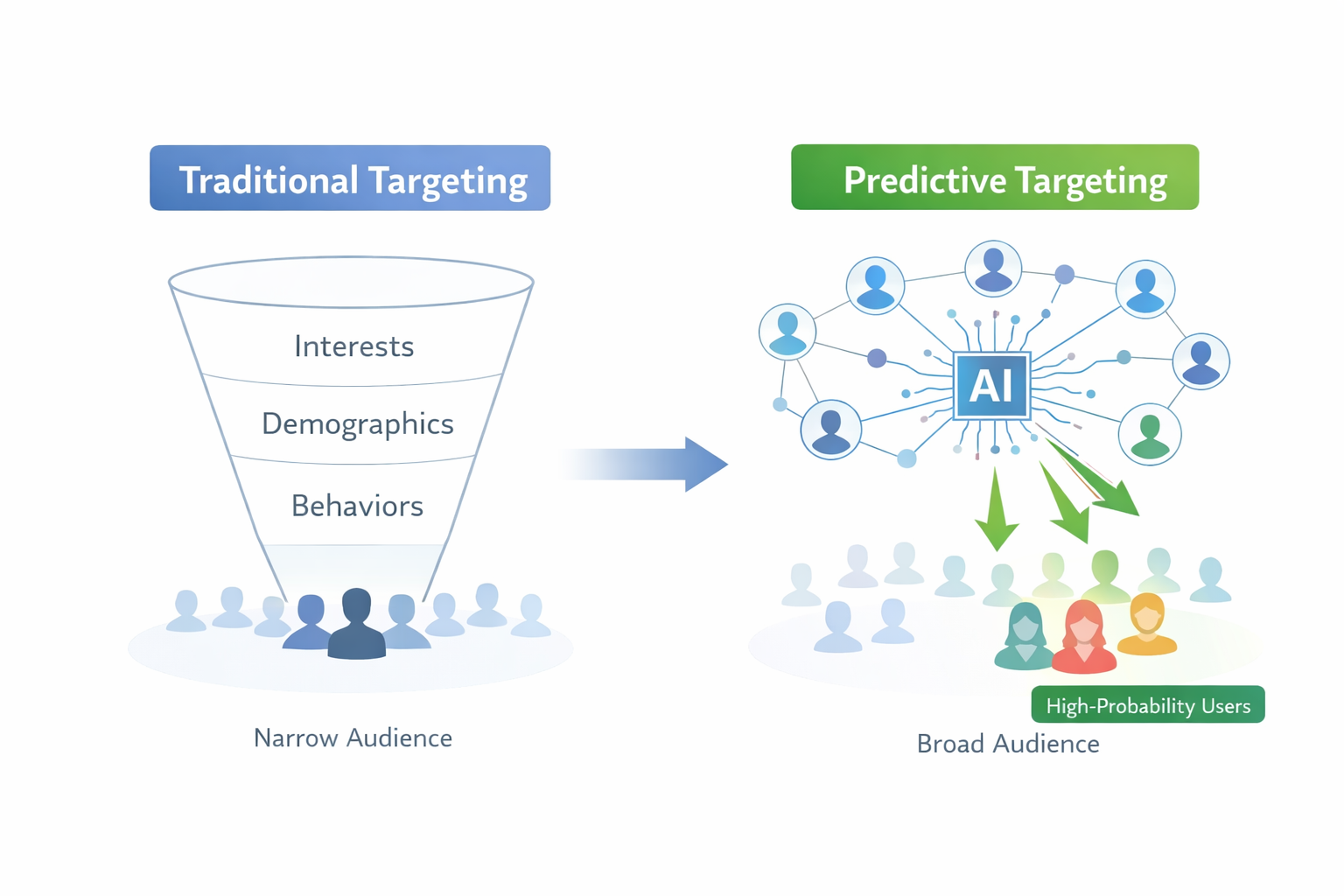
This is part of a broader shift already discussed in Why Targeting Accuracy on Facebook Is Not The Same Anymore, where traditional “precision targeting” starts to lose its impact.
What you’re seeing in your account reflects that shift. Two campaigns with very different targeting setups can end up delivering to similar users once enough data accumulates. At that point, the algorithm is doing the heavy lifting.
Targeting hasn’t disappeared. It just moved from a manual setup step into a predictive system.
How Predictive Targeting Actually Works
At a practical level, predictive targeting is happening every time your ad enters an auction.
The system doesn’t ask, “Does this user match your audience?”
It asks, “What’s the expected outcome if we show this ad to this user right now?”
That decision is based on a combination of inputs:
-
Estimated Action Rate (EAR):
This is the system’s prediction of how likely someone is to convert. It’s built from behavioral patterns — not just within your account, but across the platform. -
Value or bid signal:
If your campaign is optimizing for conversions or value, the system weighs how important that outcome is. A higher-value action increases how aggressively the system competes in auctions. -
Ad quality and engagement signals:
If users interact positively with your ad, delivery strengthens. If they ignore it or hide it, delivery weakens over time.
What matters is how these inputs combine. The system is ranking users based on expected outcomes, not simply matching them to targeting rules.
That’s why two advertisers using the same targeting can still get completely different results.
The Role of Conversion Signals in Prediction
This is where most campaigns quietly break.
Predictive targeting depends entirely on the quality of the signals it receives. If those signals are weak or misleading, the system will optimize in the wrong direction — efficiently.
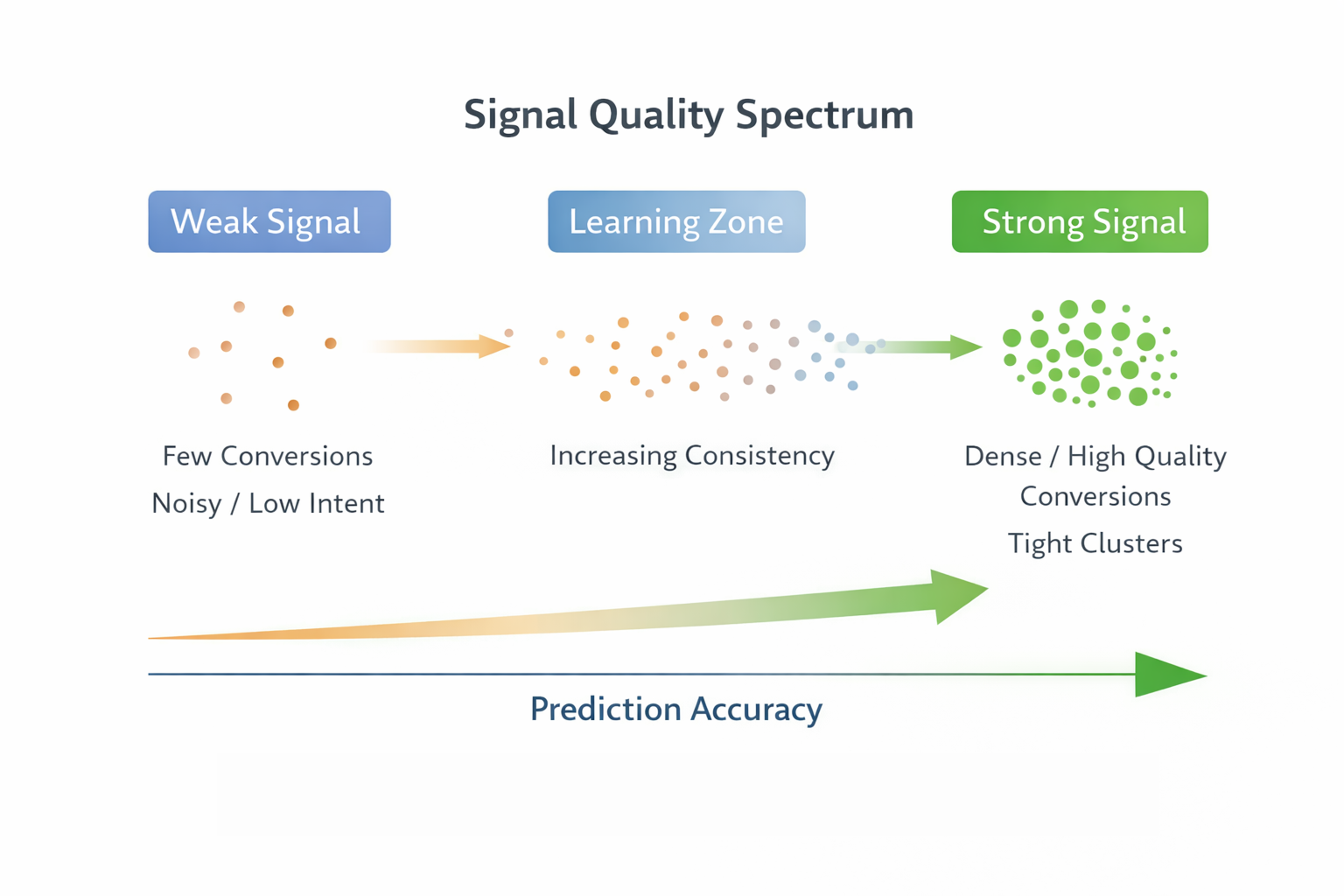
You’ll usually see this in a few patterns:
-
Low event volume creates unstable learning:
When you’re generating very few conversions per week, the system doesn’t have enough data to identify patterns. This leads to inconsistent delivery and unpredictable performance. -
Low-quality conversions distort targeting:
If your campaign is optimized for leads that don’t turn into revenue, the system keeps finding more of those same users. -
Inconsistent signals reset progress:
Large daily fluctuations in conversions make it difficult for the model to stabilize.
This is closely tied to what’s explained in How to Tell If Facebook Ads Are Optimizing for the Wrong Goal. In many cases, the issue isn’t targeting — it’s what the system is being trained to prioritize.
Why Broad Targeting Often Outperforms Detailed Targeting
Broad targeting feels uncomfortable because it removes the illusion of control.
But from the system’s perspective, restriction is often the bigger limitation.
When you narrow your audience too much:
-
You reduce the number of auctions your ads can enter.
-
You limit the behavioral diversity the system can learn from.
-
You increase competition within a smaller pool.
With broader targeting, the system has room to explore and adjust. It can test multiple behavioral clusters and shift spend toward what’s working.
In practice, this often leads to more stable and scalable performance over time.
If you’ve seen this behavior but couldn’t fully explain it, Broad Targeting: When It Beats Narrow breaks down exactly why this happens.
Where Predictive Targeting Breaks Down
The system is powerful, but it doesn’t fix bad inputs. It amplifies them.
1. Low Signal Volume
When conversion volume is too low, the system can’t distinguish real patterns from noise.
You’ll typically notice:
-
Campaigns stuck in learning.
-
Unstable spend patterns.
-
Performance that feels random.
2. Delayed Feedback Loops
If conversions are reported late — especially from a CRM — the system is always optimizing based on outdated data.
That creates a gap between actual value and perceived value, which leads to inefficient scaling.
3. Mixed Intent Signals
When different conversion types are grouped together, the system averages them.
For example:
-
Ebook downloads.
-
Webinar signups.
-
Demo requests.
If all are treated equally, the system will prioritize whichever is easiest to generate — not what drives revenue.
4. Over-Segmented Campaign Structures
Splitting campaigns into too many ad sets reduces signal density.
Instead of one strong learning system, you get multiple weak ones.
This leads to slower optimization and more volatility, which is exactly what’s described in Over-Segmentation in Facebook Ads: Why Too Many Campaigns Kill Efficiency.
How to Align Campaigns With Predictive Targeting
Once you understand how the system works, your role changes. You’re no longer trying to control targeting directly — you’re shaping what the system learns from.
Strengthen the Conversion Signal
Make sure the system is optimizing for outcomes that actually matter:
-
Track deeper funnel events like qualified leads or sales.
-
Assign values where possible.
-
Remove low-intent events from optimization.
Increase Signal Density
Instead of spreading data across multiple campaigns:
-
Consolidate similar audiences.
-
Combine regions with similar performance.
-
Reduce unnecessary segmentation.
More data in one place leads to better learning.
Reduce Feedback Delay
Faster feedback improves performance:
-
Sync CRM data more frequently.
-
Use server-side tracking.
-
Focus on faster-converting funnels during scaling.
Control Inputs, Not Outcomes
You can’t reliably force the algorithm to target specific users.
What you can control:
-
The signals it receives.
-
The structure of your campaigns.
-
The consistency of your data.
Once those are aligned, targeting improves naturally.
Diagnostic Signals to Monitor
To evaluate whether predictive targeting is working, look at how campaigns behave:
-
CPM trends:
Rising CPM with stable performance often means the system is moving into higher-quality segments. -
Conversion consistency:
Stable daily conversions indicate reliable learning. -
Frequency vs performance:
Rising frequency without performance gains suggests saturation. -
Spend distribution:
Uneven spend can signal unstable learning.
These are direct indicators of how the system is making decisions.
The Real Shift: From Audience Control to Signal Engineering
The biggest change is conceptual.
You’re no longer selecting the right audience. You’re creating the conditions that allow the system to find the right users.
That means focusing on:
-
Signal quality.
-
Campaign structure.
-
Feedback speed.
When those are aligned, the algorithm consistently finds better opportunities than manual targeting ever could.
Practical Takeaway
If performance is off, don’t start by tweaking targeting.
Start by asking:
-
What is the system actually optimizing for?
-
How much data does each campaign receive?
-
How fast does feedback return?
Fix those, and targeting usually fixes itself.