Meta’s Advantage+ Shopping Campaigns (ASC) promise faster results with less manual work. Just upload your ads, set a budget, and let Meta’s system do the rest. Sounds great — but does it really deliver?
If you run an online store and advertise on Facebook or Instagram, you’ve probably wondered whether ASC is the right choice. The truth is, ASC can work — but it’s not for everyone.
This article explains when ASC helps your e-commerce business grow, when it hurts, and how to set it up the right way.
What are Advantage+ Shopping Campaigns?
ASC is Meta’s most automated campaign type. It removes most of the manual steps you’re used to — like choosing who to target, where to show your ads, or how to split your budget.
You only set:
-
A daily or lifetime budget;
-
Up to 150 ads (images, videos, carousels);
-
Optional customer lists or audience suggestions.
Meta’s algorithm does the rest — it picks where your ads go, who sees them, and how much to spend on each impression. The goal is to get you more conversions with less effort.
But there’s a catch. You give up control. You can’t choose specific audiences, placements, or even see detailed reporting. If your campaign underperforms, it’s hard to tell what went wrong.
That’s why ASC works better for some businesses than others.
For a deeper understanding of how ASC fits into Meta's broader ad automation system, read: Unlock Meta Advantage+: The Smarter Way to Boost Your Facebook Ads.
Who gets the best results with ASC?
ASC works best for e-commerce brands that already have a lot of purchase data, stable product catalogs, and broad customer appeal. It needs good data to learn what works.
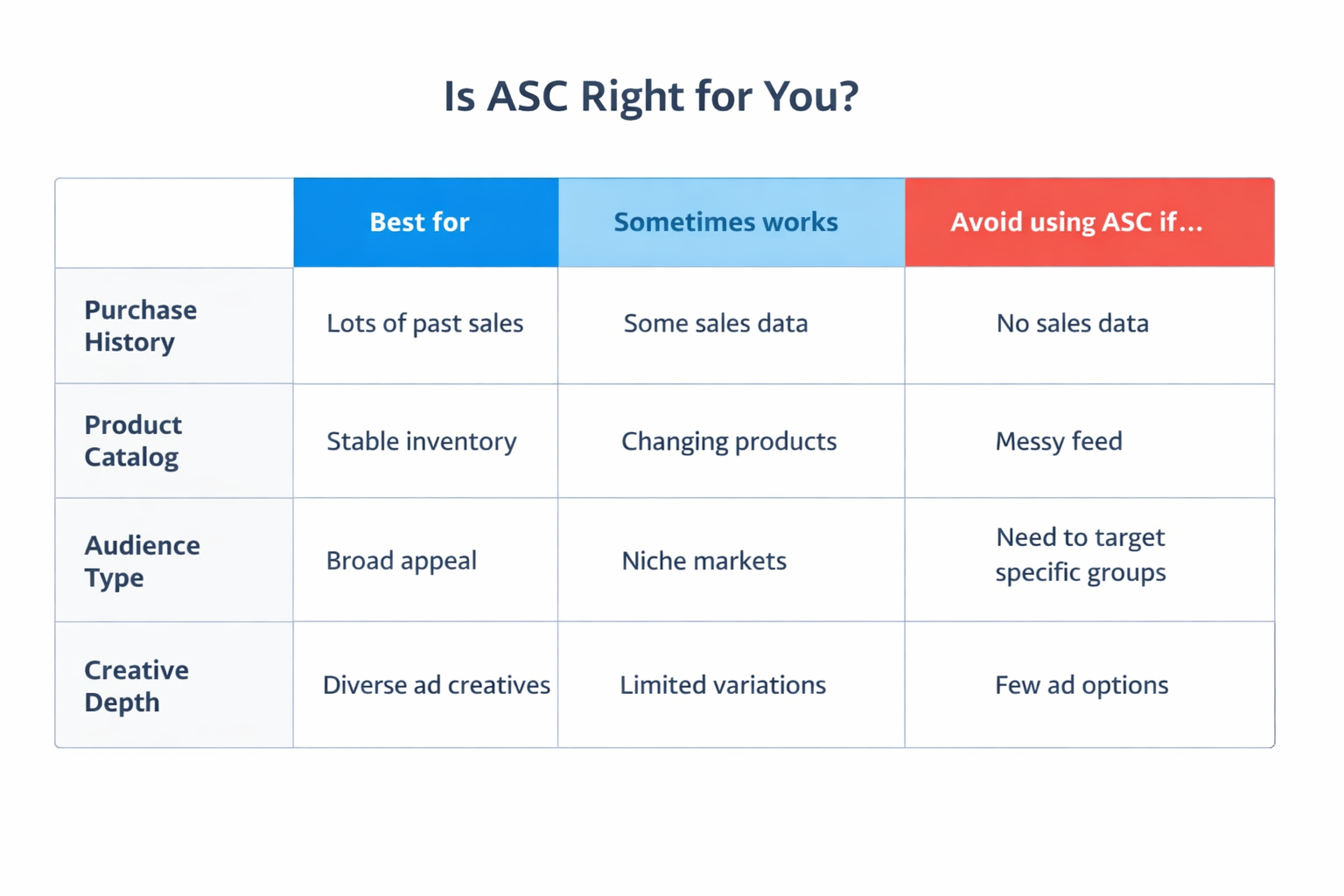
ASC works especially well for:
-
Brands with lots of past purchases — so Meta’s algorithm has data to learn from;
-
Products with broad appeal — like apparel, beauty, or tech accessories;
-
Stores with stable inventory — fewer issues from out-of-stock items or feed errors.
If your Meta pixel and Conversions API are set up correctly and collecting solid purchase data, ASC can use that to find more people likely to buy.
Let’s say you sell high-volume items like wireless earbuds or activewear. These types of products often appeal to large audiences, which gives ASC room to optimize. Manual targeting doesn’t always add value in these cases — the algorithm does a better job at finding interested shoppers.
Also, ASC uses dynamic product ads (DPAs) a lot. That means if your product feed is messy or your inventory changes often, your performance may drop. A clean, reliable product catalog helps the system work better.
Why ASC doesn’t always work
Even though ASC sounds simple, many advertisers run into problems. Without the right setup, ASC can waste budget and give you worse results than manual campaigns.
Common issues include:
-
Less control over who sees your ads — leading to low-intent or unqualified traffic;
-
Creative burnout — ads wear out quickly if you don’t rotate fresh content;
-
No clear insights — if performance drops, you can’t see what caused it.
Creative burnout is one of the most common ASC challenges. Learn how to spot and fix it here: How to Avoid Ad Fatigue and Keep Optimal Ads Costs .
ASC doesn’t let you focus on high-value segments, like loyal buyers or niche interests. It optimizes for quick wins — whoever converts easiest. That often means your ads show to deal-seekers or one-time buyers who don’t offer long-term value.
And if things go wrong — for example, your ROAS drops — you won’t know if it was the ad creative, product feed, audience shift, or something else. That lack of insight makes optimization tricky.
How to get better results with ASC
Even though ASC is automated, you still have ways to improve performance. Think of ASC like a powerful engine — but you need to give it high-quality fuel.
Here's how to set ASC up for success:
-
Add helpful audience signals, like top customers or high-spending buyers;
-
Upload a wide mix of creatives, each focused on different benefits or objections;
-
Exclude overlapping audiences, like retargeting lists or recent buyers.
While Meta says audience suggestions are optional, they help guide the algorithm early on. For example, uploading a list of your best customers tells the system, “Look for more people like this.” But don’t upload too many — too much input can actually hurt learning.
If you’re struggling to get ASC out of the learning phase, check out: How to Finish the Facebook Learning Phase Quickly .
Creative variety is just as important. Don’t just upload 10 versions of the same product shot. Instead, show different formats (video, carousel), different angles (features, lifestyle), and different value messages.
When should you avoid ASC?
ASC isn’t the right fit for every situation. If you’re still figuring out your product positioning or need more control over ad spend, it’s better to stick with manual campaigns.
You should avoid ASC when:
-
You’re launching a new product and need to test angles or audiences;
-
You want to control budget by country or segment;
-
Your product needs education, not just quick conversions.
For early-stage campaigns, visibility and control matter more than automation. Read this guide if you’re not seeing results: Facebook Ads Not Converting: How To Fix It .
If you sell globally and want to spend more in the US than in lower-value regions, you can’t do that with ASC either. Meta decides where to spend the budget — and often favors cheaper clicks.
And if your product needs education — say, a new type of supplement or productivity app — ASC won’t help. These types of products do better with step-by-step messaging, landing pages, and segmented ads.
How to use ASC as part of your strategy
Don’t think of ASC as a full account replacement. It’s a tool for scale — not for testing. The best approach is to combine it with other campaigns in a smart way.
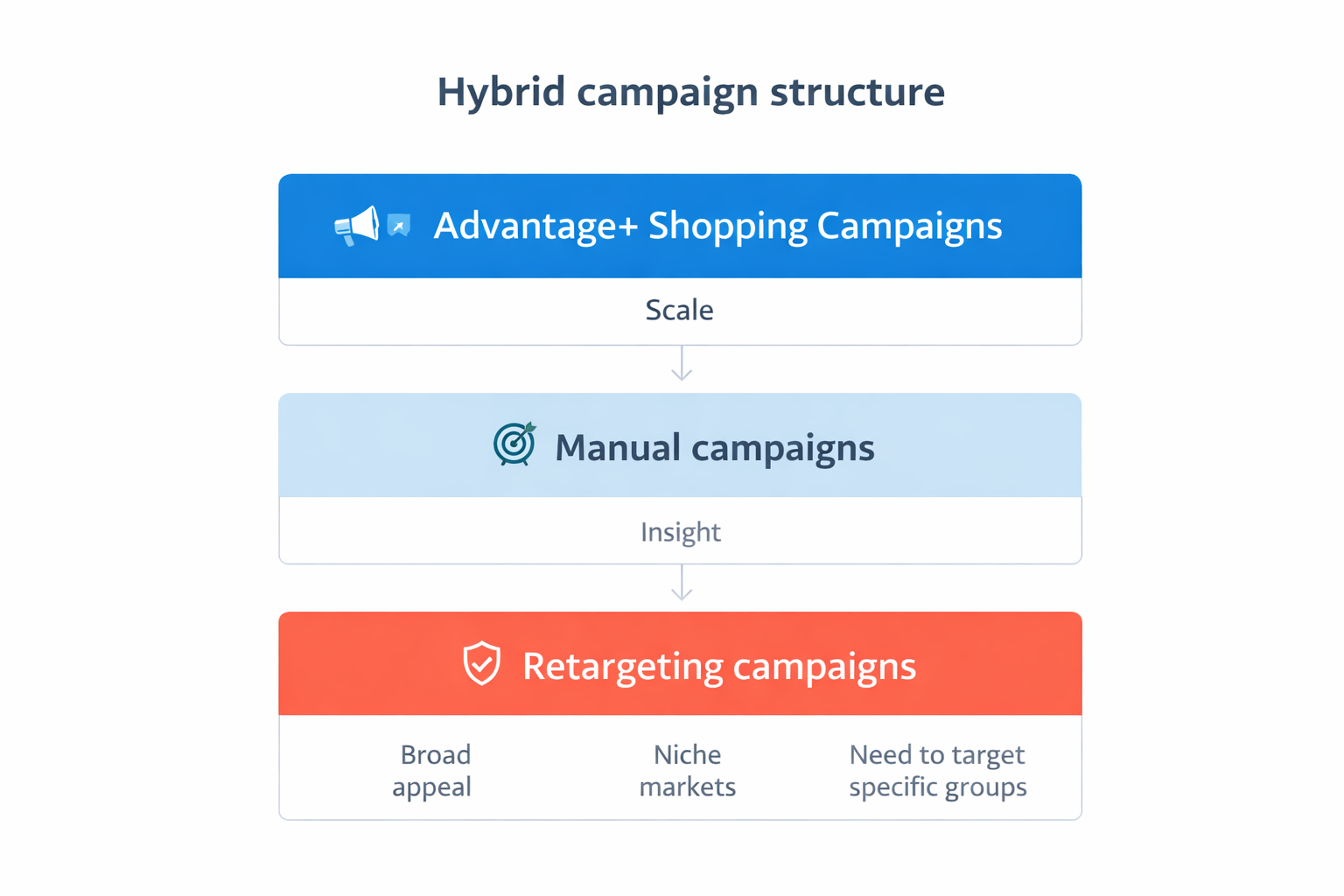
Here’s a proven setup:
-
Use ASC for broad, high-volume prospecting, once your pixel is trained;
-
Use manual campaigns to test new creatives, hooks, and audiences;
-
Use separate campaigns for retargeting, so you can control timing and frequency.
With this setup, your manual campaigns help you learn what works. ASC helps you scale what already works. And retargeting campaigns help you close the sale.
To manage ASC budget efficiently during scaling, refer to: How to Optimize Advantage Campaign Budget for Scalable Facebook Ads.
Final verdict: is ASC worth it?
Advantage+ Shopping Campaigns can be a powerful growth tool — if you use them at the right time. For established e-commerce stores with clean tracking and proven offers, ASC can deliver great results at scale.
But it’s not a magic button. You need:
-
Enough data (past purchases);
-
Strong creative variety;
-
A product with wide demand.
If you’re early-stage, launching something new, or need to test different angles, ASC will likely hold you back. Start with manual campaigns, gather insights, and switch to ASC once you know what works.
Think of ASC as a performance amplifier — not a replacement for strategy.