Ask most advertisers what Facebook Ads are for, and you’ll hear the same answer: “To drive sales.”
So they run campaigns that:
-
Retarget site visitors,
-
Promote their top products,
-
Push discounts or urgency.
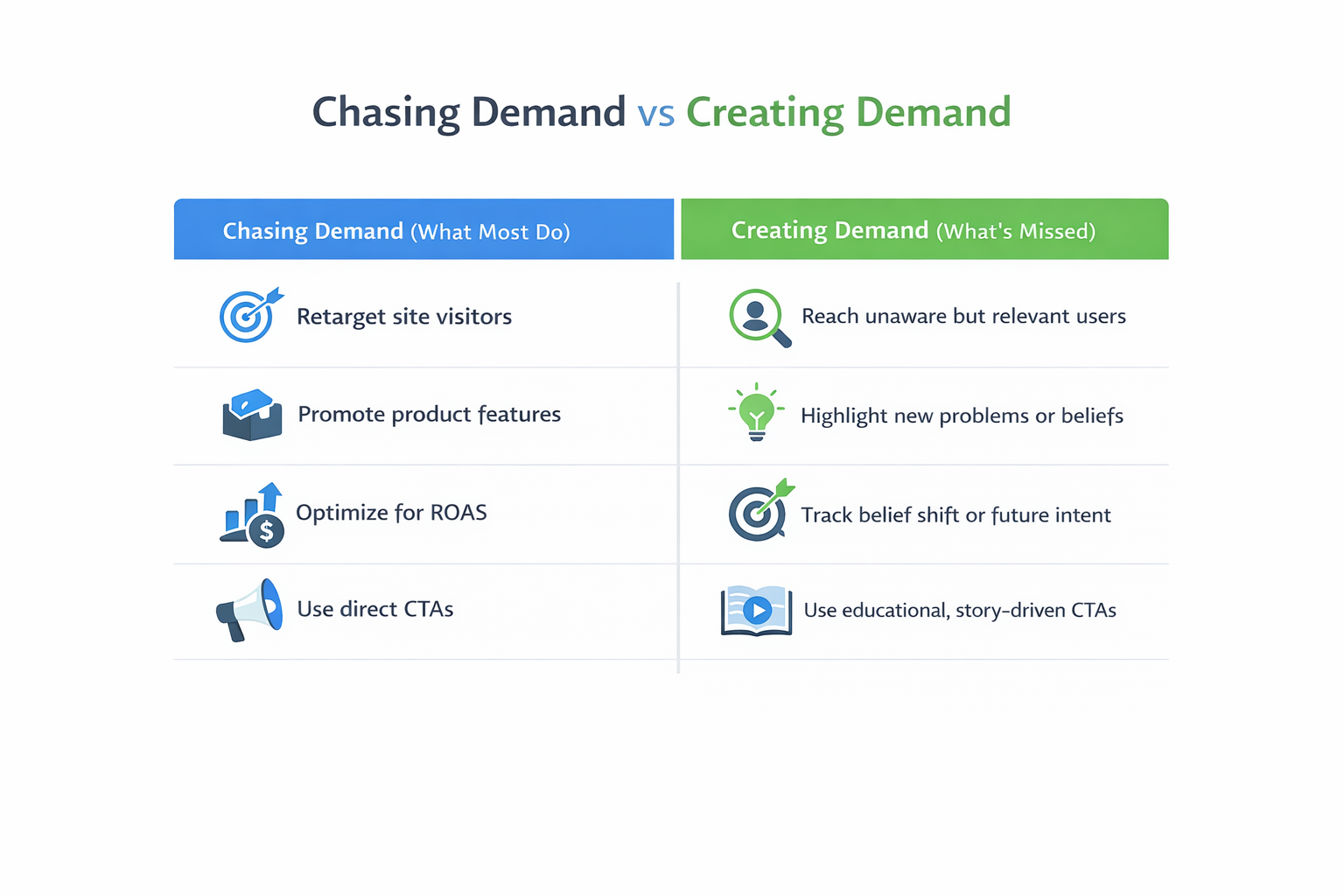
These tactics work — for a while. But they depend on people already wanting what you offer.
Eventually, scale plateaus. Results decline. And advertisers blame the algorithm.
What they miss is this: Facebook is also a demand creation engine — if you stop treating it like Google.
This misconception is explored in detail in why your Facebook campaign needs a middle of funnel strategy.
What advertisers think demand creation means (but gets wrong)
Many confuse demand creation with awareness.
They boost posts, run feel-good videos, or chase vanity metrics like impressions.
But true demand creation means something more specific:
You shift the buyer’s priorities or perception before they even enter the market.
It’s not about being seen — it’s about planting a new idea that changes what people want or why. To do this effectively, you must match ad messaging to buyer awareness levels.
Here’s what most advertisers miss: they skip the belief shift.
Demand isn't created by showing a product — it’s created by showing why the current approach isn’t working.
For example:
-
Don’t say: “Here’s our time-tracking tool.”
-
Say: “Why manual time logs cost agencies $1,200/month in hidden losses.”
You can’t create demand without creating discontent with the status quo.
What Facebook does well (that most advertisers ignore)
Facebook is uniquely good at reaching people who aren’t actively searching.
But most advertisers still build ads like it’s search:
-
They start with product features.
-
They optimize for purchases.
-
They test offers instead of narratives.
This misses how people scroll, discover, and engage on social platforms. To use Facebook for demand creation, advertisers need to adjust three things:
1. The creative: selling a shift, not a SKU
Most Facebook ads fail at demand creation because they skip to the product.
Instead, build creative that walks users through why they should care in the first place.
What advertisers miss:
→ They test formats, not messages
Instead of testing image vs. video, test these message types:
-
Status quo problem: “Still tracking time in Excel?”
-
New opportunity: “Agencies using async check-ins save 4+ hours/week.”
-
Emotional stakes: “Missed a deadline again? It’s not your fault — it’s your system.”
-
Social proof with context: “Over 1,200 small firms dropped timesheets for good. Here’s how.”
For more creative testing guidance, see Facebook ads testing strategy: how to build a campaign testing roadmap.
→ They forget narrative pacing
Don’t cram everything into one ad.
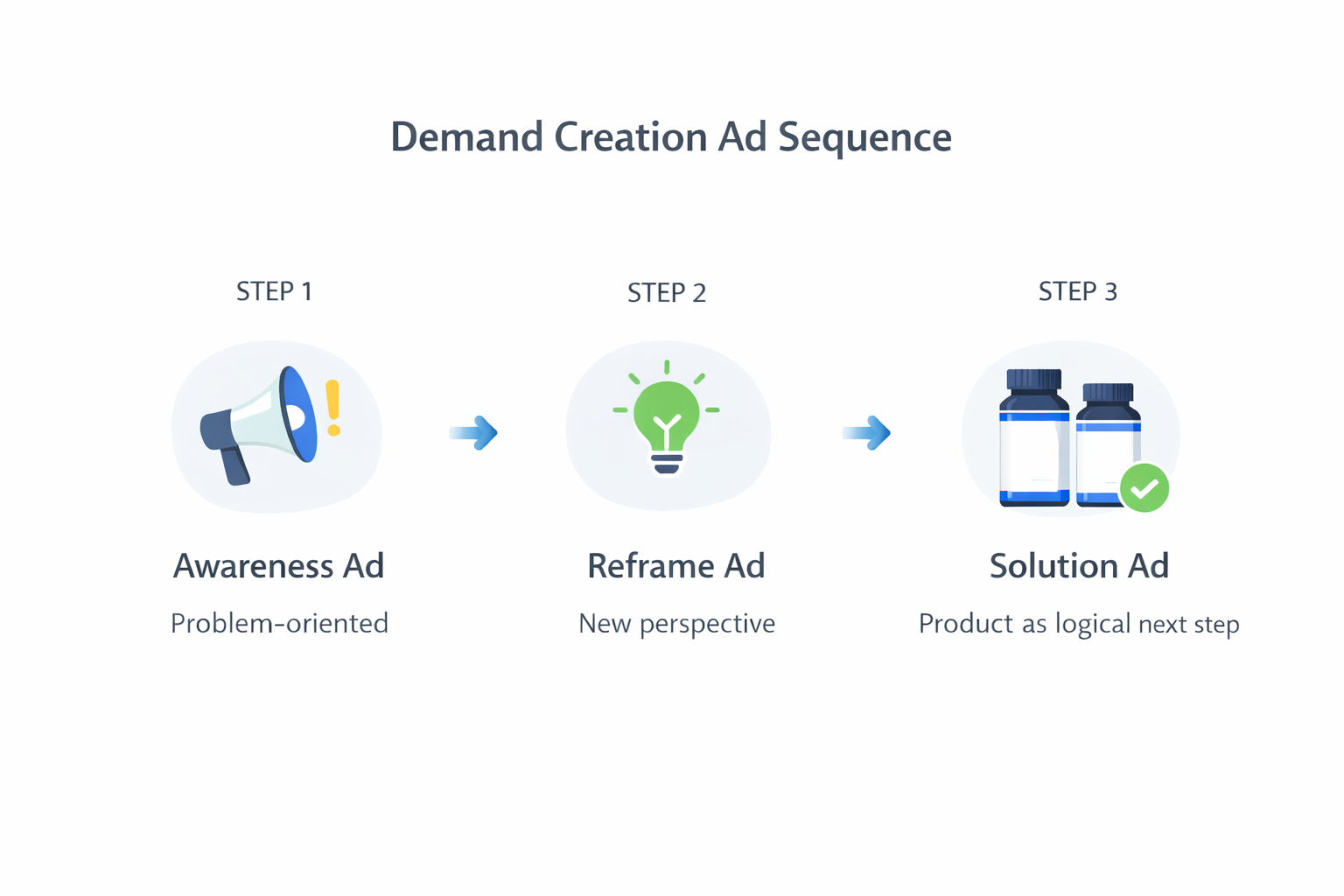
Use sequences:
-
First ad introduces the problem.
-
Second ad reframes it.
-
Third ad introduces your product as the solution.
This layered approach is one reason multi-step Facebook campaigns outperform single-step campaigns.
2. The funnel: confusing interest with intent
What advertisers miss: they treat attention like it means readiness.
But just because someone watches a video doesn’t mean they’re ready to buy.
This mistake leads to premature CTAs, hard offers, or irrelevant retargeting.
Instead, build intent layers that reflect how awareness builds.
Use behavior to separate cold and warm:
-
Cold: Watched 50% of a belief-shifting video
-
Warming up: Clicked on quiz or downloaded a guide
-
Hot: Visited product page or added to cart
Match ad content and landing pages accordingly. Don’t show cold users a product demo — show them a problem worth solving.
To better understand targeting warm vs cold, read the truth about Facebook ads warm audiences.
3. The metrics: misreading performance signals
The biggest mistake advertisers make is judging demand creation by conversion metrics. They kill great top-of-funnel campaigns because they don’t convert in-platform.
Here’s what gets missed:
→ Time lag effects
The ad that introduced the problem rarely gets credit for the sale. Purchases come days later, through another device or channel.
→ Invisible demand signals
Look beyond ROAS. Track:
-
Branded search lift (Google Search Console)
-
Direct traffic spikes
-
CRM quality over time
-
Increase in guide downloads or webinar signups
Also consider why relying only on last-click attribution hurts ad strategy.
→ Creative-as-insight
Even low-CTR creatives can reveal what resonates.
For example: If a “hidden cost” angle gets shared or commented on, it’s a clue for deeper campaign themes.
Advanced demand creation plays most advertisers never try
Here are three demand creation techniques overlooked by most Facebook advertisers:
1. Category entry point ads
Introduce a new use case that shifts when or why people buy.
-
“Use our time tracker for hourly freelancers — not just agencies.”
-
“The skincare routine for runners.”
2. Myth-busting carousels
Dispel common beliefs with a swipeable series:
-
“SPF doesn’t matter on cloudy days.” → False.
-
“Retinol can’t be used with acids.” → Not always.
-
“You only need moisturizer in winter.” → Nope.
Each myth busted reframes the product’s relevance.
3. Emotive explainer videos
Use storytelling that mirrors the user's life before the product. Highlight pain points, frustrations, or workarounds. Only then introduce the product as the obvious relief.
Summary: what advertisers miss (and how to fix it)
Advertisers miss the role Facebook can play at the beginning of the buyer journey.
They treat it like a closing tool — not an opening move.
What most miss:
-
Creative that shifts beliefs instead of listing features
-
Funnels that nurture curiosity before pitching solutions
-
Metrics that reveal influence, not just transactions
What to do instead:
-
Run insight-led creative that educates or reframes
-
Track non-click behaviors and lagging indicators
-
Design a multi-step journey, not a one-ad sprint
Demand isn’t found — it’s made. And Facebook, when used right, is one of the best places to make it.