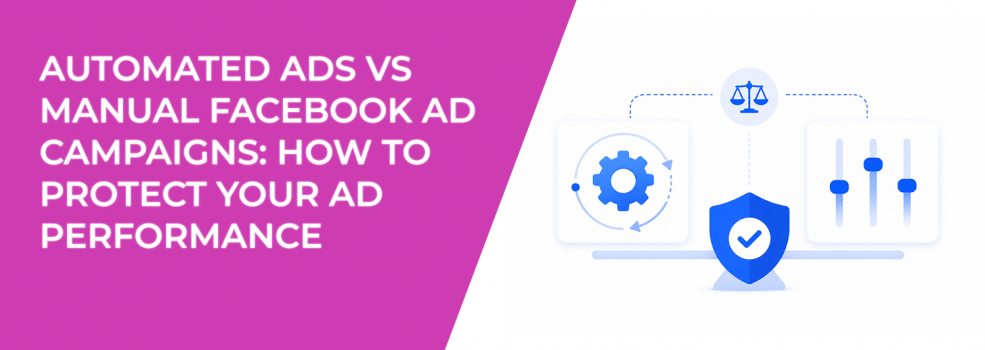
Choosing between Automated Ads and manual campaign setup creates two different performance risks.
The first problem appears when advertisers rely too heavily on automation. Meta expands delivery aggressively and often optimizes toward cheaper conversions instead of better buyers.
The second problem appears when advertisers overcomplicate manual campaigns. Too many audiences, ad sets, and targeting layers can slow learning and destabilize delivery.
Both setups can damage CPA and ROAS when used in the wrong situation.
Problem 1: Automated Facebook Ads Can Lower Lead Quality During Scaling
Meta’s automation system follows the conversion signal it receives. If the campaign optimizes for low-friction actions, the algorithm searches for users most likely to complete those actions cheaply.
That works for simple offers and broad e-commerce campaigns.
It becomes risky for B2B lead generation, high-ticket services, or niche targeting.
A common scenario looks like this: a campaign launches with strong CPL and healthy CTR, then lead quality drops after scaling. Sales teams start reporting weak-fit leads while Ads Manager still shows efficient front-end metrics.
The issue is usually optimization drift.
Meta expands beyond the strongest audience segment once easy conversions slow down. The campaign keeps generating volume, but the buyer intent weakens.
This is one reason why broad targeting wastes ad spend when campaigns depend on precision.
Problem 2: Manual Facebook Campaigns Often Become Too Complex
Many advertisers react to automation problems by taking full manual control.
That creates another issue.
Campaigns become overloaded with:
-
audience segmentation,
-
layered interests,
-
duplicated ad sets,
-
and isolated placements.
The account feels more controlled, but Meta receives fragmented conversion data.
When budgets spread across too many segments, learning slows down. Some ad sets never gather enough conversion signals to stabilize properly.
This usually leads to:
-
unstable CPM,
-
uneven spend allocation,
-
repeated learning resets,
-
and rising CPA during scaling.
The problem is not manual setup itself. The problem is excessive structural complexity.
Solution: Use Hybrid Control Instead of Choosing One Extreme
The strongest advertisers rarely use fully automated or fully manual structures. They let Meta optimize delivery while keeping manual control over the variables that affect business outcomes most.
This is why it helps to balance automation with manual campaign control.
In most cases:
-
automation should handle placements and bid pacing,
-
while advertisers control audiences, exclusions, funnel structure, and conversion events.
For example, a local restaurant can usually benefit from Automated Ads because conversion quality is easy to recognize. A B2B SaaS campaign usually needs tighter manual controls because low-quality leads create real downstream costs.
The more expensive a bad conversion becomes, the more strategic control the campaign usually needs.
Final Takeaway: The Best Setup Depends on Conversion Risk
Automated Ads usually fail when Meta cannot clearly identify what a valuable customer looks like. Manual campaigns usually fail when advertisers overbuild campaign structure and weaken optimization signals.
The best-performing accounts sit between those extremes.
Use automation where Meta improves efficiency. Use manual control where precision protects CPA, CAC, and lead quality.
For a deeper breakdown of when Facebook Automated Ads actually work well, the key question is simple: how expensive is a low-quality conversion for your business?