Many advertisers assume video ads should improve ROAS automatically. Video gets more engagement. It attracts more attention. It often generates more clicks than static creative.
But stronger engagement does not always lead to stronger profitability.
This is one of the most common problems in Facebook advertising: video ads increase activity metrics without improving purchase efficiency.
The campaign gets views, reactions, and traffic, but revenue does not improve enough to justify the spend increase.
Problem: Video Ads Often Attract Attention Without Increasing Buying Intent
Facebook video ads are naturally good at generating engagement.
Movement catches attention in the feed. Users pause longer. Some videos also create curiosity clicks because they feel entertaining or visually interesting.
The problem appears when that attention does not translate into purchase intent. This usually happens when the video optimizes for engagement instead of decision-making.
For example, many video ads focus heavily on:
- Cinematic editing.
- Fast motion graphics.
- Emotional storytelling.
- Broad lifestyle messaging.
- Trend-driven content.
These elements can improve watch time while attracting users who are not close to buying.
As a result, the campaign receives traffic that looks active but converts poorly. That weakens ROAS even when CTR appears healthy.
This is why many advertisers eventually discover that high CTR Facebook ads don’t convert. The ad earns clicks, but not enough commercial intent behind those clicks.
Why Video Engagement Can Mislead Performance Analysis
Video campaigns often create misleading success signals.
Advertisers see:
- Lower CPC.
- Higher engagement.
- More video views.
- Better social proof.
- More shares or reactions.
At first glance, the campaign appears stronger.
But ROAS depends on profitable conversion behavior, not feed activity.
A video that attracts broad curiosity may lower traffic quality even while increasing top-of-funnel engagement.
This becomes especially expensive in conversion campaigns because Meta continues optimizing toward the engagement patterns it receives. If low-intent users interact heavily with the creative, the algorithm may continue finding similar users.
Over time, spend rises without improving purchase efficiency.
This is why high click volume doesn’t mean high buying intent in Facebook campaigns.
Solution: Build Video Ads Around Purchase Motivation, Not Attention Alone
The strongest Facebook video ads do more than capture attention. They qualify the viewer.
That means the video should communicate:
- Who the product is for.
- What specific problem it solves.
- Why the offer matters now.
- What outcome the buyer should expect.
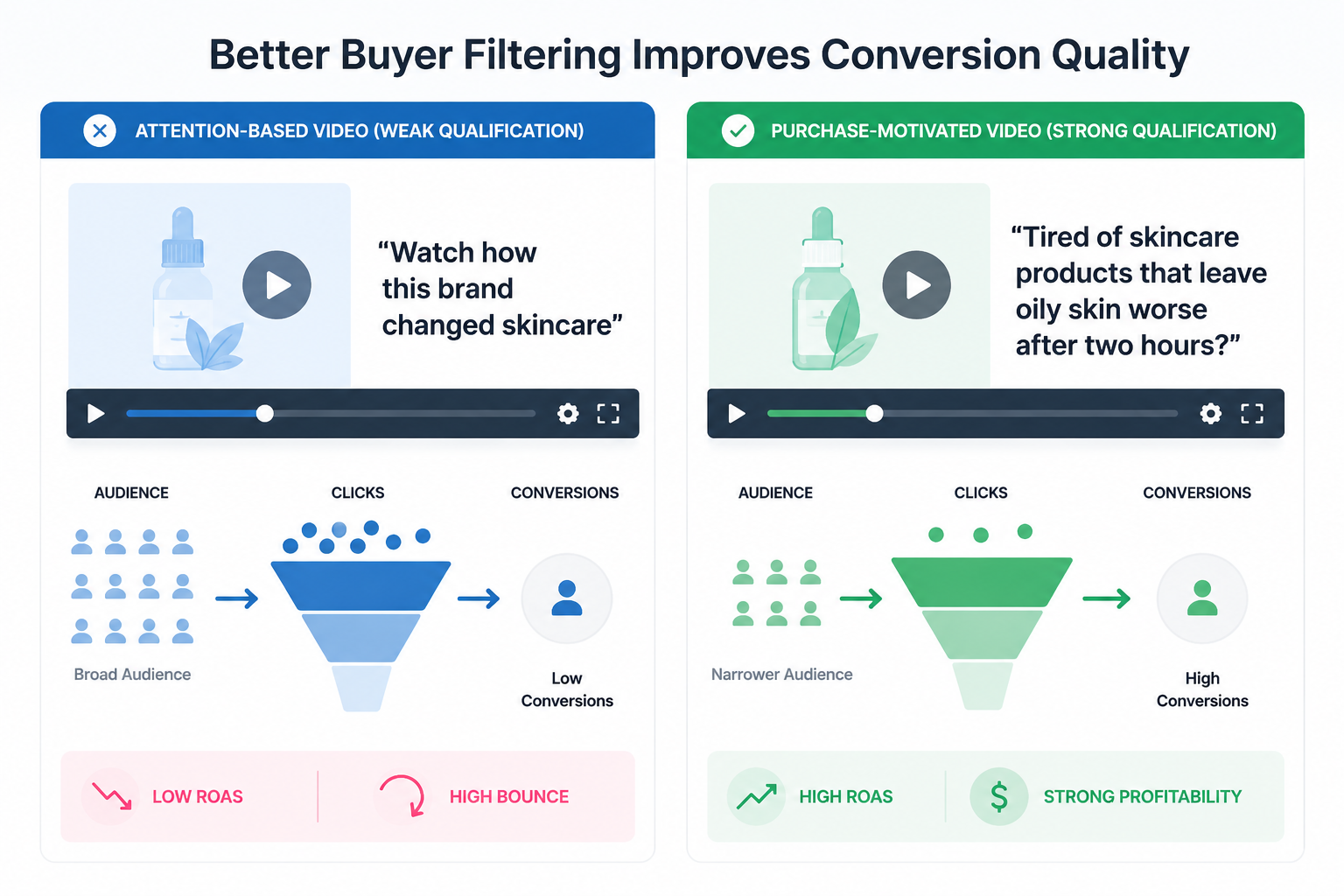
A video that only entertains often creates weak buyer filtering. A video that speaks directly to a buyer problem usually improves conversion quality.
For example, these two openings create very different traffic:
- Weak opening: “Watch how this brand changed skincare.”
- Stronger opening: “Tired of skincare products that leave oily skin worse after two hours?”
The second version narrows the audience immediately. Fewer users may engage, but the users who continue watching are often closer to buying intent.
That difference matters more for ROAS than raw engagement volume.
Why Some Static Ads Outperform Video for Profitability
Static ads often convert better because they force clarity.
The user sees:
- One image.
- One message.
- One CTA.
That simplicity reduces friction.
Video, on the other hand, asks the viewer for more time and attention. If the added time does not improve buying intent, the extra engagement has little commercial value.
This is especially noticeable in:
- Retargeting campaigns.
- Offer-driven campaigns.
- Discount promotions.
- Simple lead generation offers.
- High-intent warm audiences.
In these situations, static ads can move users toward action faster than video.
That does not mean video is ineffective. It means video only improves ROAS when the additional context actually helps conversion intent.
How to Tell if Video Ads Are Hurting ROAS
The easiest way to identify the problem is to compare engagement quality against conversion quality.
Common warning signs include:
- Strong watch time but weak conversion rate.
- High CTR but low purchase volume.
- Cheap traffic with poor average order value.
- Increased spend without better revenue efficiency.
- Strong top-of-funnel metrics but declining ROAS.
Many advertisers continue scaling these campaigns because the engagement metrics look impressive.
But profitable Facebook advertising depends on conversion quality, not feed activity.
This is why advertisers eventually need to ask what impacts CPA the most instead of focusing only on engagement metrics.
Final Takeaway
Facebook video ads do not improve ROAS automatically.
Video performs well when it helps qualified buyers understand the product, trust the offer, or move through a more complex buying decision.
But when video focuses too heavily on attention and not enough on buyer intent, campaigns often generate engagement without improving profitability.
The best-performing Facebook video ads do not simply attract viewers. They attract viewers who are more likely to convert.