The first audience you launch with matters more than many advertisers realize.
A starter audience does not only determine who sees the first version of your ad. It also influences what Meta learns, which users enter your retargeting pools, how your early results look, and whether your next optimization decisions are based on useful data.
When that starter audience is weak, your campaign begins by spending money on the wrong lesson.
The Problem
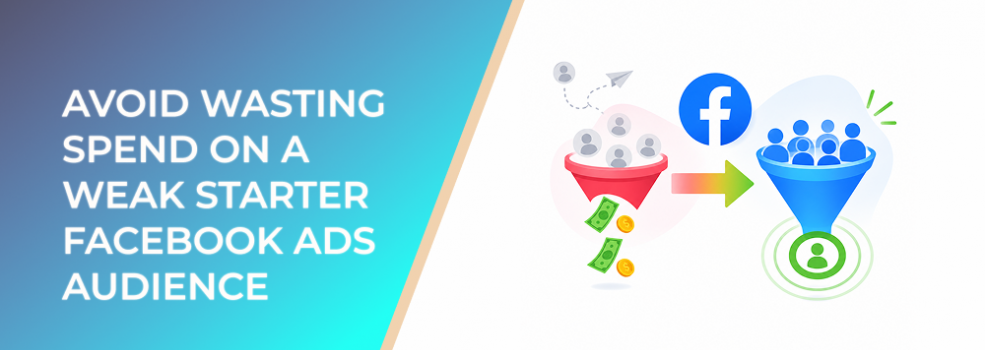
A weak starter Facebook ads audience is an initial audience built from assumptions instead of meaningful signals.
It often looks reasonable at setup. The size is acceptable. The interest sounds related. The geography seems right. The campaign can launch quickly.
But the audience lacks a strong connection to the business goal. It may include casual content consumers, low-intent users, unqualified prospects, irrelevant buyers, or people who like the category but have no reason to care about your offer.
This is especially risky when launching ads directly from a Facebook Page or starting a new Meta campaign with limited account history. Early spend becomes the testing ground, and poor inputs can produce poor learning.
Why This Problem Hurts Performance
A weak starter audience hurts performance because it distorts early campaign data.
The first wave of impressions, clicks, and conversions tells you whether your ad is working. But when the wrong audience sees the ad, the data becomes noisy.
A low CTR may not mean the creative is bad. A high CPC may not mean the offer is weak. A low conversion rate may not mean the landing page is broken. It may simply mean the audience was never a good fit.
This wastes budget in three ways.
First, you pay for irrelevant impressions. Second, you make optimization decisions from unreliable data. Third, you may build retargeting and lookalike audiences from weak traffic.
The cost is not only the money spent. It is the time lost chasing the wrong diagnosis.
Common Scenarios Where This Happens
A small business launches its first Page ad and chooses a broad local audience because it wants reach.
A startup launches before it has enough customer data and chooses generic interests that describe the category but not the buyer.
An agency inherits a new account and needs to launch quickly, so it uses a safe-looking interest stack instead of researching audience sources.
A B2B marketer wants to test Facebook but starts with “business decision-makers” rather than specific job roles, industries, or professional communities.
An ecommerce brand uses a competitor’s broad category as inspiration but never identifies which competitor followers, influencer audiences, or niche communities show real purchase intent.
Why the Problem Happens
Weak starter audiences usually happen because advertisers prioritize launch speed over audience quality.
The campaign setup process makes it easy to start with basic information: age, location, gender, interests, and objective. That simplicity is useful, but it can hide strategic gaps.
Another cause is lack of first-party data. New businesses, new offers, and early campaigns may not have enough website traffic, CRM records, or purchase data to build strong custom or lookalike audiences.
Weak starter audiences also happen when marketers confuse category relevance with buyer relevance. A person interested in “home decor” is not necessarily looking for a premium interior design service. A person interested in “software” is not necessarily a buyer for a B2B automation tool.
Finally, starter audiences fail when creative does not help filter the audience. Generic ads invite generic clicks.
The Solution
The solution is to build a starter audience from the strongest available signal, even when you do not have much account data yet.
Start with the business outcome. Define whether you need purchases, booked calls, qualified leads, trials, consultation requests, store visits, or pipeline. The audience should be built around people likely to take that action.
Next, identify your strongest audience source.
If you have customers, start with your best customers. If you have CRM data, segment by quality. If you have website traffic, use meaningful behaviors rather than all visitors. If you have little first-party data, look for external audience signals.
Good starter audience sources can include:
- Competitor followers.
- Niche Instagram profiles.
- Facebook groups related to the problem.
- Industry communities.
- LinkedIn professional criteria.
- Engaged followers or content engagers.
- Customer social-profile data.
- High-intent website behavior.
- Sales-qualified lead lists.
Then launch with a clean test structure. Use one or two strong starter audiences rather than many weak ad sets. Give each audience enough budget to produce readable results. Match the creative to the source audience so the test is meaningful.
How LeadEnforce Helps
LeadEnforce is especially useful when you need a stronger starter audience but do not yet have enough pixel data, customer volume, or historical campaign results.
LeadEnforce can help advertisers build audiences from Facebook groups, Instagram profile followers, LinkedIn job-title and company data, and custom social-profile links.
That makes it practical for early campaign testing. Instead of launching with a vague interest like “marketing,” a B2B advertiser can start from a more relevant professional or community-based audience. Instead of targeting everyone interested in “fitness,” an ecommerce brand can source audiences from niche Instagram profiles or Facebook groups that better match its offer. Instead of guessing which local users may care, a local business can look for relevant community-based signals.
LeadEnforce’s role is not to make the campaign automatic. It helps create a better starting point so your first test produces cleaner data.
Risks and Considerations
A strong starter audience still needs enough size to deliver. A source that is too narrow may be relevant but difficult to scale.
Audience source quality also varies. A Facebook group with many inactive members may be less useful than a smaller group with active discussion. An Instagram profile with a large following may include broad fans rather than buyers. LinkedIn-derived criteria may identify professional fit but still need persuasive creative to generate action.
A weak offer can also waste a strong audience. If the landing page, pricing, or lead form is misaligned, better targeting will not fully solve the problem.
Compliance and privacy should also stay part of the workflow. Audience creation and activation should follow applicable platform rules and responsible data-use practices.
Prerequisites and Dependencies
You need a clear campaign objective. A starter audience for purchases may look different from a starter audience for lead generation or awareness.
You need a defined ICP, even if it is provisional. Early-stage advertisers can work with a hypothesis, but it should be specific enough to test.
You need at least one credible audience source. That may be CRM data, website behavior, competitor research, relevant groups, Instagram profiles, LinkedIn professional criteria, or custom social-profile data.
You need creative that reflects the audience source. A community-based audience should see copy that matches its pain points. A professional audience should see role-specific value. A competitor-adjacent audience should understand why your offer is different.
You also need success metrics beyond surface-level engagement. Starter tests should be judged by the quality of learning, not just whether the campaign spends.
Practical Recommendations
Do not launch your first ad set with the broadest audience available just because it feels safer.
Build one strong starter audience from your best available signal. Then build one comparison audience only if you have enough budget to test both properly.
Use specific creative to qualify clicks. Mention the use case, pain point, industry, customer type, or buying situation clearly.
Review early results by audience quality. Look at conversion rate, lead quality, sales feedback, downstream actions, and CAC instead of only CPC.
Use LeadEnforce when your weakest point is audience discovery. It fits naturally before launch, when you need to find people connected to relevant communities, profiles, followers, professional criteria, or social-profile data before your ad account has enough learning history.
Final Takeaway
A weak starter audience can waste budget before your campaign has a fair chance to work. The fix is to start with stronger audience signals, cleaner test structure, and creative that speaks to a specific buyer.
Your first Facebook ad audience does not need to be perfect. It needs to be intentional enough to produce useful learning.
Join the free 7-day LeadEnforce trial period to build a stronger starter audience before your next Facebook ad campaign goes live.
Related LeadEnforce Articles
- How to Build Your Target Audience from a Facebook Group — Directly relevant for building starter audiences from niche communities.
- How LeadEnforce Lets You Target Instagram Followers — Explains how follower-based audience building can support more focused Meta campaigns.
- How to Build High-Performing Custom Audiences in LeadEnforce — Useful for advertisers building stronger custom audiences before scaling.
- Smarter Lookalikes: How to Use LeadEnforce to Reach High-Intent Audiences — Helps turn stronger starter audiences into better scaling seeds.
- Facebook Ad Targeting 101: How to Reach the Right Audience — Provides foundational context for Facebook audience planning and campaign setup.