One of the easiest ways to waste Facebook ad budget is to choose the wrong ad format before the campaign even starts.
A boosted post can feel like the fastest path to paid reach. You already have a post, the interface is simple, and the campaign can go live quickly. But that speed can become a problem when the campaign needs tighter audience control, stronger conversion signals, creative testing, exclusions, or clearer measurement.
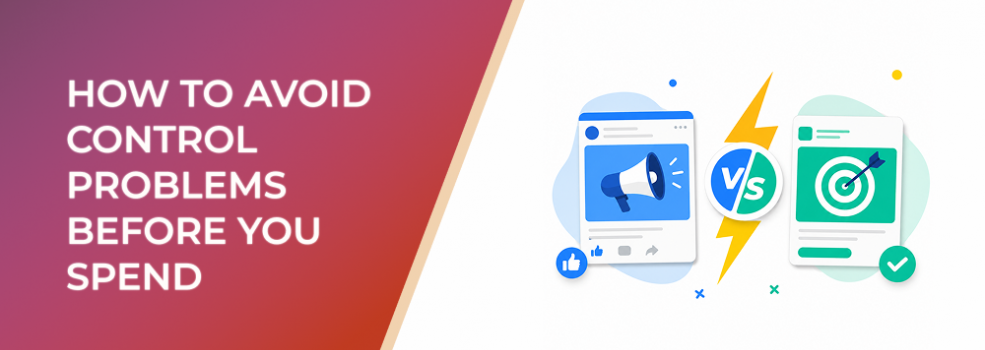
A full Meta campaign takes more setup, but it gives advertisers more room to control how the campaign is built and optimized. Meta’s own Help snippets distinguish boosted posts from ads created in Ads Manager or Meta Business Suite by noting that boosted posts are still ads, while Ads Manager and Business Suite offer more advanced customization.
The real question is not whether boosted posts are good or bad. The question is whether the format gives you enough control for the result you want.
The Problem
The problem is choosing a boosted post when the campaign actually needs a full ad setup.
This happens when advertisers start with convenience instead of campaign requirements. They see a post performing well organically, click boost, choose a broad audience, set a budget, and expect the campaign to behave like a structured acquisition campaign.
That is where the control problem begins.
A boosted post may be suitable for visibility, light engagement, or quick promotion. But it can become limiting when you need to control the objective, test multiple creatives, separate audiences, exclude existing customers, optimize for qualified leads, or measure performance beyond surface engagement.
The opposite mistake also happens. Some marketers overbuild full campaigns for simple visibility goals where a boosted post would have been faster and sufficient.
Both mistakes waste time and budget.
Why This Problem Hurts Performance
The wrong format affects performance because it limits what Meta can optimize toward and what the advertiser can learn.
If you use a boosted post for a lead-generation goal, you may see strong reach, cheap engagement, or a low CPC while CPA, CAC, or lead quality stays weak. The campaign may be getting activity, but not the activity that matters commercially.
If you use a full campaign for a small visibility push, you may spend too much time on setup, testing structure, and reporting when the business only needed a short-term awareness lift.
Poor format choice also makes diagnosis harder. If performance is weak, you may not know whether the issue is the audience, creative, objective, placement, offer, landing page, or conversion path. That slows testing and creates budget decisions based on incomplete evidence.
For performance marketers, agencies, and growth teams, this matters because control problems compound quickly. A small targeting mismatch can become expensive. A weak objective can train delivery toward the wrong behavior. A poorly structured test can create results that look useful but do not improve ROAS or lead quality.
Common Scenarios Where This Happens
An SMB owner boosts every strong-looking Facebook post because it is easy, then wonders why bookings do not increase.
An agency boosts a client’s most-liked post to show fast activity, but the client expects qualified leads and revenue impact.
A B2B team boosts a thought-leadership post and expects demo requests, even though the post was built for discussion rather than conversion.
An ecommerce brand boosts a product post for reach but needs product-page conversions, purchase optimization, and audience segmentation.
A startup launches a boosted announcement post and later realizes it did not collect enough useful data to guide the next campaign.
These scenarios all come from the same mistake: the advertiser chooses the ad format before defining the level of control the goal requires.
Why the Problem Happens
The problem happens because boosted posts make advertising feel simple.
That simplicity is useful, especially for small teams, local businesses, creators, and marketers who need speed. But the interface can make a boosted post feel like a smaller version of a full campaign. It is not.
A boosted post starts from existing content. A full campaign starts from a campaign objective, ad set structure, audience plan, creative strategy, placement logic, optimization goal, and measurement framework.
The difference becomes important when the campaign moves from visibility to performance.
Another root cause is metric confusion. Marketers often judge boosted posts by reach, engagement, and CPC, then compare those numbers with full campaigns judged by CPA, CAC, ROAS, lead quality, or conversion rate. That comparison is misleading because the campaigns are designed for different levels of control and different business outcomes.
The final cause is audience uncertainty. When marketers do not know exactly who should see the ad, they rely on broad delivery and hope Meta finds the right users. That may be acceptable for awareness, but it is risky for acquisition.
The Solution
The solution is to choose the format based on control requirements.
Use a boosted post when the campaign goal is simple, fast, and visibility-oriented. A boost can work well when you want to extend reach, amplify a strong organic post, promote a local announcement, support an event, build social proof, or test whether a message gets attention from a broader audience.
Use a full Meta campaign when the campaign needs performance control. That usually includes lead generation, sales, purchases, retargeting, audience exclusions, structured A/B testing, funnel segmentation, conversion optimization, placement analysis, creative variation, or scalable ROAS.
A practical decision framework looks like this:
First, define the business result. Are you trying to create awareness, drive engagement, generate traffic, collect leads, increase purchases, or test a new offer?
Second, define the required control level. Do you need custom audiences, exclusions, conversion events, multiple ad sets, different creative versions, or placement-level analysis?
Third, define the success metric. If success is reach or engagement, a boost may be enough. If success is CPA, CAC, ROAS, qualified lead rate, or revenue, a full campaign is usually the better structure.
Fourth, choose the simplest format that can realistically achieve the goal. Do not use complexity as a badge of sophistication. Use it only when the campaign needs it.
How LeadEnforce Helps
LeadEnforce is most useful when the decision points toward a full campaign because the advertiser needs better audience control.
When a boosted post is too broad for the goal, the next problem is usually audience quality. The campaign needs to reach people who are more likely to care about the offer, not just people who are easy to engage.
LeadEnforce helps advertisers build audience inputs from Facebook groups, Instagram followers and engagers, LinkedIn-derived professional data, and custom social-profile sources. Its Facebook targeting feature focuses on building audiences from Facebook group members, its Instagram feature focuses on profile followers, and its LinkedIn feature describes creating Facebook and Instagram audiences from LinkedIn job titles, industries, and companies.
That makes LeadEnforce relevant when advertisers move from a simple boost into a full campaign and need more specific audience inputs.
For a B2B lead-generation campaign, that might mean building an audience around professional criteria instead of broad interests. For an ecommerce campaign, it might mean testing followers of niche Instagram profiles. For a local or community-driven business, it might mean starting from relevant Facebook groups.
LeadEnforce does not replace campaign strategy, creative quality, tracking, or offer strength. It supports the audience side of the full-campaign workflow when audience relevance is one of the reasons boosted posts are not enough.
Risks and Considerations
Do not assume a full campaign will automatically outperform a boosted post.
If the offer is weak, the creative is unclear, the landing page is misaligned, or the conversion signal is unreliable, more campaign control will not fix the core issue.
Also watch audience size. Highly specific audiences can improve relevance, but audiences that are too small may restrict delivery, increase frequency, or produce unstable test results.
If LeadEnforce is part of the workflow, source quality matters. The selected Facebook groups, Instagram profiles, LinkedIn criteria, or social-profile sources should match the ICP. Poor source selection can create a precise audience that is still wrong.
Finally, review Meta policies and applicable privacy requirements before launching any audience-driven campaign.
Prerequisites and Dependencies
Before choosing between a boosted post and a full campaign, you need a clear campaign objective, a defined ICP, a strong offer, and a practical success metric.
For boosted posts, the post should already communicate the message clearly and have a realistic visibility or engagement goal.
For full campaigns, you need enough budget to test, a campaign structure that separates key variables, a relevant destination or lead path, and reliable measurement for the business result you care about.
If LeadEnforce is used, you also need relevant source communities, profiles, professional criteria, or custom social-profile data that reflect the audience you actually want to reach.
Practical Recommendations
Start every campaign with the outcome, not the format.
Use boosted posts for lightweight visibility, content amplification, local announcements, and simple engagement tests.
Use full Meta campaigns when you need qualified leads, purchases, retargeting, creative testing, audience exclusions, conversion optimization, or better control over CPA and ROAS.
Audit your current boosted posts. For each one, write down the real goal. If the goal is visibility, keep the boost simple. If the goal is acquisition, rebuild it as a structured campaign.
When moving into a full campaign, improve the audience input before increasing budget. That is where tools like LeadEnforce can fit naturally: after the campaign goal is clear and before the advertiser starts scaling spend.
Final Takeaway
Boosted posts are not the problem. Using them when you need full-campaign control is the problem.
Choose a boosted post when the goal is fast, simple distribution. Choose a full Meta campaign when the goal requires audience precision, testing, conversion optimization, and measurable business impact.
To build more relevant audiences when a simple boosted post is not enough, join the free 7-day LeadEnforce trial period.
Related LeadEnforce Articles
- Boosted Posts vs Meta Ads: What Actually Drives Better CPA and ROAS — Explains why the difference between boosts and full Meta ads is fundamentally about control.
- Should You Boost a Facebook Page Post? Performance Pros, Risks, and Better Uses — Helps advertisers evaluate when boosting is useful and when it becomes limiting.
- When a Facebook Boosted Post Fits Your Campaign Goal — and When It Does Not — Provides a goal-based framework for deciding when a boosted post is appropriate.
- Choose the Right Facebook Page Ad Goal Before You Spend Budget — Useful for connecting Page-created ad setup to the business result the campaign needs.
- Use Facebook Page Ads as a Real Performance Test, Not Just a Quick Boost — Shows how to make Page-created ads more structured and useful for learning.