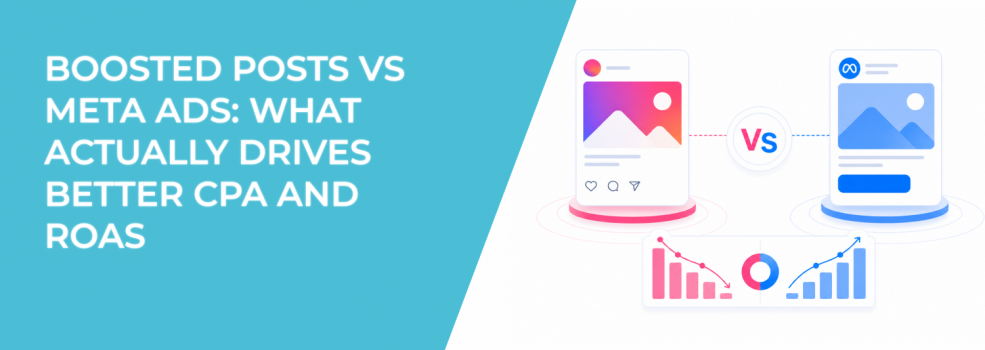
Boosted posts and Meta ads are often treated as interchangeable. They’re not.
Both require budget, both enter the same auction, and both appear in similar placements. But the way they’re built — and how they perform — is fundamentally different.
The difference isn’t format. It’s control.
That difference directly impacts CPC, CPA, and ROAS.
What a boosted post really is
A boosted post is simply an existing piece of content turned into an ad. You take something already published — a post, Story, or Reel — and pay to show it to a larger audience.
It’s the fastest way to launch a campaign. The platform pre-fills most of the setup, and you only need to define a few parameters before publishing.
When boosting, you typically control:
- Your goal, such as engagement, messages, or website visits.
- Your budget and duration.
- Basic audience traits like age, gender, and interests.
- Placement selection across Facebook and Instagram.
This simplicity is the main advantage. It’s also the main limitation.
Boosted posts are designed for visibility, not optimization.
What Meta ads actually do differently
Meta ads, created through Ads Manager or Business Suite, give you access to a much deeper system.
Instead of promoting a single post, you build a structured campaign with defined objectives, audiences, and creative variations. The system can optimize for outcomes like conversions, leads, app installs, or purchases.
This changes how the algorithm behaves.
Instead of distributing content broadly, Meta begins predicting which users are most likely to complete a specific action — and prioritizes those users in the auction.
That shift is what separates awareness campaigns from performance campaigns. If you’re unsure how that structure works, it helps to review how to structure high-performance Meta campaigns before comparing results.
Why boosted posts often look good but perform poorly
Boosted posts tend to generate strong surface-level metrics. Engagement increases, CPC may drop, and reach expands quickly.
But once you look at post-click behavior, a different pattern appears.
Traffic comes in, but conversion rates stay low. Leads may increase, but quality declines. Sales teams start filtering out more responses.
This happens because boosted posts often optimize for engagement rather than intent.
Cheap engagement does not translate into revenue.
That’s why many advertisers eventually realize that why boosting posts often limits performance is not about the format — it’s about the lack of control.
The targeting gap between boosted posts and Meta ads
Targeting is one of the biggest differences between the two approaches.
Boosted posts allow basic targeting, which is enough for broad reach but not for precision. Meta ads, on the other hand, allow layered targeting, audience overlap control, and advanced segmentation.
This creates a performance gap.
- Boosted posts reach a wider but less qualified audience.
- Meta ads can focus on users with higher intent signals.
Over time, this difference becomes visible in campaign metrics. Boosted campaigns may maintain engagement while conversion efficiency declines. Structured campaigns tend to stabilize as the system learns who actually converts.
Improving this requires a deeper understanding of how to improve your targeting strategy instead of simply expanding reach.
Placement and delivery behave differently
Boosted posts allow limited placement selection, typically focusing on core surfaces like Feed and Instagram.
Meta ads unlock a wider distribution system. Campaigns can run across Messenger, Audience Network, Stories, Reels, and additional placements.
This matters because not all placements perform equally.
A campaign limited to a few placements may face higher competition and higher CPM. A campaign with broader placement access can distribute spend more efficiently.
Understanding why ad placement choices can make or break your Facebook campaign helps explain why this difference directly affects cost and scalability.
Creative control and testing capabilities
Boosted posts rely on existing content. You can adjust text variations, but the structure is fixed.
Meta ads allow full creative control. You can test different formats, build carousel ads, adjust messaging for different audiences, and align creative with funnel stages.
This creates a major advantage during optimization.
Instead of guessing what works, you can test systematically and scale winning variations. That’s a key part of running efficient campaigns, especially if you’re applying structured testing methods like those described in what to test first in Facebook campaigns.
Without testing, performance improvements are limited.
When boosting posts actually makes sense
Boosting is not ineffective — it’s just limited.
It works well when the goal is visibility or engagement. If you want to promote content, increase reach, or drive interaction, boosting is efficient.
It also works when speed matters. For local promotions, announcements, or short-term campaigns, the simplicity of boosting can be an advantage.
The problem starts when advertisers expect the same setup to deliver conversions at scale.
When Meta ads are the better choice
Meta ads are designed for performance-driven outcomes.
They are the better choice when:
- You need predictable CPA or ROAS.
- You are generating leads or driving purchases.
- You want to scale campaigns over time.
The additional complexity allows you to control inputs, test variations, and optimize based on real conversion data.
That’s what makes them suitable for growth-focused campaigns.
The hidden cost factor most advertisers ignore
In many regions, boosting through the Instagram iOS app introduces an additional cost layer. Apple may apply a 30% service fee before your budget enters Meta’s system.
This doesn’t affect how your campaign performs inside Ads Manager, but it changes your real cost per result.
Your reported CPA may look stable while your actual cost increases.
This is one more reason why relying solely on boosted posts can create misleading performance insights.
Final takeaway
Boosted posts and Meta ads are not competing tools — they serve different purposes.
Boosted posts are designed for distribution. Meta ads are designed for optimization.
Use boosted posts when you want reach. Use Meta ads when you need results.
Understanding that distinction is what separates campaigns that look good from campaigns that perform profitably.