Digital marketing success is impossible to manage without measurement. Campaigns may look active—traffic is coming in, ads are running, and content is being published—but activity does not always translate into performance. Key Performance Indicators (KPIs) provide a structured way to evaluate whether marketing efforts are actually contributing to business objectives such as revenue growth, customer acquisition, and retention.
However, not all metrics deserve equal attention. Many teams track dozens of numbers without understanding which ones drive decisions. This article breaks down essential digital marketing KPIs, explains what they measure, and clarifies why they matter.
What Are Digital Marketing KPIs?
Digital marketing KPIs are quantifiable metrics used to assess the effectiveness of online marketing activities. They align marketing performance with strategic goals, allowing teams to optimize campaigns, justify budgets, and forecast results.
Effective KPIs share three characteristics:
-
They are tied to business outcomes, not just activity
-
They can be acted upon
-
They provide consistent, comparable insight over time
Traffic and Awareness KPIs
Website Traffic
Website traffic measures the number of users visiting a website within a given period. While traffic alone does not guarantee success, it provides the foundation for all downstream conversions.
Why it matters: Without sufficient traffic volume, even high-performing conversion funnels cannot scale.
Useful context: According to industry benchmarks, companies that consistently grow website traffic by more than 10% quarter over quarter are significantly more likely to outperform revenue targets.
Traffic Sources
Traffic source distribution shows where visitors come from, such as organic search, paid ads, social media, or referrals.
Why it matters: Understanding traffic sources helps marketers allocate budget toward channels that generate not only volume, but quality traffic that converts.
Engagement KPIs
Bounce Rate
Bounce rate represents the percentage of users who leave a site after viewing only one page.
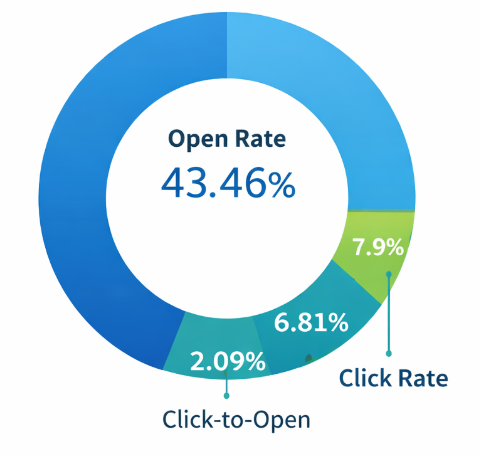
Key email engagement benchmarks: open rate, click-to-open rate, and overall click rate for recent digital marketing performance
Why it matters: A high bounce rate often signals mismatched messaging, poor user experience, or irrelevant traffic. Reducing bounce rate typically correlates with improved conversion performance.
Average Session Duration
This KPI measures how long users stay on a website during a session.
Why it matters: Longer session durations generally indicate stronger engagement and content relevance. Sites with higher session duration tend to generate more leads per visit.
Conversion KPIs
Conversion Rate
Conversion rate is the percentage of visitors who complete a desired action, such as submitting a form or requesting a demo.
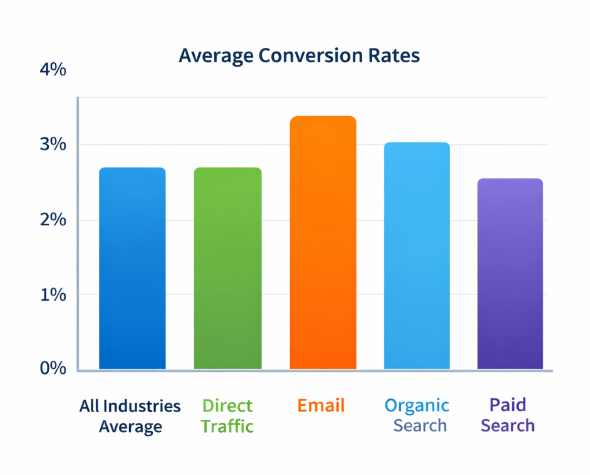
Average conversion rates by industry and traffic source showing how efficiency varies across channels
Why it matters: Conversion rate directly reflects how efficiently traffic is being turned into leads or customers. Even small improvements can produce substantial gains without increasing ad spend.
Useful statistic: Research shows that improving conversion rates by just 1% can increase total marketing-driven revenue by up to 10% when applied at scale.
Cost per Conversion
This metric calculates how much budget is required to generate a single conversion.
Why it matters: Cost per conversion determines whether campaigns are financially sustainable. Lowering this KPI allows teams to scale acquisition without increasing overall spend.
Revenue and ROI KPIs
Customer Acquisition Cost (CAC)
CAC measures the total marketing and sales cost required to acquire a new customer.
Why it matters: When CAC exceeds customer lifetime value, growth becomes unprofitable. High-performing marketing organizations closely monitor CAC alongside revenue metrics.
Return on Marketing Investment (ROMI)
ROMI evaluates how much revenue is generated for every unit of marketing spend.
Why it matters: Data-driven organizations that actively optimize campaigns based on ROI metrics consistently report significantly higher profitability compared to teams relying on surface-level engagement metrics.
Retention and Lifetime Value KPIs
Customer Lifetime Value (CLV)
CLV estimates the total revenue a business can expect from a customer over the duration of the relationship.
Why it matters: Focusing on CLV shifts marketing strategy from short-term acquisition to long-term value creation.
Churn Rate
Churn rate measures the percentage of customers who stop using a product or service within a given period.
Why it matters: Reducing churn often has a greater impact on revenue than increasing acquisition, especially in subscription-based or B2B models.
How to Choose the Right KPIs
Selecting KPIs should start with business goals, not available data. A lead generation campaign, for example, should prioritize conversion rate, cost per lead, and lead quality rather than impressions or clicks alone.
Best practice is to limit KPI dashboards to a focused set of metrics that clearly inform decisions. Overloading reports with vanity metrics reduces clarity and slows optimization.
Common KPI Mistakes to Avoid
-
Measuring activity instead of outcomes
-
Evaluating KPIs in isolation rather than in context
-
Changing KPIs too frequently to establish trends
-
Ignoring data quality and attribution accuracy
Suggested Reading
Conclusion
Digital marketing KPIs are not just reporting tools; they are decision-making instruments. When selected and interpreted correctly, they reveal what is working, what is not, and where resources should be focused. Measuring the right KPIs enables marketing teams to move beyond assumptions and build predictable, scalable growth.