Most social ad campaigns — especially on Meta platforms like Facebook and Instagram — are optimized around visible user actions. But there's a fundamental gap in this model: signal is not the same as intent.
To build more profitable and scalable campaigns, advertisers must move beyond surface metrics and rethink how attention and intent actually form. This is especially important in 2026, where creative saturation, automation bias, and platform opacity make old-school tactics less effective.
The signal vs intent framework helps teams align their targeting, creative, and measurement around what actually drives customer behavior — not just what the platform tracks.
Understanding the difference between signal and intent
Most ad strategies treat observed behavior as a proxy for buyer readiness. But this assumption often leads marketers astray.
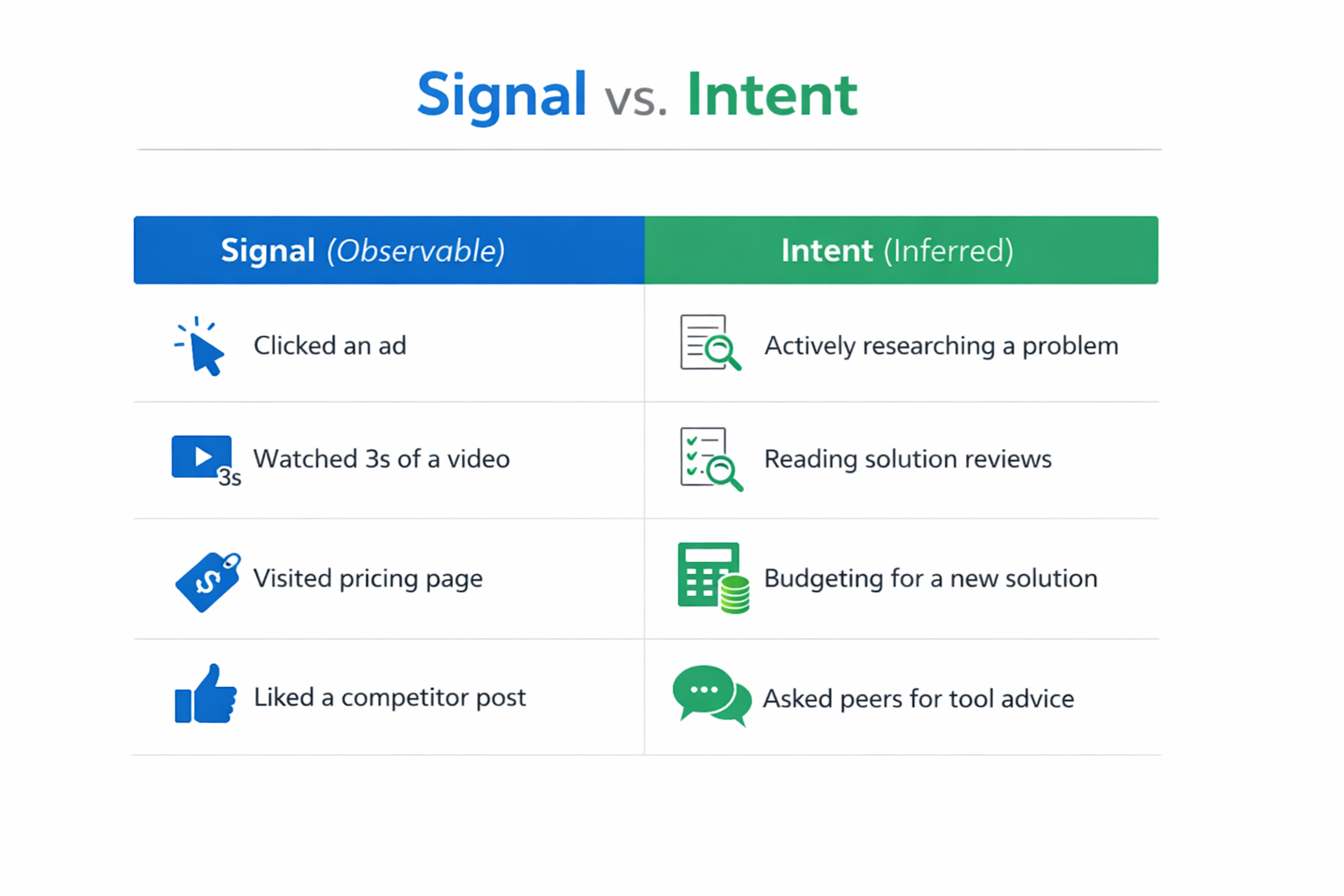
Definitions:
-
Signal refers to any observable interaction — a click, video view, like, or page visit.
-
Intent refers to internal motivation — a desire or plan to act, regardless of whether it has been expressed.
Signals are easy to track but easy to misread. Intent is harder to detect but far more valuable for growth.
Consider this example: someone clicks on a carousel ad out of curiosity but has no intention of buying. The algorithm interprets this signal as interest and prioritizes similar users — creating a false-positive loop. Meanwhile, high-LTV buyers who research independently or convert later go under-optimized because they don’t signal early.
This creates systemic inefficiency in how campaigns scale. To understand how signal-based optimization can mislead performance, read Why Clicks Don’t Equal Demand.
Why most advertisers confuse signal with intent
Advertisers rarely challenge the premise that engagement equals interest. But platforms reward engagement, not accuracy. The result is a skewed performance model that penalizes long-cycle buyers and rewards low-friction behavior.
| ❌ Flawed strategy | ✅ What you should do instead |
|---|---|
| Optimizing for CTR only | Optimize for customer value (e.g., LTV, downstream conversion rate) |
| Retargeting clickers who don’t convert | Target inferred intent (e.g., behavioral signals, profile relevance) |
| Killing ads before delayed conversions show | Use post-click surveys and CRM-based attribution to assess influence |
1. Algorithmic feedback loops distort campaign data
Most social platforms optimize delivery based on near-term signals. If your ad gets clicks, the system finds more users likely to click. But this doesn’t necessarily align with users likely to buy — especially in considered purchase categories.
For example:
-
A user clicks because the image is bold, not because the offer is relevant.
-
A video view may be due to autoplay, not active interest.
These signals are useful for understanding attention, but misleading when used to optimize intent. Over time, the algorithm learns to over-index on "fast clickers" rather than true decision-makers — especially if your budget is limited or if you're running short optimization windows.
These loops become self-reinforcing, creating artificially high CTRs with low downstream revenue.
To break out of this cycle, advertisers should rethink performance metrics. For guidance, see How to Analyze Facebook Ad Performance Beyond CTR and CPC.
2. Short-term metrics skew creative decisions
Advertisers under pressure to hit weekly or daily goals often rely on early performance metrics to judge creative. This includes:
-
Click-through rate (CTR) in the first 24 hours.
-
Video views over 3 seconds.
-
Cost per result in the first optimization window.
While these metrics are easy to access, they favor shallow engagement. Ads that require more cognitive processing — like long-form testimonials or complex reframing — may underperform early, but convert better over time.
This results in a bias toward creative that wins the click, not the customer. Learn how to improve testing strategy with Secrets Behind High-Performing Creative Testing Campaigns.
Applying the signal vs intent framework
To improve paid social outcomes, advertisers should rethink campaign architecture across three levels: targeting, creative structure, and measurement. In each case, the goal is to identify and nurture real buyer intent, not just chase the loudest signals.
Targeting: prioritize inferred intent over engagement history
Standard Meta targeting often revolves around retargeting recent engagers. But these users may be habitual clickers or already saturated with ads. Instead, intent-driven targeting asks: who is likely to care about this offer, even if they haven’t clicked yet?
Segment audiences based on inferred intent stage:
-
Passive problem-aware users: These users haven’t visited your site or clicked your ads but are part of your ICP. They consume content related to your category but haven’t taken action.
-
Reframing users: These individuals have engaged with competitor content or parallel category ads. They’re familiar with the space but stuck in old assumptions.
-
High-intent users: Repeat site visitors, abandoned carts, deep scrollers, or those with high email open rates and on-site time.
Each of these segments requires a different messaging strategy, and none of them can be fully captured through basic engagement-based audiences.
For strategies that go beyond basic custom audiences, see How to Identify High-Intent Audiences Using Facebook Insights.
Creative: distinguish between attention-grabbing and decision-driving formats
Many advertisers evaluate creative performance with surface-level metrics: which ad gets the cheapest click, the most views, or the lowest CPM.
But high-signal ads aren’t always high-converting. This is especially true in categories with longer sales cycles or high consideration.
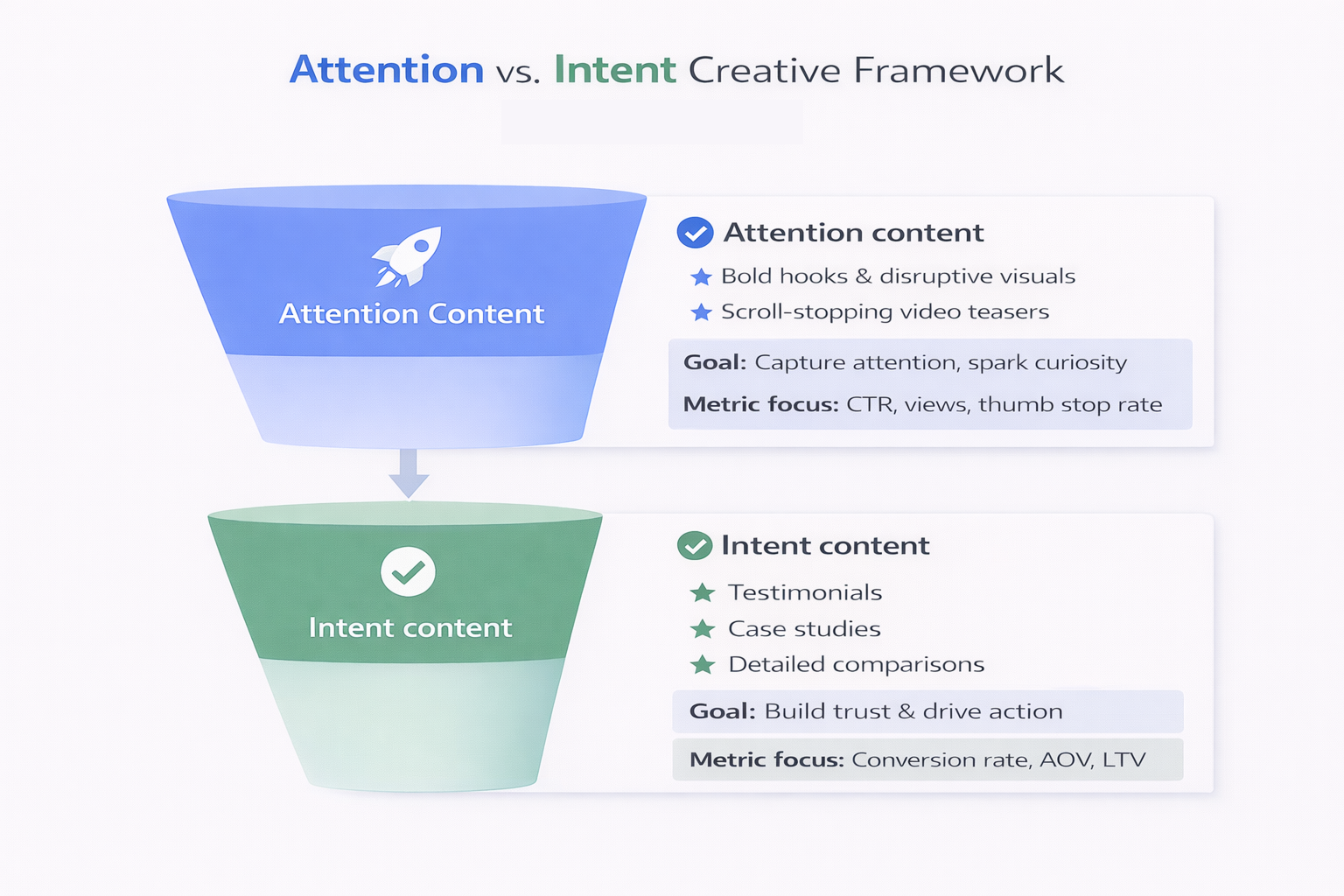
To address this, apply a dual-layer creative model:
Layer 1: attention content
This creative captures the user’s focus. It's designed to disrupt scrolling and spark curiosity. Examples include:
-
Bold visuals with unusual headlines ("Why most CRM tools fail sales teams")
-
Short, looping video hooks that highlight a pain point without solving it
-
Swipe-style carousels showing broken before-state experiences
These assets perform well on top-of-funnel metrics — but should be used primarily to qualify attention, not close the deal.
Layer 2: intent content
This creative builds trust, relevance, and emotional clarity. It often underperforms on CTR, but outperforms on conversion rate. Examples include:
-
First-person case study videos describing transformation
-
Long-form text ads that reframe industry assumptions
-
Side-by-side comparisons with detailed outcomes
The best campaigns balance both layers. For help testing these effectively, explore Key Strategies for Facebook Ad Testing.
Measurement: track delayed influence, not just direct actions
If you're measuring success based on last-click attribution or in-platform ROAS, you're only seeing part of the story.
To get a true sense of intent, measurement must expand beyond ad-level signals.
Adopt journey-aware measurement methods:
-
Post-purchase surveys: Ask users how they first heard about you. This often reveals brand discovery that attribution tools miss entirely.
-
CRM-matching over time: Track how users who were exposed to ads eventually convert through other channels (email, direct, search).
-
Time-lag analysis: Understand how long it typically takes from first ad view to conversion. Adjust reporting windows to reflect this.
Delayed conversions often tell the real story. For a deeper dive into attribution modeling, read Meta Ads Attribution: What to Know About Windows, Delays, and Data Accuracy.
Final note: in 2026, intent is the real constraint — not reach
In an era of automated bidding, commoditized targeting, and creative fatigue, it's not enough to capture attention. You must cultivate desire.
The signal vs intent framework helps advertisers go beyond the algorithm’s defaults and optimize for real business outcomes. It allows you to:
-
Escape the echo chamber of signal-based optimization
-
Rebuild creative strategy to reflect how decisions are actually made
-
Develop smarter measurement frameworks that capture delayed and multi-touch influence
Most brands don’t need more impressions. They need better intent.