Scaling Facebook Ads feels simple when campaigns are profitable. You increase the budget and expect revenue to grow at the same pace. In practice, scaling often reduces efficiency because you move beyond the highest-intent users into broader and more competitive auctions. Costs rise faster than revenue, and ROAS begins to compress.
Budget amplifies whatever system is already in place. If your margins are thin or conversion rates unstable, more spend magnifies those weaknesses. Stable scaling requires financial clarity, clean structure, and disciplined execution. Without those, growth becomes expensive.
Why ROAS Breaks When You Scale Too Fast
When budgets increase sharply, Meta expands delivery into less efficient audience pockets. You start competing in auctions where purchase intent is lower and bid pressure is higher. That shift raises CPM and weakens overall conversion efficiency. Even strong creatives struggle under poor auction conditions.
Common scaling side effects include:
-
Rising CPM; broader reach exposes you to more aggressive bidders.
-
Softer conversion rates; new segments are less aligned with your ideal buyer.
-
Higher frequency; impressions accumulate quickly in smaller pools.
-
Learning instability; rapid budget changes disrupt delivery patterns.
Audience expansion pressure is often misdiagnosed as creative fatigue, which is discussed in Why Audience Expansion Sometimes Lowers Facebook Ads ROI. The problem is not always the ad. It is often the audience quality.
Validate Profit Before You Add Budget
ROAS can look strong while real profit erodes. Revenue growth does not guarantee margin health. Scaling safely requires understanding how much efficiency loss your business can absorb. That buffer determines how aggressively you can expand.
Before scaling, confirm these baselines:
-
Contribution margin per order; subtract product cost, shipping, payment fees, and returns before ad spend.
-
Break-even ROAS; calculate the minimum return required to stay profitable, using guidance from How to Calculate Break-Even ROAS for Facebook and Instagram Ads.
-
Blended CAC; include all acquisition channels so Meta performance is not judged in isolation.
-
Customer lifetime value; evaluate repeat purchase behavior and review Why You Should Pair ROAS With Customer Lifetime Value (LTV).
If your margin cushion is narrow, scaling must be conservative. Small cost increases can erase profitability quickly.
Confirm Conversion Stability
Scaling multiplies whatever pattern already exists in your funnel. If conversion rates fluctuate heavily, higher spend increases volatility. Stability matters more than short-term spikes.
Audit performance before increasing budgets:
-
Review click-to-purchase rate across at least 14 to 30 days.
-
Compare daily variance instead of relying on averages.
-
Check performance by placement and device.
-
Analyze checkout or CRM drop-off rates.
Stable funnels create predictable scaling conditions.
Horizontal Scaling: Expand Without Stressing One Campaign
Horizontal scaling spreads risk across new segments rather than concentrating spend in one ad set. This reduces the impact of underperformance in any single audience. It also preserves the stability of your core campaign.
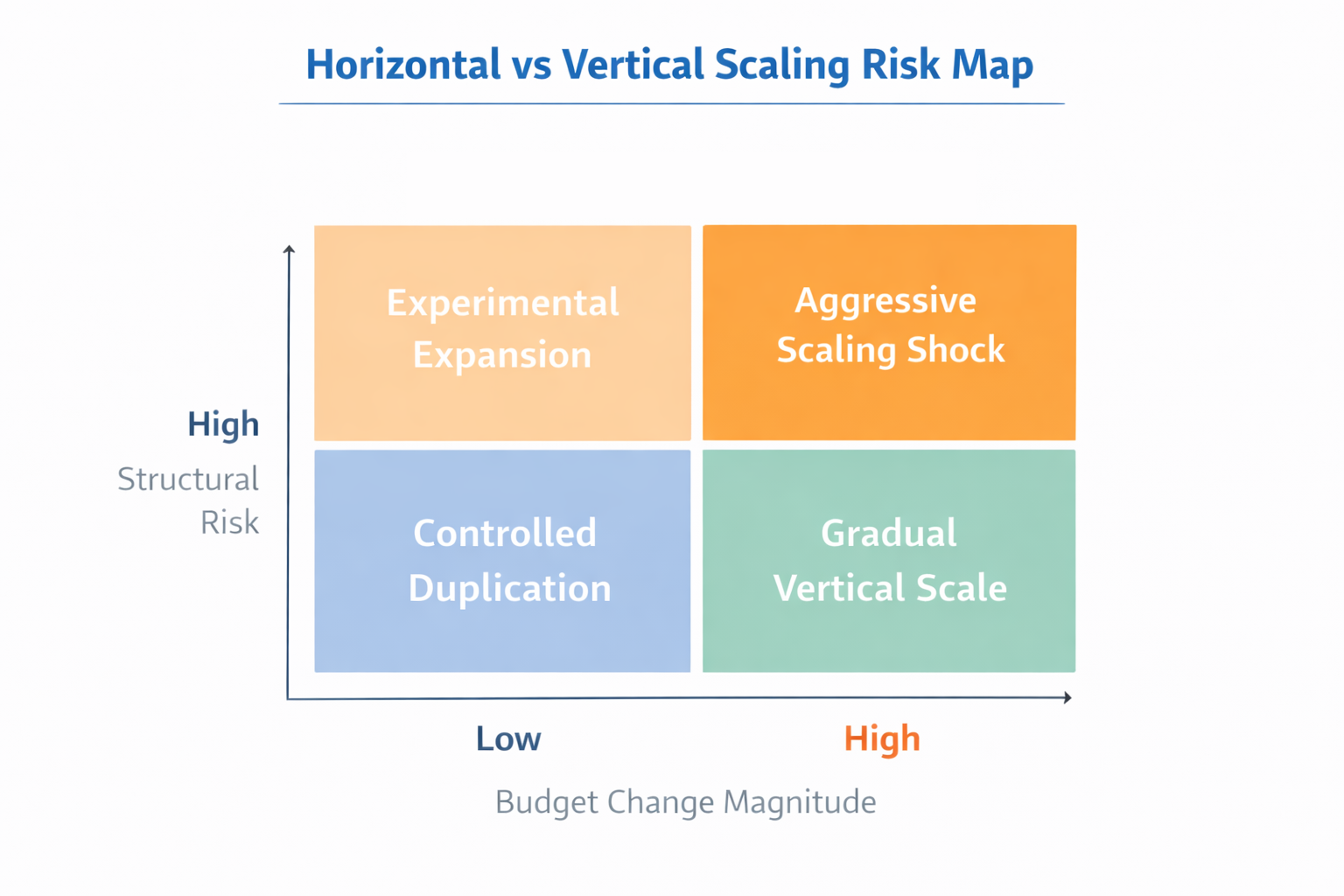
Effective horizontal expansion includes:
-
Expanding from 1 percent lookalikes to 2 percent while keeping creatives constant.
-
Testing structured interest clusters based on verified behaviors.
-
Separating retargeting windows such as 7-day and 30-day segments.
-
Launching campaigns in regions similar to your best-performing markets.
Each new segment acts as a contained experiment.
Creative Strategy During Scaling
As budgets rise, impression volume increases and frequency follows. Creative fatigue accelerates under higher exposure. Without controlled refreshes, engagement declines and acquisition cost rises.
Rotate creatives strategically:
-
Keep the hook constant while testing new visual formats.
-
Introduce updated proof elements such as testimonials or quantified results.
-
Adjust the core angle while maintaining the same offer.
-
Monitor frequency and conversion rate together, and review How to Avoid Ad Fatigue and Keep Optimal Ads Conversion Rate for deeper tactics.
Controlled variation protects data continuity while refreshing audience attention.
Vertical Scaling: Increase Budgets Gradually
Vertical scaling works when performance consistently exceeds break-even and conversion behavior is stable. The objective is to increase spend without triggering learning disruption. Large jumps often destabilize delivery.
Follow measured increments:
-
Increase budgets by 15 to 25 percent every 48 to 72 hours.
-
Scale only campaigns that outperform break-even by a safe margin.
-
Pause increases if acquisition cost rises more than 15 percent.
-
Avoid scaling during unstable demand periods.
If campaigns stall despite strong metrics, review structural risks discussed in Why Facebook Ads Don’t Scale Even With Good Metrics.
Monitor Auction Pressure Closely
Auction dynamics shift before revenue declines. Watching early signals helps you protect ROAS proactively. Do not rely solely on revenue trends.
Track these indicators:
-
CPM trends; sustained increases indicate stronger competition.
-
CTR shifts; declining engagement signals audience fatigue.
-
Conversion rate drops; small changes compound at scale.
-
Frequency growth without revenue growth; a sign of saturation.
Scaling decisions should respond to patterns, not daily swings.
Protect Blended ROAS
Campaign-level ROAS can look strong while overall efficiency declines. Blended ROAS reflects total revenue divided by total ad spend. That metric shows whether scaling improves business performance.
Monitor blended performance weekly:
-
Total revenue relative to total advertising spend.
-
Cost per new customer across campaigns.
-
Revenue share by prospecting versus retargeting.
-
Profit per order after marketing costs.
Blended visibility prevents hidden inefficiencies.
Know When to Stop Scaling
Scaling has economic limits. Marginal cost eventually rises faster than marginal revenue. Pushing beyond that point damages profitability.
Pause scaling when acquisition cost approaches break-even or when conversion rates decline across placements. Stop when frequency rises without incremental revenue or payback periods extend beyond targets. Resume only after restoring stability.
Final Thoughts
Scaling is not about spending more. It is about expanding a stable, profitable system. Strong margins, consistent conversion rates, and disciplined structure create the foundation for safe growth. Protecting ROAS depends on respecting those limits rather than chasing volume.