Launching a new product with Facebook Ads often looks fine on the surface. You get impressions, clicks, even some early conversions. But then performance stalls — or never really starts.
The issue usually isn’t just targeting or creative. In most cases, the campaign is missing the inputs Meta needs to learn.
If you’re seeing traffic without sales, you’re not dealing with a “bad campaign.” You’re dealing with incomplete signal.
Why New Products Struggle in Meta’s System
A new product enters the auction with no behavioral history. That puts it at a disadvantage from the first impression.
Meta’s system depends on:
-
Conversion repetition, where similar users complete the same action within a short window. This allows the algorithm to recognize patterns and prioritize similar users.
-
Behavioral clustering, where those users share traits — interests, actions, or timing — that can be grouped and scaled.
-
Reinforcement loops, where each new conversion strengthens the system’s confidence and improves delivery decisions.
With a new product, these loops don’t exist yet.
Instead, the system relies on weak signals like clicks or page views. That’s why early performance often resembles what’s described in Facebook Ads Not Converting: How To Fix It — activity without meaningful outcomes.
You’re getting interaction, not intent.
Missing Signal Density
Most campaigns fail early because conversions are too scattered.
A typical pattern:
-
6 purchases come from 6 different audience profiles.
-
Each conversion reflects a different motivation or use case.
-
No dominant pattern forms, so the system cannot prioritize similar users.
From Meta’s perspective, this is noise.
How to Fix It
Instead of maximizing reach, compress the learning phase:
-
Start with a narrower audience, even if CPM increases; this forces early conversions into a tighter behavioral group.
-
Use one consistent offer angle, so every conversion reinforces the same intent signal instead of fragmenting it.
-
Reduce campaign fragmentation, especially across ad sets targeting similar users, so data accumulates in one place.
If you’ve seen campaigns stall after early traction, the root cause is often structural — similar to what’s explained in Why Your Facebook Ads Stop Scaling (and How to Fix It).
You don’t scale until the system sees repetition.
Weak Offer–Market Fit Signals
When a product doesn’t convert, the first instinct is to adjust targeting. In reality, the issue often appears after the click.
You’ll typically see:
-
High CTR, which indicates curiosity rather than buying intent.
-
Low conversion rate, showing hesitation or mismatch after landing.
-
Rising CPC, as the system struggles to find responsive users.
These are feedback signals, not random fluctuations.
What’s Actually Happening
Users click, but they don’t commit.
That hesitation feeds back into delivery:
-
Low-quality post-click behavior reduces auction competitiveness.
-
The system shifts toward cheaper but less qualified traffic.
-
Conversion rates decline further as signal quality degrades.
This is the same pattern described in Why Your Ads Get Clicks But No Sales: Fixing the Audience Misalignment.
How to Diagnose It
Focus on what happens after the click:
-
Compare landing page view → purchase drop-off, to identify where users disengage.
-
Analyze conversion rate by creative, not just CTR, to spot misleading engagement.
-
Review session behavior, such as time on page or scroll depth, if available.
If engagement collapses post-click, the issue is not targeting — it’s offer clarity.
No Pre-Conversion Momentum
Most new product campaigns try to convert immediately. That works only when demand already exists.
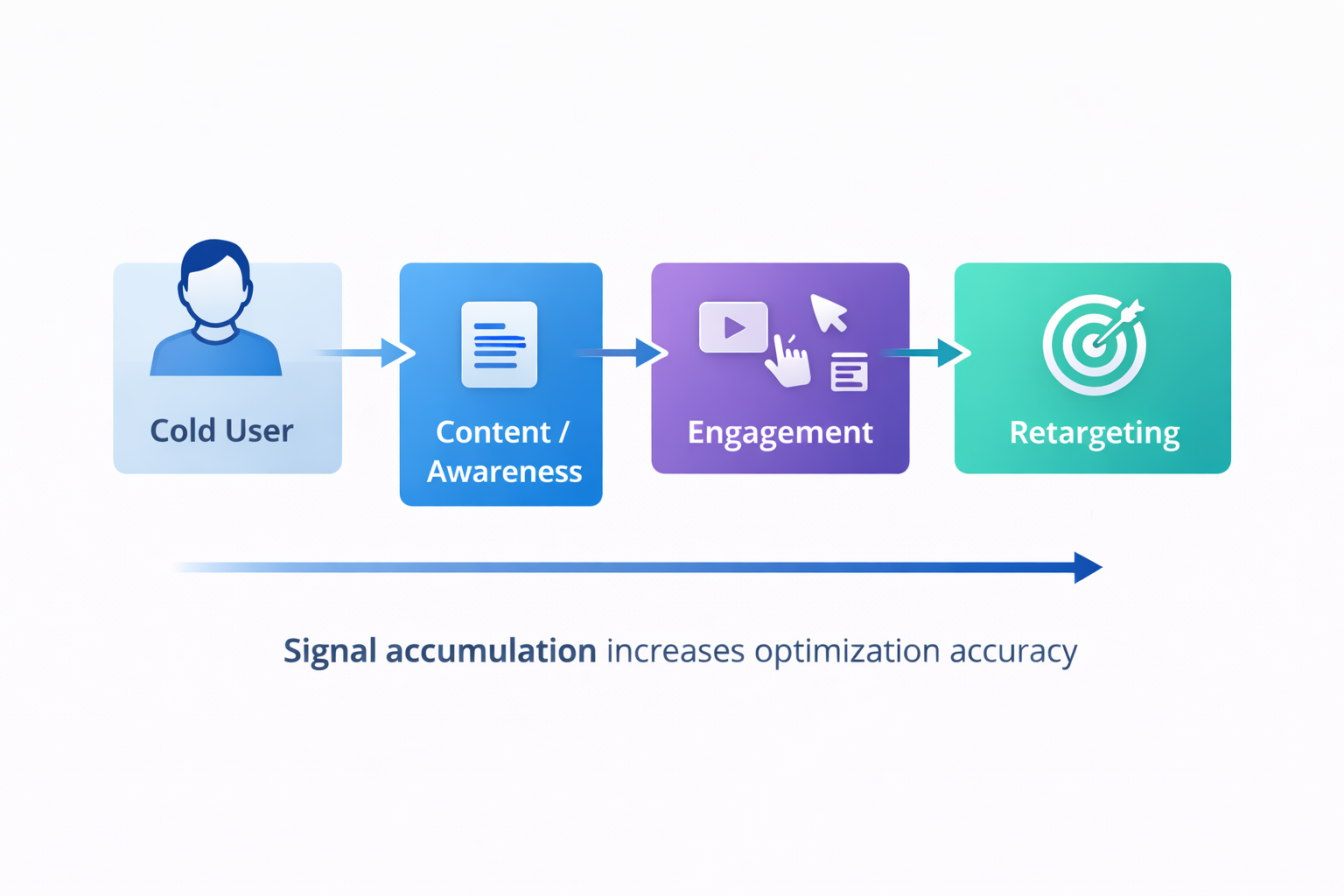
In most cases, users need context first.
Without that:
-
Every impression starts from zero; no familiarity builds.
-
The algorithm lacks intermediate signals to learn from.
-
Conversion events remain too sparse and inconsistent.
What’s Missing
Pre-conversion momentum.
You can see how structured funnels solve this in Facebook Ads Funnel Strategy: From Audience Identification to Conversion.
How to Build It
Introduce a progression of intent:
-
Educational creatives, explaining the problem and positioning the product as a solution.
-
Engagement campaigns, capturing users who show early interest but don’t convert immediately.
-
Retargeting layers, focusing on users who interacted with content or product pages.
This creates continuity instead of isolated impressions.
The algorithm performs better when it sees a sequence, not a single event.
Misaligned Optimization Event
Optimizing for purchases too early is one of the most common launch mistakes.
If volume is too low, the system cannot stabilize.
You’ll notice:
-
Learning limited status, indicating insufficient data.
-
Large CPA swings, caused by unstable signal input.
-
Uneven spend distribution, as the system searches for patterns.
When to Adjust
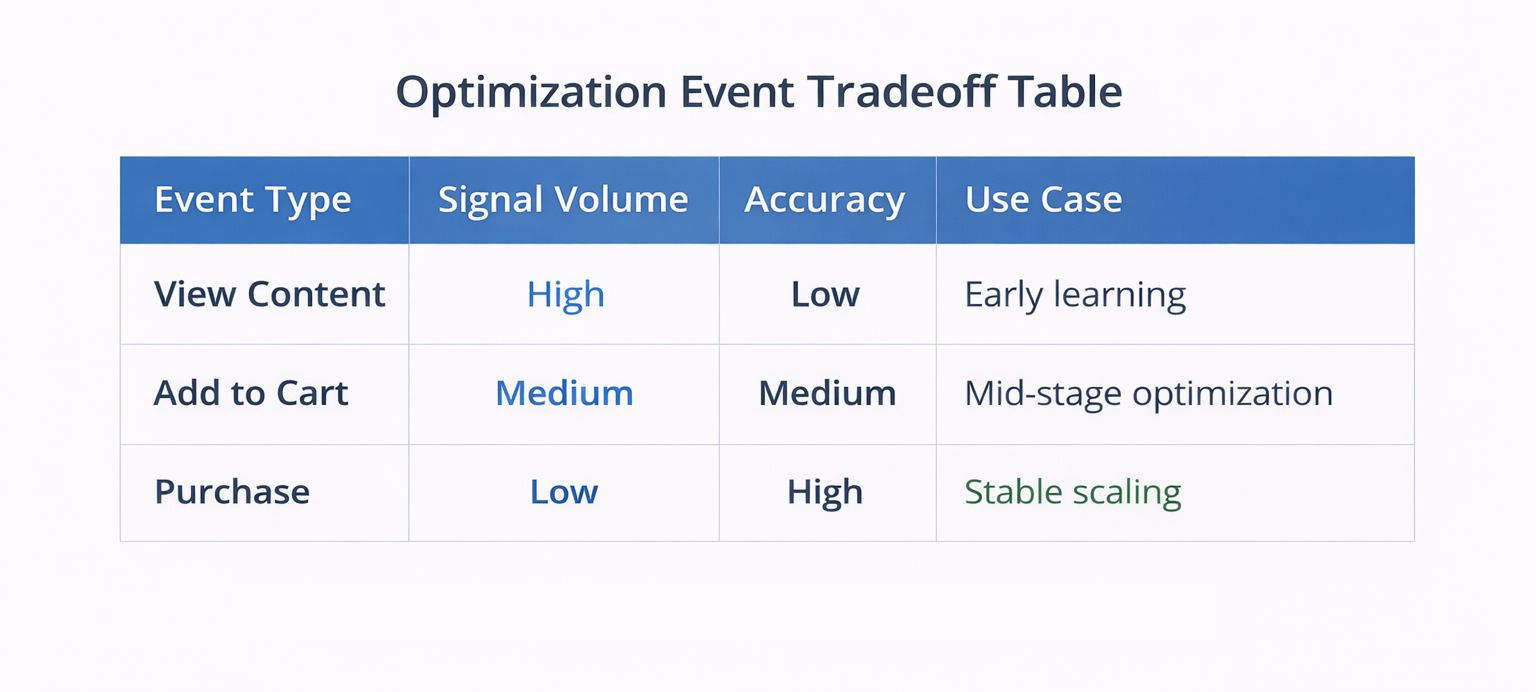
Temporarily shift to a higher-frequency event:
-
Add-to-cart, when users show clear product interest but don’t purchase.
-
View content, when traffic exists but deeper actions are limited.
The Tradeoff
This approach introduces a clear compromise:
-
Faster learning and more stable delivery;
-
Lower alignment with actual revenue outcomes.
Use it to build momentum — then return to purchase optimization once data improves.
Creative That Doesn’t Anchor the Product
Creative determines who clicks — and who filters themselves out.
If your ads are too broad:
-
You attract curiosity instead of intent.
-
Conversion signals become diluted across different user types.
-
The system struggles to identify a consistent audience.
What Effective Creative Does
It pre-qualifies the user before the click:
-
Clearly communicates who the product is for, reducing irrelevant traffic.
-
Sets expectations about price, complexity, or use case, avoiding mismatched clicks.
-
Highlights a specific value proposition, not generic benefits.
This often reduces CTR slightly, but improves conversion rate and stabilizes CPA.
Fragmented Testing Structure
New product campaigns often test too many variables at once.
You might be running:
-
Multiple audiences, each with different targeting logic.
-
Several creatives, each pushing a different angle.
-
Different offers, competing for the same conversion signal.
This spreads data too thin.
What to Change
Start with a controlled structure:
-
One clearly defined audience;
-
One core offer;
-
A small set of distinct creatives.
Once you see consistent conversion behavior, expand gradually.
Testing works only when cause and effect can be isolated.
Practical Takeaway
When a new product doesn’t convert, the issue isn’t performance — it’s missing structure.
Meta needs:
-
Concentrated and repeated signals;
-
Clear intent shaped before the click;
-
A progression of interactions, not isolated impressions.
If you build those elements first, performance becomes predictable.
If you skip them, the algorithm has nothing stable to optimize — and no reason to improve.