When a campaign isn’t generating enough results, the instinct is usually to change the offer, tweak the landing page, or adjust targeting.
In most cases, that’s premature.
What actually determines whether you get results at all happens earlier — at the level of delivery, auction participation, and system constraints. If those aren’t working, the campaign never reaches a point where conversion optimization matters.
A useful way to approach this is to treat “low results” not as a single problem, but as a set of distinct scenarios. Each one has a different cause — and requires a different fix.
If Your Ad Isn’t Spending at All
This is the cleanest failure mode. Nothing is happening because the system isn’t delivering.
You’ll typically see a campaign that’s active but barely spends, with impressions staying flat throughout the day. In some cases, there’s a visible delivery error. In others, the issue is more subtle — something in the setup prevents the ad from fully entering auctions.
What this means:
The system hasn’t accepted your ad as eligible for consistent delivery.
This often happens after edits. A small issue — tracking, destination, or formatting — is enough to suppress delivery without fully stopping the campaign.
What to do:
-
Check delivery status at the ad level and resolve any errors.
-
Verify tracking setup — especially if you recently changed events or domains.
-
Avoid making multiple fixes at once. Resolve one issue, then confirm delivery recovers.
If you want a deeper breakdown of how statuses affect delivery, see Understanding Facebook Ad Statuses: Common Issues and How to Fix Them.
If Other Ads Spend but Yours Doesn’t
This situation creates confusion because the campaign is working — just not for the ad you’re looking at.
Inside an ad set, Meta quickly shifts delivery toward whatever it predicts will perform best. That means one ad can absorb most of the impressions while others effectively disappear.
This is especially misleading when you’re trying to evaluate creatives.
What this means:
Your ad is losing the internal ranking decision.
It’s not broken. It’s just being deprioritized.
What to do:
-
Don’t judge ads based on uneven delivery — run structured tests instead.
-
Use proper split testing.
-
Remove weaker ads to reduce internal competition.
Without isolating variables, you’re not measuring performance — you’re observing allocation.
If Delivery Status Shows “Learning” or “Learning Limited”
This is where many campaigns get stuck without a clear explanation.
You’ll see inconsistent performance, fluctuating costs, and unstable delivery. The instinct is to intervene, but that usually makes things worse.
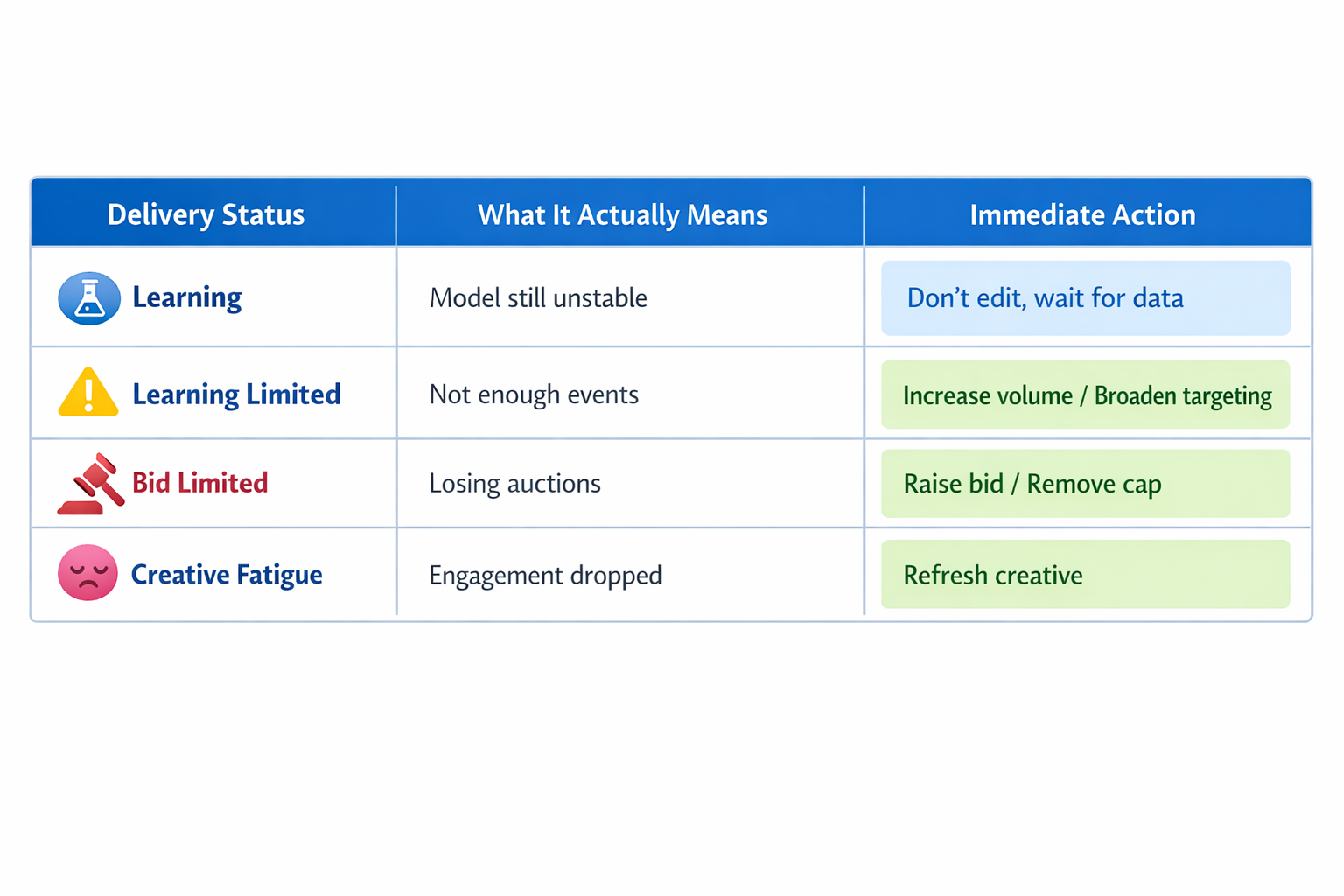
What this means:
The system doesn’t have enough data to make reliable predictions.
-
“Learning” → still exploring different user clusters.
-
“Learning Limited” → not enough conversion events to complete that process.
Every edit resets this cycle. So frequent adjustments keep the campaign in a permanent state of instability.
What to do:
-
Let the campaign run without changes until it exits learning.
-
Increase signal volume by:
-
broadening targeting,
-
increasing budget,
-
or optimizing for a higher-frequency event.
-
-
Consolidate fragmented ad sets.
If you’re dealing with this frequently, it’s worth reviewing How to Optimize Facebook Campaigns for Faster Learning Phase Exit for structural fixes.
If You Can’t Spend Your Full Budget
This is one of the most misunderstood scenarios.
The campaign is active. Everything looks correct. But spend consistently stays below budget.
Most assume this is a demand issue. It’s not.
What this means:
Your bid or cost constraints are too tight for the auction environment.
The system is skipping auctions where it can’t meet your limits. So instead of overspending, it simply underdelivers.
You can often confirm this by watching CPM trends. If CPM rises but spend doesn’t follow, your bid is no longer competitive.
What to do:
-
Switch to a highest-volume strategy to re-enter auctions.
-
Gradually increase cost caps instead of making large jumps.
-
Monitor delivery immediately after changes — it usually reacts quickly.
This is not about optimization. It’s about permission to compete.
If Performance Drops After Initial Delivery
A campaign that starts strong and then declines is usually not “random.” There’s a predictable mechanism behind it.
You’ll often see:
-
strong early results,
-
followed by a drop in impressions,
-
then a decline in conversions.
What this means:
Your creative has lost its ability to generate engagement signals.
As users see the same ad repeatedly, interaction drops. That reduces predicted action rate, which reduces auction participation.
This is why performance decline often looks like a delivery issue — because it becomes one.
What to do:
-
Refresh creatives before performance collapses.
-
Change the angle or hook, not just minor visual elements.
-
Track frequency as an early signal.
For a deeper breakdown of how fatigue develops, see Ad Fatigue on Facebook: How to Spot It Early and Fix It Fast.
If Some Ad Sets Never Scale
When certain ad sets consistently underdeliver, even with budget available, the issue is often structural.
This becomes visible when performance is uneven across ad sets without a clear reason.
What this means:
Your ad sets are competing against each other.
If they target similar audiences, they enter the same auctions. Only one wins. The rest lose visibility and never gather enough data to improve.
Over time, this creates a gap where some ad sets scale and others stagnate.
What to do:
-
Consolidate overlapping ad sets.
-
Use broader targeting instead of splitting audiences too narrowly.
-
Remove unnecessary segmentation unless it serves a clear purpose.
This is one of the most common hidden inefficiencies.
If You Get Traffic but Not Results
At this point, delivery is working. The system is doing its job. The issue shifts downstream.
You’ll typically see decent CTR and steady traffic, but conversions remain low.
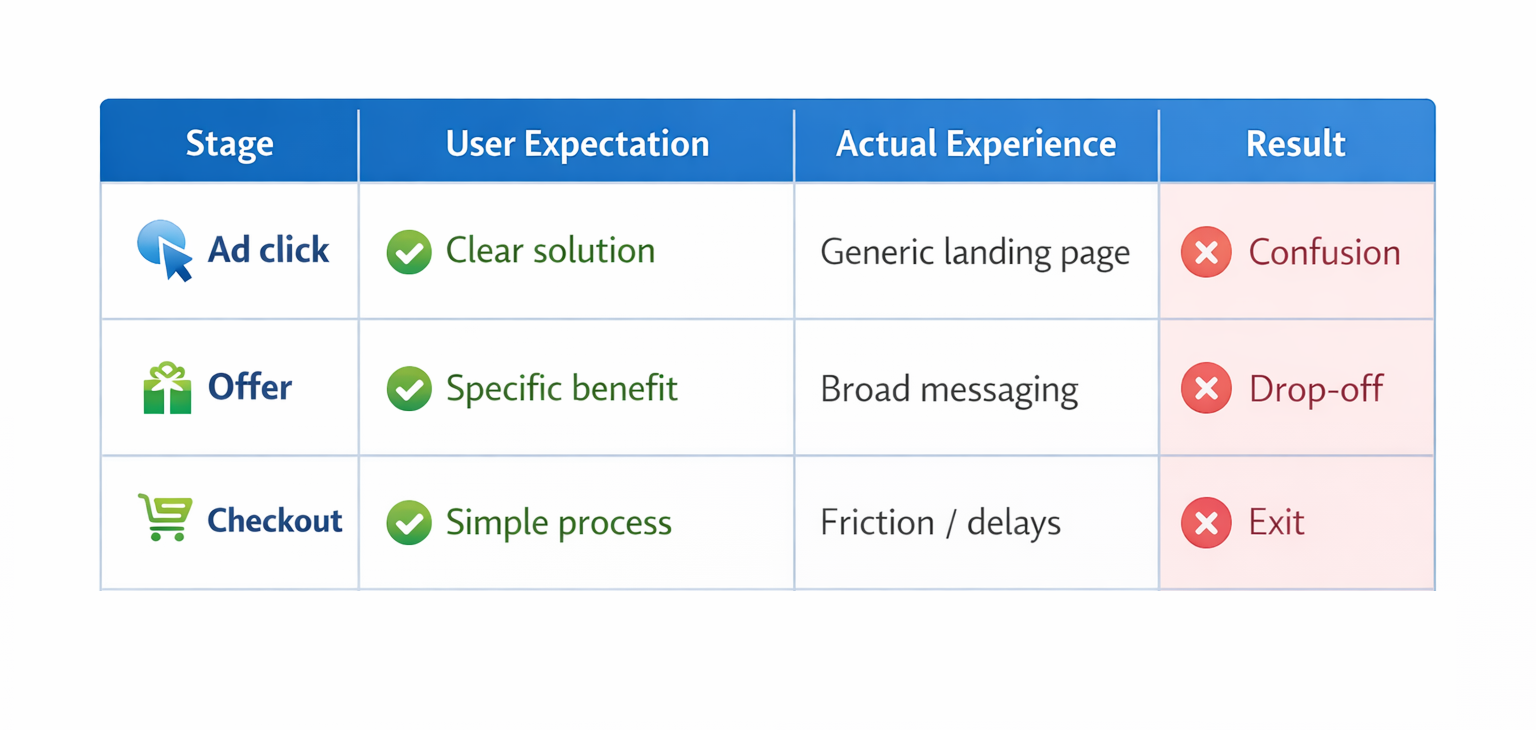
What this means:
There’s a mismatch between the ad and the post-click experience.
The user clicks because the message is compelling, but what they see next doesn’t match the expectation.
This can come from:
-
overly broad messaging,
-
unclear landing pages,
-
or friction in the conversion process.
What to do:
-
Align the ad promise with the landing page content.
-
Narrow your messaging to a specific use case.
-
Audit post-click experience (speed, clarity, structure).
If this pattern sounds familiar, it’s closely related to Facebook Ads Not Converting: How To Fix It.
Final Perspective: Results Depend on Where the System Breaks
“Not enough results” is not a diagnosis. It’s an outcome.
What matters is identifying where the system is breaking:
-
no delivery → eligibility issue,
-
uneven delivery → internal prioritization,
-
unstable delivery → lack of data,
-
limited spend → bidding constraint,
-
declining delivery → creative fatigue,
-
weak results → post-click mismatch.
Each of these requires a different response. Applying generic optimization advice usually makes things worse because it doesn’t address the actual constraint.