
Paid social campaigns are often evaluated using surface-level metrics such as click-through rates (CTR), cost per acquisition (CPA), and return on ad spend (ROAS). While these indicators provide useful signals, they do not answer the most important question: are your campaigns generating incremental value?
Incrementality measures the true causal impact of your advertising—what would not have happened without your campaigns. Without this perspective, businesses risk overestimating performance and misallocating budget.
What Is Incrementality?
Incrementality refers to the additional conversions, revenue, or outcomes directly attributable to a marketing activity beyond what would have occurred organically.
For example, if a campaign reports 1,000 conversions but 600 of those users would have converted anyway, the incremental impact is only 400 conversions.
This distinction is critical because most attribution models—especially platform-reported ones—tend to over-credit campaigns due to factors like view-through attribution and retargeting bias.
Why Incrementality Matters
1. Avoid Overstated Performance
Platform-reported metrics often inflate results. According to industry studies, up to 30–50% of attributed conversions in paid social can be non-incremental, particularly in retargeting-heavy strategies.
2. Optimize Budget Allocation
Incrementality helps identify which campaigns are truly driving growth versus those that are capturing existing demand. This ensures budget is directed toward net-new impact.
3. Improve Long-Term Strategy
Focusing on incremental lift enables more accurate forecasting and sustainable scaling.
Common Pitfalls in Measuring Performance
Last-Click Attribution Bias
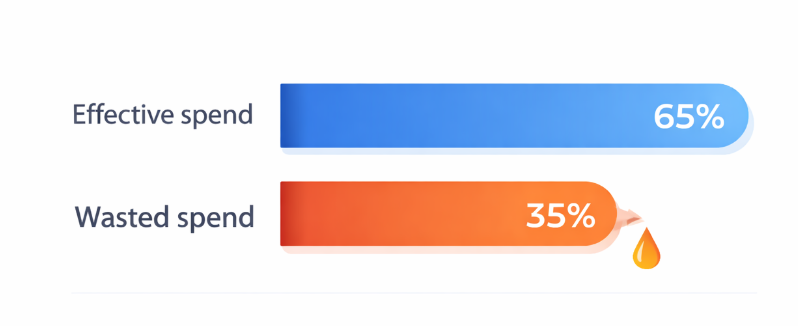
Without incrementality measurement, a significant share of ad budgets may be misallocated to non-impactful conversions
Last-click models assign full credit to the final touchpoint, ignoring earlier interactions and organic intent.
Retargeting Overreliance
Retargeting campaigns often show strong performance but may primarily capture users already close to conversion.
Platform Self-Attribution
Each advertising platform tends to claim conversions independently, leading to double counting and inflated totals.
Methods to Measure Incrementality
1. Holdout Testing
Holdout tests compare a group exposed to ads with a control group that is not.
-
Split your audience into test and control groups
-
Expose only the test group to ads
-
Measure the difference in conversion rates
This approach provides the most reliable measure of causal impact.
2. Geo-Based Experiments
Geo testing involves running campaigns in selected regions while excluding others.
-
Select comparable geographic areas
-
Run campaigns in test regions only
-
Compare performance against control regions
This method is particularly useful for large-scale campaigns.
3. Conversion Lift Studies
Many platforms offer built-in lift studies that estimate incremental impact.
However, results should be interpreted cautiously, as methodologies are often opaque.
4. Time-Based Experiments
Pause campaigns for a defined period and observe changes in performance.
-
Establish a baseline
-
Pause or reduce spend
-
Measure the impact on conversions
While simpler to execute, this method can be influenced by seasonality and external factors.
Key Metrics to Track
When evaluating incrementality, focus on:
-
Incremental conversions
-
Incremental revenue
-
Cost per incremental acquisition (CPIA)
-
Incremental ROAS
These metrics provide a clearer view of true campaign effectiveness.
Practical Example
A brand runs a retargeting campaign that reports:
-
2,000 conversions
-
$50,000 revenue
After conducting a holdout test, results show:
-
Control group conversions: 1,200
-
Test group conversions: 2,000
Incremental conversions: 800
This means 40% of reported conversions are truly incremental, while 60% would have occurred without the campaign.
Best Practices
Prioritize Testing Over Assumptions
Regularly run incrementality tests rather than relying solely on platform metrics.
Balance Prospecting and Retargeting
Prospecting campaigns typically drive higher incremental lift compared to retargeting.
Align Teams Around Incremental Metrics
Ensure marketing, analytics, and leadership teams focus on incremental outcomes rather than vanity metrics.
Use Consistent Methodologies
Apply the same testing frameworks over time to ensure comparability.
Supporting Statistics
-
Studies indicate that 30–50% of paid social conversions may be non-incremental in retargeting campaigns
-
Incrementality testing can reduce wasted ad spend by up to 25%
-
Brands using holdout testing report up to 20% more accurate performance measurement
Conclusion
Incrementality is essential for understanding the true value of paid social campaigns. By moving beyond traditional attribution models and adopting rigorous testing methods, businesses can make more informed decisions, reduce wasted spend, and drive sustainable growth.
Recommended Articles for Further Reading