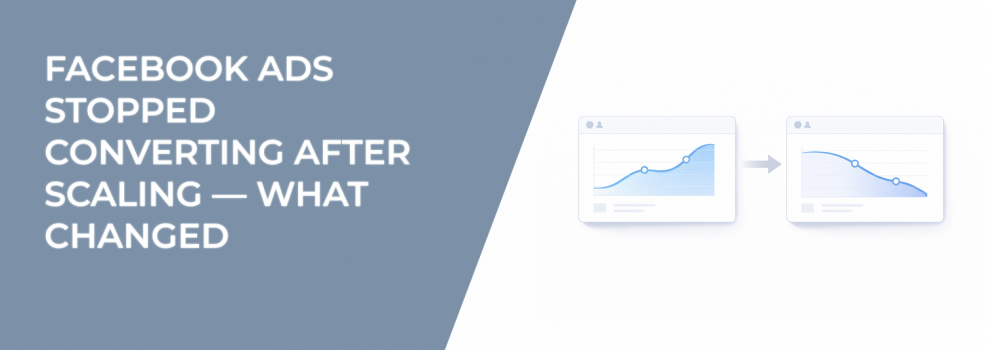
You increase budget, performance holds for a moment — then conversions drop. CPA rises, results become unstable, and nothing you tweak seems to fix it.
This isn’t random. Scaling changes how the system behaves. The conditions that made your campaign work no longer exist in the same way.
If you’ve seen this before, you’re not alone. Many advertisers run into the same pattern described in Facebook Ads Not Converting: How To Fix It.
Let’s break down what actually changed — and how to respond without making things worse.
Scaling Pushes You Into Worse Auctions
At lower spend, Meta prioritizes the highest-probability users. Once you scale, that pool runs out quickly.
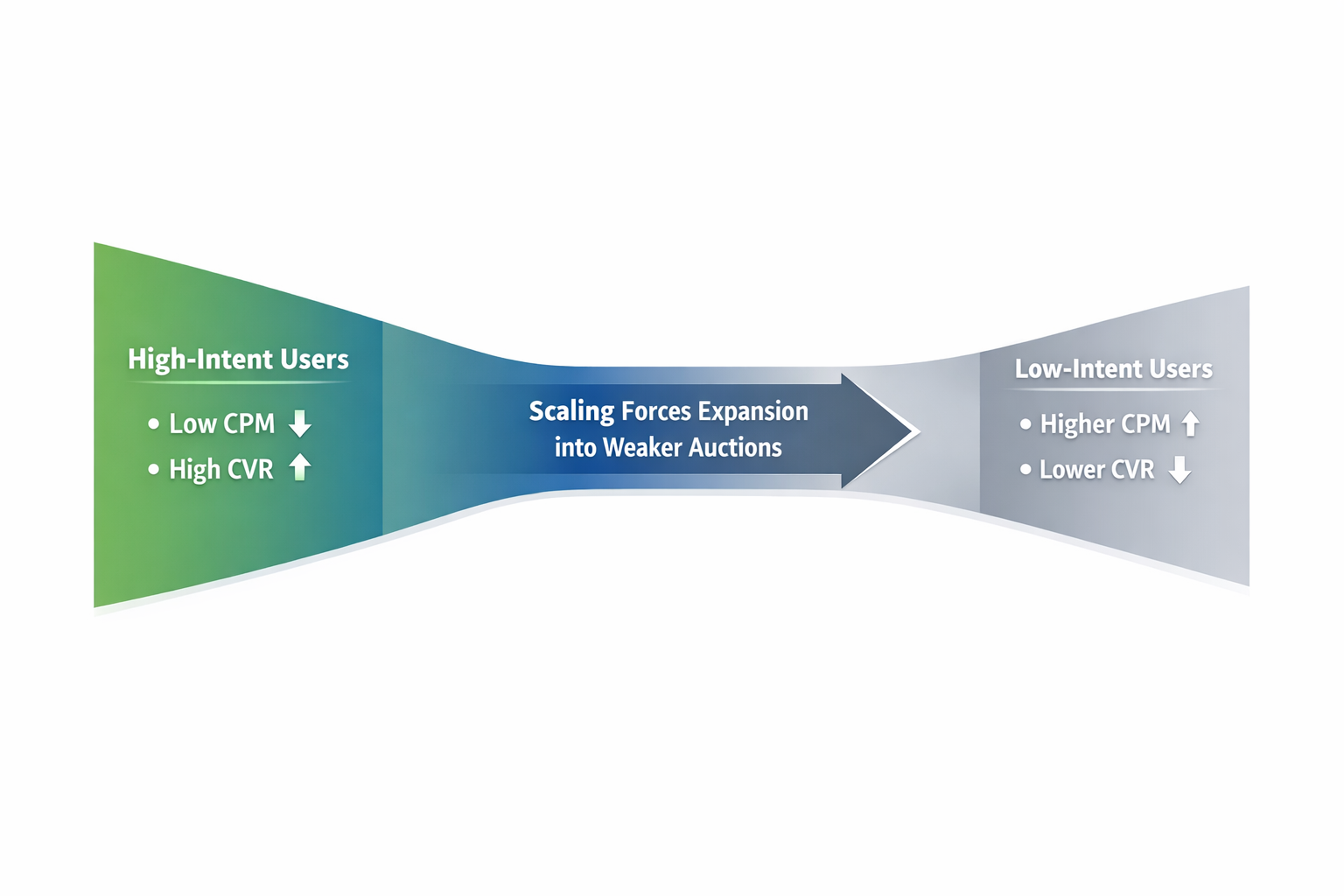
The system starts reaching less efficient inventory.
-
Weaker intent users — People loosely matching your converters but without strong recent behavior.
→ You’ll often see CTR stay stable while CVR drops, which signals declining traffic quality. -
More expensive auction windows — Your ads enter peak competition periods.
→ Spend shifts toward higher CPM hours, even if targeting stays the same. -
Broader audience clusters — The algorithm expands into adjacent segments.
→ Reach increases, but precision drops.
What shows up in Ads Manager:
-
CPM rising without CTR improvement;
-
Conversion rate declining while clicks remain stable;
-
Delivery spreading wider instead of going deeper.
This is directly connected to how auctions behave, as explained in Facebook Ad Auction: Do Ad Sets Compete Against Each Other?
Your Conversion Signal Becomes Noisy
At smaller budgets, conversions come from a tight, repeatable pattern. The system learns quickly.
After scaling, that clarity disappears.
-
Fragmented conversion behavior — Different users convert for different reasons.
→ The system loses a clear optimization direction. -
Longer time-to-conversion — New audiences need more time.
→ You’ll see delayed conversions appearing days later. -
Lower signal density — Spend spreads across more segments.
→ Each segment receives less consistent data.
Diagnostic signals:
-
Conversions appearing 2–3 days late;
-
Frequent “learning limited” status;
-
CPA fluctuating despite stable spend.
If you don’t account for this, you risk reacting too early — a common issue discussed in How to Finish the Facebook Learning Phase Quickly.
Your Offer Stops Working at Scale
An offer that converts warm users often fails with cold audiences.
At low scale, you capture demand. At higher scale, you need to create it.
-
Value perception drops — Broader audiences don’t immediately connect.
→ What felt compelling now feels generic. -
Friction becomes more expensive —
→ Long forms, unclear steps, or weak positioning now hurt conversion rate significantly. -
Message-to-audience fit breaks —
→ Your creative no longer matches the expanded audience.
What to check:
-
Conversion rate by audience segment;
-
Landing page behavior (scroll depth, completion rate);
-
Drop-off points across the funnel.
If you’re seeing clicks but no conversions, this often overlaps with issues covered in Why Your Ads Get Clicks But No Sales: Fixing the Audience Misalignment.
Budget Changes Disrupt Learning Behavior
Scaling affects how the algorithm distributes spend and learns.
Even without a visible reset, internal dynamics shift.
-
More aggressive bidding —
→ The system raises bids to win more auctions, causing CPM spikes. -
Higher exploration rate —
→ More budget allows broader testing, reducing short-term efficiency. -
Recent data takes priority —
→ Weak new signals can temporarily override strong historical data.
What you’ll notice:
-
Uneven daily spend distribution;
-
Immediate CPA spikes after scaling;
-
Gradual stabilization over several days.
This is why sudden budget increases often hurt performance — a pattern also explained in Why Daily Budget Increases Can Hurt Your Performance (and What to Do Instead).
Frequency and Creative Fatigue Accelerate
Scaling increases how quickly your audience sees the same ads.
Even with expansion, high-probability users are still reached first.
-
Frequency rises faster than expected —
→ Audience growth doesn’t keep up with budget. -
Creative fatigue sets in earlier —
→ Repetition reduces effectiveness. -
Engagement quality declines —
→ CTR may hold, but conversion intent drops.
How to spot it:
-
Frequency increasing alongside falling CVR;
-
Stable CTR but declining conversions;
-
Ad-level performance decay over time.
For a deeper breakdown of this, see Ad Fatigue on Facebook: How to Spot It Early and Fix It Fast.
Attribution Delays Mislead You
After scaling, you reach users with longer decision cycles.
This creates a delay between interaction and reported conversion.
-
Conversions show up later —
→ Same-day results look worse than reality. -
Optimization runs on incomplete data —
→ The system reacts to partial signals. -
Decisions become reactive —
→ Campaigns get paused too early.
What to monitor:
-
1-day vs. 7-day attribution differences;
-
Conversion lag trends;
-
Multi-day performance, not daily snapshots.
This effect is explained in detail in Facebook Attribution Window Explained: How It Impacts Your Results.
What To Do Instead of Reacting
When performance drops, the instinct is to revert everything.
That usually resets learning and makes recovery slower.
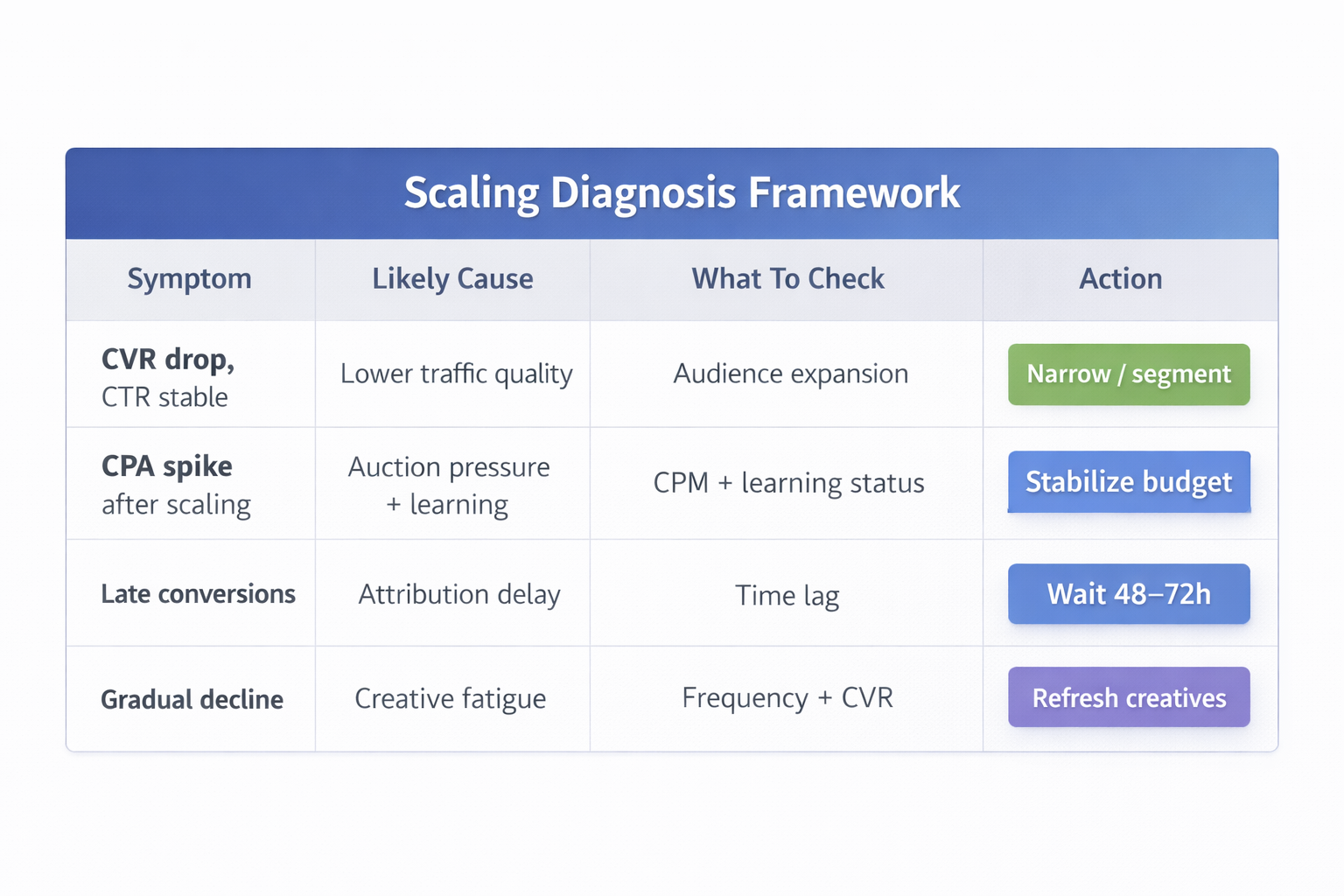
Stabilize First
-
Hold budget steady for 3–5 days;
→ Allow the system to rebuild consistent signals. -
Avoid stacking changes;
→ Changing multiple variables removes diagnostic clarity. -
Track trends, not daily spikes;
→ Focus on rolling averages instead of single-day data.
Restore Signal Quality
-
Temporarily narrow targeting;
→ Re-concentrate conversions into stronger clusters. -
Separate high-intent segments;
→ Protect retargeting and strong lookalikes. -
Optimize for deeper events;
→ Prioritize qualified leads over raw volume.
Adapt the Offer
-
Increase perceived value;
→ Stronger positioning, clearer differentiation. -
Reduce friction;
→ Shorter forms, simpler next steps. -
Adjust messaging for colder audiences;
→ Add context instead of assuming intent.
Expand Creatives Intelligently
-
Test new angles, not small variations;
→ Change the message, not just visuals. -
Match creatives to funnel stages;
→ Different messaging for warm vs. cold users. -
Refresh before fatigue peaks;
→ Replace ads before conversion rate collapses.
Final Takeaway
Scaling doesn’t just increase spend.
It changes who you reach, how the system learns, and what it costs to convert.
If conversions drop, nothing is broken.
You’ve entered a different operating environment.
The goal isn’t to recover past performance — it’s to rebuild stability at a higher scale.