Campaign learning phases are a critical component of modern advertising platforms. During this period, algorithms collect data to understand how to deliver ads most effectively. However, inefficient handling of this phase can result in wasted budget, unstable performance, and delayed results.
Understanding how to optimize learning phases is essential for improving return on ad spend (ROAS), reducing cost per acquisition (CPA), and accelerating campaign performance.
What Is the Learning Phase?
The learning phase occurs when an advertising platform’s algorithm is actively testing different audience segments, placements, and creatives to identify the most effective combinations. During this stage, performance can fluctuate significantly.
Most platforms require around 50 optimization events per ad set within a 7-day period to exit the learning phase. Campaigns that fail to meet this threshold may remain in a prolonged learning state, limiting their effectiveness.
Why Optimization Matters
Data shows that campaigns exiting the learning phase efficiently can achieve up to 20–30% lower CPA compared to those that remain unstable. Additionally, stable campaigns tend to deliver more consistent results, with reduced volatility in key performance metrics.
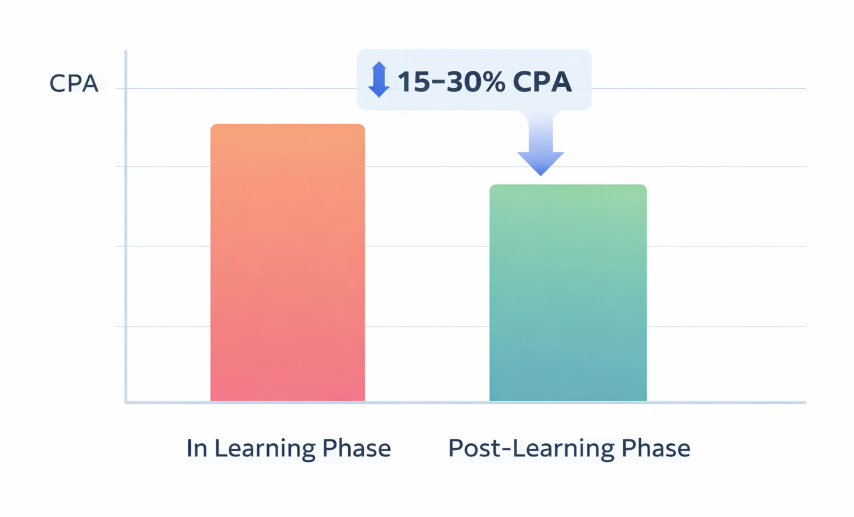
Cost efficiency improves significantly after campaigns exit the learning phase
Optimizing this phase ensures:
-
Faster performance stabilization
-
Improved budget efficiency
-
More accurate algorithmic targeting
Key Challenges in the Learning Phase
Several factors can disrupt or prolong the learning phase:
-
Frequent budget changes exceeding 20–30%
-
Continuous creative edits
-
Narrow audience targeting
-
Low conversion volume
According to industry benchmarks, nearly 45% of campaigns fail to exit the learning phase within the expected timeframe due to insufficient data signals.
Strategies to Optimize Campaign Learning Phases
1. Consolidate Campaign Structures
Avoid excessive segmentation. Combining ad sets allows algorithms to gather data faster, increasing the likelihood of reaching the required optimization events.
Simplified structures often lead to:
-
Faster learning completion
-
Improved delivery efficiency
-
Reduced overlap in audience targeting
2. Ensure Sufficient Conversion Volume
Aim to generate at least 50 conversion events per week per ad set. If this is not achievable, consider optimizing for higher-funnel events temporarily.
For example, switching from purchase optimization to add-to-cart events can help accumulate data faster, accelerating the learning process.
3. Minimize Significant Edits
Major changes reset the learning phase. These include:
-
Budget changes above 20%
-
Targeting adjustments
-
Creative replacements
Limit edits during the first 5–7 days after launch to allow the algorithm to stabilize.
4. Optimize Budget Allocation
Allocate budgets strategically to ensure each ad set has enough spend to generate meaningful data.
Campaigns with insufficient daily budgets often struggle to exit the learning phase, leading to inefficient delivery.
5. Use Broad Targeting
Broader audiences provide more data points, enabling algorithms to identify high-performing segments more quickly.
Research indicates that campaigns using broader targeting can reduce CPA by up to 15% during the learning phase.
6. Leverage Historical Data
Utilize insights from previous campaigns to guide targeting and creative decisions. Historical performance data can shorten the testing period and improve early-stage results.
7. Maintain Creative Consistency
Introduce multiple creatives at launch rather than rotating them frequently. Stable creative sets allow the algorithm to test variations without resetting progress.
Measuring Success
Key indicators that a campaign has successfully exited the learning phase include:
-
Stable CPA over several days
-
Consistent conversion volume
-
Reduced fluctuations in delivery
Campaigns that stabilize typically see performance improvements of 10–25% within the first two weeks after exiting the learning phase.
Common Mistakes to Avoid
-
Over-segmentation of audiences
-
Frequent manual interventions
-
Insufficient budget allocation
-
Unrealistic performance expectations during early stages
Avoiding these mistakes can significantly improve campaign efficiency and shorten the learning period.
Recommended Reading
To deepen your understanding of campaign optimization and performance improvement, explore the following articles:
Conclusion
Optimizing campaign learning phases is essential for achieving consistent and scalable advertising performance. By consolidating structures, ensuring sufficient data flow, minimizing disruptions, and leveraging broader targeting, marketers can significantly reduce inefficiencies and accelerate results.
A disciplined approach to managing the learning phase not only improves immediate outcomes but also builds a stronger foundation for long-term campaign success.